
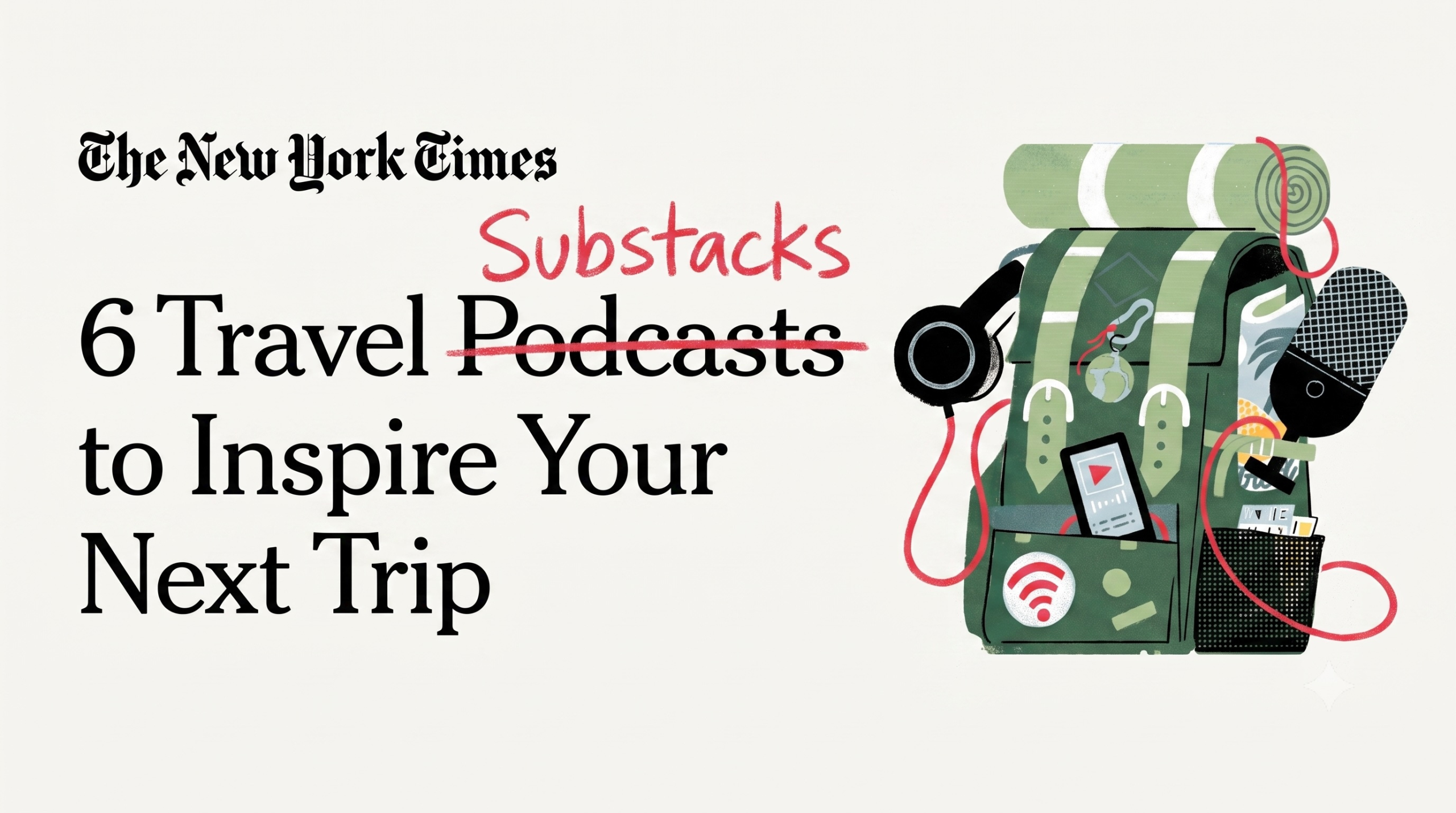
When the New York Times mentioned my podcast, Deviate, back in June, this came as both good news and less-than-good news.
The good news was that America’s most widely read newspaper had declared that I hosted a “reliably thoughtful and inspiring” podcast. “Although travel is a central theme,” the article noted, “Deviate is less about tips or itineraries and more about broadening your worldview, embracing curiosity and fostering a spirit of exploration in daily life, not just on the road.”
The less-than-good news was that the Times had run its “6 Travel Podcasts to Inspire Your Next Trip” article at a time when I’d just released a bunch of seemingly non-travel episodes. The Times had linked to a philosophical-travel episode entitled “Time is your truest form of wealth (and travel helps you embrace your riches),” but my other episodes around this time touched on things like sports movies, male friendship, comics set in a post-human rural landscape, sense-of-place in cinema, and the ritual of watching the Super Bowl.
Hence, Times readers looking for recent episodes exploring the vagabonding ethos might have been confused.
But that’s OK. My podcast is called Deviate for a reason. My new Substack series is called Deviate for the same reason. The ethos that underpins both is tied up in the fact that travel is about curiosity — and sometimes travel-fueled curiosity isn’t literally about travel itself.
Why I offset travel content with non-travel themes
Sometimes, when I appear on other people’s podcasts, I’m asked if I ever get tired of talking about Vagabonding, a book that came out more than two decades ago. Honestly, I don’t — and it consider it a blessing that people still want to talk about its themes and ideas.
The thing is, while I enjoy discussing the ethic of long-term world travel on other people’s podcasts, I don’t always feel compelled to explore these themes on my own. This is, I suppose, not great branding. While roughly 85% of my 200+ episodes do indeed have clear travel motifs, part of the thrill of producing Deviate has been the pretext to talk about things like cassette mixtapes, indoor soccer in the 1980s, my college grunge band, dinosaurs, Satanic backward masking, the Sears Christmas Wish Book, asking my parents about parental mortality, and how anxieties about nostalgia presaged meeting my wife Kiki during Covid.
Indeed, part of the joy of Deviate being mentioned in the New York Times was that it implicitly honored my willingness to be weird about what counts as travel (and my disinclination to “optimize” my content for generic travel audiences). Unlike AI, actual human writers — in this case, British journalist Emma Dibdin — can discern nuance, and suss out multiplicities that would never occur to algorithm-driven recommendations.
If you’re looking for bite-sized travel content on Substack, I encourage you to subscribe to my second newsletter, The Vagabond’s Way: Weekly Reflections on the Art of Travel. But my Deviate Substack, like my Deviate podcast, will be stubbornly unique to itself. As I wrote in my initial post, the mini-essays and free-writes I post there are about curiosity and creative attention — and while they are written with an audience in mind, they aren’t strategically optimized for an audience.
Thoughts about Substack (after a few months on Substack)
Just as my decision to begin a podcast nine years ago was inseparable from listening to scores of podcasts, my decision to start a series here was inspired by what I was reading on Substack. Sven Birkerts’ daily mini-essays are an influence, but so are Michael Weinreb’s longer-form sports essays, and Rob Walker’s insightful attention exercises. I’ll read literally anything Sherman Alexie posts here (his poem “Ode to Tonya Harding” was particularly gorgeous), and I’m awed by the high-functioning output of Austin Kleon (whose recent “Choose your own Odyssey” roundup was so insouciantly thorough and insightful I found it faintly intimidating).
In the travel-essay milieu, I’ve particularly enjoyed reading “Something Like Remembering” in The Timbuktu Review, Beenish Hussain’s “Travel Like You’re Falling in Love With Life,” JoAnna Haugen’s “After a Career in Tourism, I’m Staying Home,” and Beck Sharron’s “The Demise of an Empire: How Lonely Planet stopped serving the very people it was created for.”
Travel aside, I’ve been dazzled by such Rodrigo Brancatelli essays as “They Killed Normal and Called It Progress,” and “Your Kids Will Inherit a Beautiful Archive of a Childhood That Never Happened.” Similarly, Joshua Heath Scott’s “George Washington Never Knew About Dinosaurs” and “Technology Always Wins” had me thinking about those essays’ themes long after I read them. I’m also a fan of Rebecca Levenberg’s posts, if for no other reason that she consistently takes my free-write prompts and takes them into thoughtful directions.
It’s hard to tell where exactly Deviate Free Writes will go from here (or how reliably I’ll be able to keep up the weekly format), but I guess that’s part of the point. Thank you for reading!
Note: “Dispatches” are short vignettes, profiles, and mini-essays written and posted from the road, often in tandem with my Instagram or Substack accounts. I don’t host a “comments” section, but I’m happy to hear your thoughts via my Contact page.