
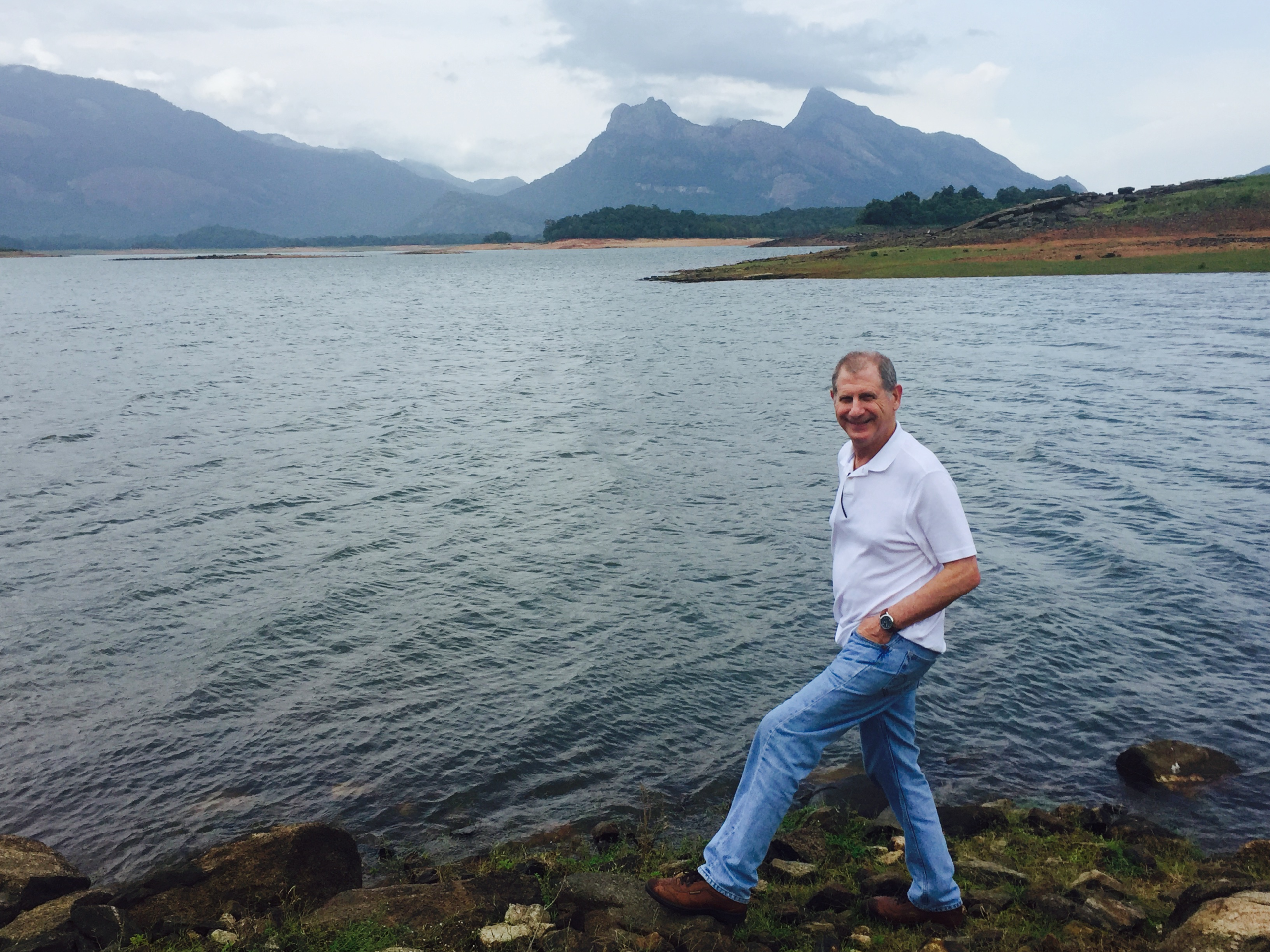
Longtime New York Times contributor Perry Garfinkel has also written for National Geographic Magazine, The Travel Channel, Travel & Leisure, and AARP the Magazine, among many others. A former reporter and editor for newspapers and magazines, he helped launch New Age Journal and EcoTraveler Magazine (both defunct). He has written four books (including national bestseller Buddha or Bust), co-authored four, and ghostwritten four. His 1989 book Travel Writing for Profit and Pleasure was recommended by Arthur Frommer. He has led travel-writing workshops for many years. When not hitting the keys, he hits a classic 1963 Gretsch blue sparkle drum set which he’s played with jazz and blues bands since high school.
How did you get started traveling?
Until I graduated from Rutgers College in New Brunswick, New Jersey, the furthest I had traveled from my home in West Orange, N.J., was to Pittsburgh, Fort Lauderdale, and a Rutgers marching-band-sponsored trip to California to perform at the Rose Bowl Parade (I’ve played drums since I was 7 years old). In the early 1970s, after an unnamed U.S. President was reelected, my then-wife and I decided to leave the country for a while. For reasons we still can’t recall, perhaps to find a guru, perhaps as a Kiplingesque “exotic” journey, we chose India as our ultimate destination. To get there we flew to Rome and traveled overland through Greece, Turkey, Iran, Afghanistan and Pakistan, entering India through Amritsar, in the state of Punjab. It was a life-changing and eye-opening experience.
How did you get started writing?
As an English major, I took a course at Rutgers, something like “Write a Novel.” My professor thought I had potential and suggested I try to get a job at a newspaper. To meet that objective, I applied to and got accepted at Boston University’s graduate journalism program. But before matriculating, I landed a summer internship at the Newark (N.J.) Star-Ledger. Though I knew nothing – I wasn’t even sure which side of the copy paper faces up – I took to reporting like a duck to water…though that last phrase shows I still can’t avoid the occasional cliche. My city editor told me that to be a good reporter you don’t have to be a great writer, you don’t even have to be smart; you just have to have an inquiring mind and listen and watch carefully and report what you see and hear. So I had the qualifications; I convinced the editor to turn my internship into a fulltime position. I never went to grad school.
What do you consider your first “break” as a writer?
The biggest break as a travel writer came when National Geographic Magazine accepted my proposal to write a feature story about a community of so-called Madawaskans that lived on the border between Maine and New Brunswick, Canada. I had the good fortune to work with the photographer Cary Wolinsky, with whom I had collaborated on some smaller assignments. I learned that writers working with photographers who think like writers makes for a great combo.
As a traveler and fact/story gatherer, what is your biggest challenge on the road?
On the road, my challenge is simple: keeping track of names and numbers and addresses and a calendar of who to meet where and when…and not losing my notebooks. I once read or heard that 90 percent of life is showing up on time. So hitting the mark on time is a big challenge and the biggest accomplishment. It also shows respect to the interviewee not to be late. I’ve never had trouble walking up to people I don’t know and engaging them. I am good at finding at least one thing in common which helps create a little bond of familiarity and connection. “Hey, you’re from New York? Me too. Do you know…?”
What is your biggest challenge in the research and writing process?
Research, once the bane of my existence and the most essential part of solid reporting, whether for travel or any other nonfiction writing, is now much easier with search engines and AI. With AI, though, it remains critical to identify sources. The Biblical reference from the Book of Matthew – “for where two or three gather in my name” – is my own litmus test for verifiability. I need three sources to confirm any fact I plan to use. I usually gather too much research in interviews and other reliable sources, so the challenge is to wedge it all in but not at the expense of fluid storytelling, filing more words than the assignment called for and deadlines. There are times when too much is just too much. As for the writing process, having some degree of ADD, and needing to write in a linear sequential style, I write slowly, methodically. I do a lot of editing in my head by now, but early on I’d write the same paragraph, even the same sentence, several times before I would be satisfied that it made sequential sense. To achieve that, I will read the story I’m writing from the top, out loud, many, many times looking for what should logically follow.
What is your biggest challenge from a business standpoint?
As a business, freelance writing is akin to daring yourself to go to a ledge with a deep ravine just a step away – and taking the dare anyway. Fees are never commensurate with the time and effort, and heart and soul, one puts into a piece. And nowadays some of those fees have dropped, especially when magazines shift from print to online-only. After a few years I found the rhythm of freelance cash-flow to keep me relatively in the black: you take on several assignments at once, get paid weeks if not months after filing a story that’s been accepted and in some cases only after it’s been published. If you play it right, the incoming money comes in dribs and drabs while you pitch more ideas so that there’s always cash coming in and cash in the future.
Have you ever done other work to make ends meet?
When the flow is a no-go, I have worked as a corporate communications and media specialist. I also have led travel writing workshops for many years, at such educational centers as the Smithsonian Institution and the California state university system. I continue to do so; my next will be at Kripalu, America’s largest yoga and retreat center, located in Stockbridge, Massachusetts, focusing this time on spiritual travel writing. Teaching also benefits my own writing, as it forces me to analyze and remember how I know how to do what I do as a writer, so that I can share these insights and forewarn writers of the pitfalls and successes.
What travel authors or books might you recommend and/or have influenced you?
My travel writer influences are eclectic and somewhat off the beaten path of what’s traditionally considered travel writers. John McPhee’s books, among them The Pine Barrens, Coming into the Country, and Uncommon Carriers, showed me how to seamlessly weave facts and personal observation. V.S. Naipaul’s The Middle Passage and An Area of Darkness balance his travels with his deeply personal reflections. Jack Kerouac holds a special place in my writing heart. His On the Road not only literally set me on the road (I couldn’t wait to drive cross country, and did at least 3 times) but also freed me from all the rules of writing I had so arduously followed.
What advice and/or warnings would you give to someone who is considering going into travel writing?
My advice, which I follow myself, is to not make travel writing your sole genre of writing. Diversify. It will broaden your horizons, so to speak. And the depth of your writing will reflect that. You can be a Jack or Jill in several areas. You can choose to position yourself as an expert in one particular country, or type of travel (adventure, wellness, spiritual, solo, family) or become a generalist. Study who you want to write for to decide if that publication prefers first person or third. In either case, I recommend weaving in facts – historical dates, heights, geographic specifics, geology – and quotes from people you’ve interviewed. This will ground your writing even if you use flowery language and wax eloquent on all you see, hear and feel.
What is the biggest reward of life as a travel writer?
I’ve traveled to 35 countries, reporting on everything from interviewing the erstwhile royal Mewar family of Udaipur, Rajasthan, India; to whitewater rafting down the Salmon River in Idaho; canoeing down the Allagash River in Maine with a three-generation family of guides; dining at Michelin star restaurants in Rio De Janeiro, Paris and Manhattan; and covering the graffiti movement in Bogota. I’ve interviewed His Holiness the Dalai Lama, Clint Eastwood, Wolfgang Puck and a family of Dalits (formerly known as Untouchables) living in a one-room shack but with a generosity rare at any socio-economic level. All these places and all these people have become part of my being. No amount of money could equal the rewards of wisdom and empathy I earned just by knowing them and being there. I am who I am because of these collected experiences.