
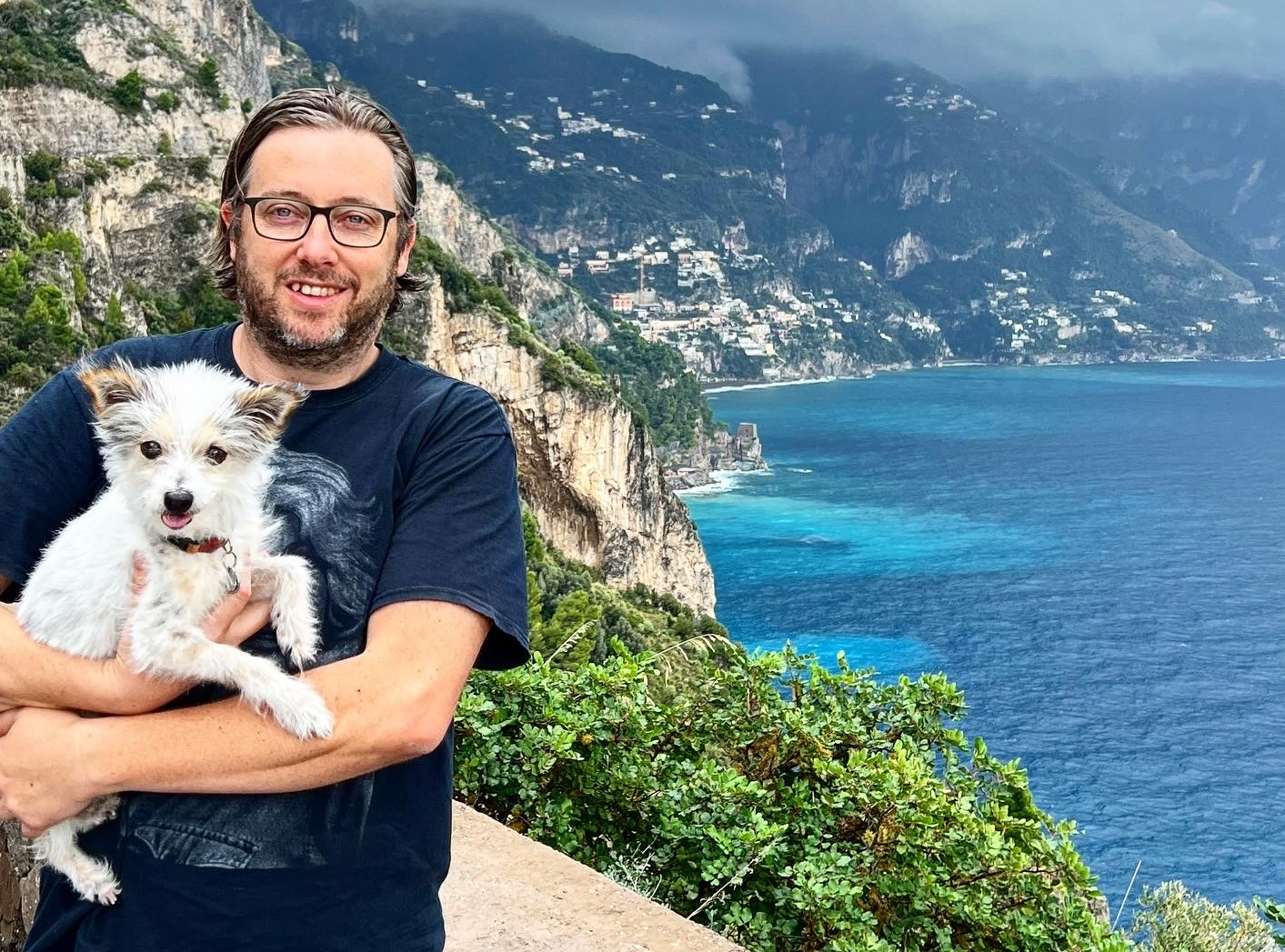
Brendan Shanahan is a writer and painter, living in Australia. He has been a journalist, tour guide, and advertising creative. He is best known for the books In Turkey I Am Beautiful (2008), The Secret Life of the Gold Coast (2004), and Mr Snack and the Lady Water: Travel Tales From My Lost Years (2013). He is writing a new novel set in Las Vegas, where he lived for almost a decade.
How did you get started traveling?
I’m Australian — travel is a cultural prerogative. In this country we have a very powerful sense of being isolated from the rest of the world, the places where all the “important” things are happening. Also, my mother’s family was Italian, so I grew up with a notion that Australia was a small and isolated place and that culturally literate people should travel. As soon as I finished school, I strapped on a backpack and went all over Europe for as long as I could afford. The mid-90s was awesome. You could still be the only person in the museum, no cruise ships in Venice, and Eastern Europe (especially Berlin) was wild.
How did you get started writing?
I always wrote but I discovered a particular talent while editing the university newspaper. I ended up writing half the articles because most people just couldn’t be bothered handing things in. I have a particular talent for comedy, which served me well.
What do you consider your first “break” as a writer?
I have a very strange arc. I got a column writing about rock music for a newspaper in Sydney. After university, I started working for them full-time, training to become a journalist. I quickly discovered that I hated it. Luckily, on the strength of my rock writing, a publisher approached me to write a book. It was a biography of a crazy cult celebrity/gay icon who had been accused of having murdered her previous husband. I decided that I would quit my job and fly to Perth to live in her mansion. It was gonzo insanity, but after that I decided that I was temperamentally unsuited to office work. I started writing books and freelancing.
As a traveler and fact/story gatherer, what is your biggest challenge on the road?
Time management. You have to email people as far ahead as possible. It’s actually gotten easier, because everyone can be contacted now, but getting a slot to talk to people or get across town to see what you have to see often takes longer than you expect.
What is your biggest challenge in the research and writing process?
Research is just so much easier now in the post-internet age. Perhaps the real problem is finding an original angle. People can Google everything now. It’s made unearthing interesting stuff harder.
What is your biggest challenge from a business standpoint?
My entire life is a business challenge. I earn very little from travel writing — the secret is, most people don’t. That’s why everyone on a “familiarization trip” is either a very young person who doesn’t mind being poor, or an older grand dame editor type who is financially stable and doesn’t really need the money. When I was starting in the early 2000s, the top rate for luxe magazines was $1 per word. 25 years later, it’s exactly the same — except now they want you to do the online version (to fuel their SEO) for nothing. Recently, while living in the UK, I wrote a feature for a famous magazine. Looking for a copy, I went to a newsagent and asked where it was. He said he hadn’t heard of it. I was shocked, but I looked around and realised that newsagents are now vape shops that stock magazines as a novelty. Frankly, the industry is on life support and I’m not very optimistic.
Have you ever done other work to make ends meet?
I can’t tell you the humiliating things I have done for money. In fact, half the written work I’ve done over the years is not stuff I’m proud of. But you gotta do what you gotta do. These days, most of my income comes from advertising (mostly hospitality!) but I have also been a tour guide which I really enjoyed mostly, I suspect, because I love putting on a show and being the centre of attention. Travel writing has been reduced to a side hustle.
What travel authors or books might you recommend and/or have influenced you?
Norman Lewis blew me away when I was in my late teens. I think he’s the greatest travel writer of all time. There’s a story by him in the Granta travel writing compilation called Essex. It’s about his move there. It’s an extraordinary work of art because it describes, in very plain language, a very unremarkable series of events in a place that is widely (and unfairly) derided as one of the worst places in England. It’s extraordinary because it shows that you don’t have to write about exotic places or famous people — you can create compelling and moving stories about the boring suburb you live in. Showing the familiar in a different light is a special kind of magic trick. Orwell, Burgess, Greene: all those British modernist writers are brilliant, but he’s my favourite.
What advice and/or warnings would you give to someone considering travel writing?
You should definitely do it if you want to, but be aware that it’s incredibly difficult financially. The travel blogger has seemingly replaced the freelance travel writer, but I think even they are undergoing a transition — SEO is changing rapidly with AI. Maybe try and combine the two and be more disciplined than me? Published travel writing is tough because editors get bombarded with pitches. (Although, frankly, the degree to which editors simply ignore pitches is rude and self-defeating.) Always be humble — and humor helps. Don’t be shy about approaching a friend-of-a-friend-of-a-friend for introductions. Most writers are in the same boat. They’re happy to help someone who is struggling at the start. Befriend other writers. Flatter them. Send them fan mail! Show them your work. If it’s good they will introduce you. Obviously, you also need to also write for those low-paid publications that specialize in exploiting hungry young people. It sucks, but that’s capitalism.
What is the biggest reward of life as a travel writer?
The glorious places you get to go, obviously. I peek inside a life I could never possibly afford, which is enormous fun but it also makes me realize something important: I really don’t care about luxury. At all. If I never get to stay in another palace or six-star beach resort, I couldn’t care less. Turning something you love into a job has one big downside that no one ever mentions — it can destroy the joy of the thing you love. That hasn’t happened to me. My happiest moments are sitting on a hot bus full of chickens and crying babies, waiting to leave for a place I’ve never seen.