


By Rolf Potts
Back in 1981, when I was ten years-old and in the fourth grade, I drew a poster that illustrated everything I loved and hated about the world. For some reason I’ve kept it after all these years, and not too long ago I hung it up in the mudroom of my house. Take a look at this poster, and you’ll get a sense for who I was in elementary school: I loved pepperoni pizza and the color red and the number three, but I hated mosquitoes and cigarette smoke and boiled squash. Of the top five things I wanted to do with my time on earth, number four was to “live a satisfying life,” and number two was “live in a more peaceful world.”
Pretty heady stuff — but these aspirations paled behind my number one aspiration at age ten, which was a desire to play MISL indoor soccer for the Wichita Wings.
The then-new sport of professional indoor soccer was an attempt to make the internationally beloved “beautiful game” more marketable to an American TV audience. In this way, major-league indoor soccer wasn’t just sport, it was a distinctively American form of popular entertainment that lovingly stole from other forms of 1980s entertainment popular at the time.
Indeed, indoor soccer wasn’t just an attempt to move the outdoor game onto carpeted indoor hockey rinks and make it faster, It was a spectacle that seemed to mix the propulsive energy of new wave with the theatrical rivalries of professional wrestling. A cultural remix on the level of hip-hop, that created a visual spectacle on a par with Music Television.
Or, at least, that’s how I, as a child of the eighties, tend to remember it.
Indoor soccer was designed to compete with hockey as America’s fourth major sport, behind baseball, football, and basketball. Unlike the outdoor game, which was considered too slow and low-scoring for American audiences, indoor soccer had lots of goals, plenty of commercial breaks, and a bright orange ball that was easy to follow on TV screens.
As with hockey, you could make substitutions while play was still happening, and a tie-game after regulation meant overtime, and, if that didn’t settle things, a shootout. This was an innovative way to Americanize the sport and make it more TV-friendly, but at times this made it seem like rules were being made up in real-time because, quite literally, they were. Unlike the outdoor game, indoor soccer was broken into four 15-minute periods, and featured fast, physical play, simple rules, and lots of scoring. As Sports Illustrated noted: “An outdoor game may end 1-0 and leave the crowd delighted. In indoor soccer the score is more likely to be 10-8. “Deep-think strategy is not a big part of the indoor game; fast break on offense, get four guys back on defense is pretty much it.”
Amidst all of this innovation, soccer purists were quite naturally scandalized by players passing the ball to themselves off the sideboards and scoring goals by accident when the ball bounced off of three different players. For this reason, some skeptics derisively referred to indoor soccer as “human pinball.”
In addition to pioneering all of these novelties, the new league had to compete against outdoor soccer by creating new markets, which is how it ended up with a team in, of all places, Wichita, Kansas. The promoters who decided to bring a major-league indoor soccer team to Kansas proposed a Wichita team to the league as the midwestern soccer equivalent of professional football’s beloved Wisconsin franchise, the Green Bay Packers. The Kansas Coliseum, which came to host the Wings games, was located on a rural stretch of land at the north end of town, And visiting teams would literally see cows – and smell cow manure – when they got off the team bus to play the Wings.
Despite this bucolic aura that surrounded their games, the Wings were an instant hit in Wichita. The local newspaper, the Wichita Eagle, wrote feature stories about the team as much as 30 times a month, and the Orange Army, a Wings fan-club named for the color of the team’s uniforms, made the 9000-seat Kansas Coliseum a notoriously noisy venue for visiting teams.
Apart from winning games, one of the ways the Wings brought in fans was to cultivate a carnival-like sense of showmanship. At a time when NBA and NFL contests were still introducing players in the fairly straightforward manner of college games, the Wings entered the darkened arena at the Kansas Coliseum in clouds of smoke, to piercing horns of the Rocky theme song and when the team won, the arena played Queen’s stomping anthem “Another One Bites the Dust.”
Indeed, the league had a way of marketing the games as a user-friendly product, in the same way one might market soap or tires or blockbuster movies. Whereas Wichita Wings games had spotlights and pyrotechnics, Kansas City Comets games featured a laser light show, the Baltimore Blast entered the arena at home games in a fake spaceship lowered down from the rafters at the top of the Civic Center, and the Memphis Americans had a pizza-with-the-players fan-promotion the proved so popular it had to be canceled because the players were gaining too much weight.
Wichita also encouraged its soccer players to interact with fans after the game, and the presence of handsome young European stars in a place like Kansas meant that the Wichita Wings became the first major-league American sports team to achieve 40% female fan attendance at games. When Sports Illustrated wrote about indoor soccer in the 1980s, it pointed out that sex appeal was an active part of the leagues marketing strategy, and even as a little kid in Wichita, I could see that this was a real thing. My older sister, for instance, loved the Wings – and in particular she loved a blond-haired young London native named Andy Chapman, the team’s all-star forward. Andy Chapman was larger than life in Wichita, and I’ve often joked that if you put Harrison Ford, Sting, and Andy Chapman in a room together in Wichita in 1981, the girls of Kansas would have trampled the actor and the rock star in an effort to get closer to the charismatic young Wings player.
It was thanks to players like Andy Chapman, and the chemistry of the team in general, that by 1983 the Wichita Wings were selling out nearly every home game, averaging higher arena attendance in my little industrial Kansas hometown than the NBA Hawks were drawing in Atlanta, or the Cavaliers in Cleveland, or the pre-Michael Jordan Bulls in Chicago. The people of Wichita took pride in rooting for an underdog team, representing an underdog town, playing in an underdog league of an underdog American sport. It was glorious.
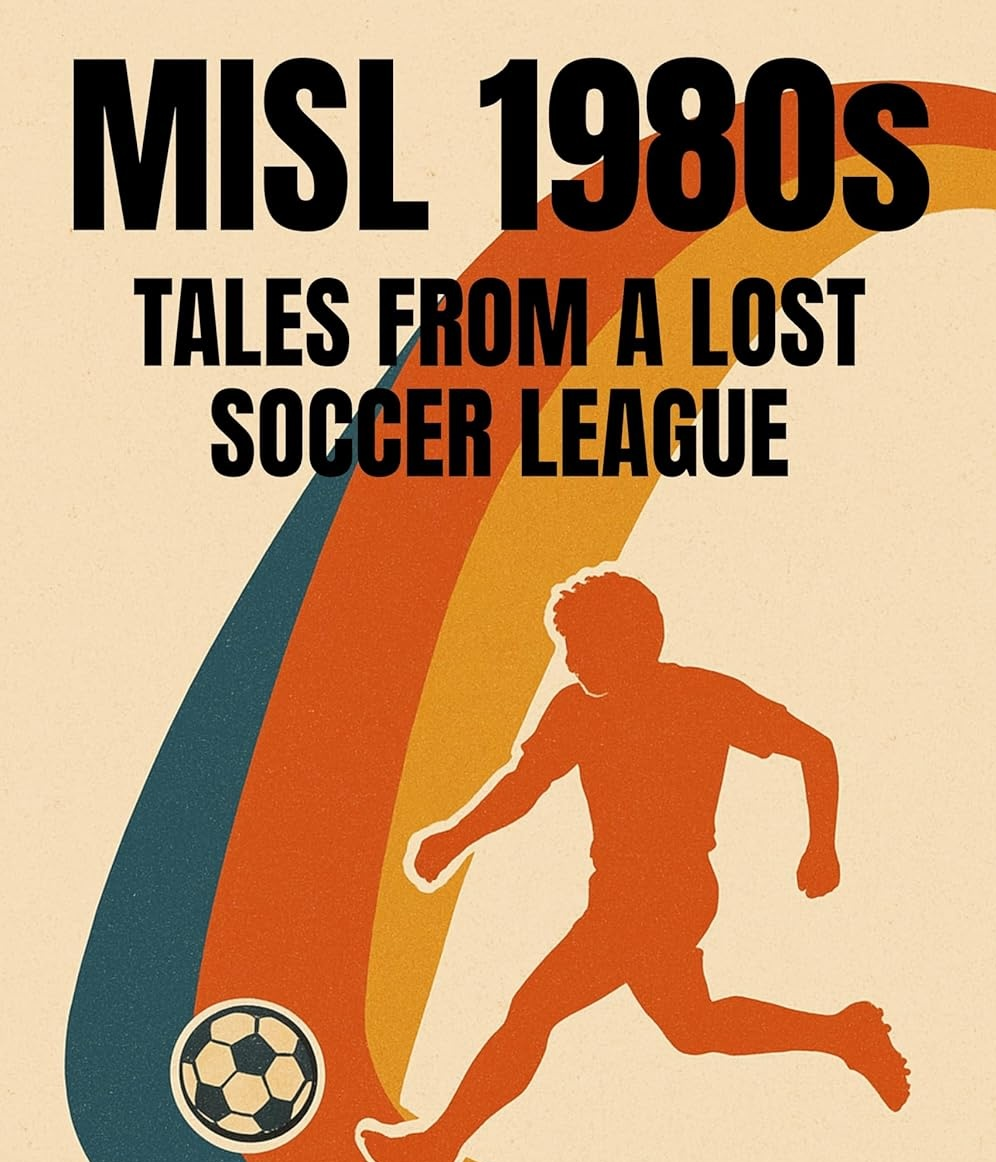
The book you’re holding in your hands was researched and compiled by author and filmmaker Tim O’Bryhim, who I met at — of all places — a post-MISL indoor soccer game in Wichita in the 2010s. I had been watching the soccer contest and enthusing to my friends about having just read Make This Town Big, a terrific oral history of the Wichita Wings that took me back to the 1980s, when the guy sitting in front of me turned around and said, “yeah, I co-wrote that book.” Thus began a friendship that led to, among other things, me introducing and moderating a Tallgrass Film Festival screening of Tim’s 2020 documentary God Save the Wings.
This new book zooms out and delves further into the fascinating American saga of MISL soccer, from its inception and debut in the 1970s, to its heady golden age in the 1980s, to its eventual decline and disbandment in the 1990s — to its influence not just on not just professional soccer, but on American precessional sports in general.
Along the way you’ll learn what it was like to coach and play in the league, as well as what it was like to be a fan of the MISL. You’ll learn about indoor soccer’s most memorable players, from the Wichita Wings I idolized as a kid (Chico Borja, Erik Rasmussen, Mike Dowler, Kim Roentved), to the superstars of the big-city teams who invariably defeated the Wings in the playoffs — players like Steve Zungul, Slobo Ilijevski, Tatu, and Branko Segota.
You’ll learn how the league managed outwit the better-funded 1970s outdoor league (the NASL) in its quest for fans and media attention; you’ll learn about its early celebrity investors (people like baseball start Pete Rose and TV producer Norman Lear), and its early moguls (including the men who owned the L.A. Lakers and the Miami Dolphins); you’ll learn how the sport came to mix sporting intensity and flashy arena entertainment in a way that is still being replicated in major league professional sports.
The MISL is long gone, but — as an American cultural phenomenon that deserves to be a part of the way all Americans remember the 1980s — it is my hope that this book will help ensure it is never forgotten.