
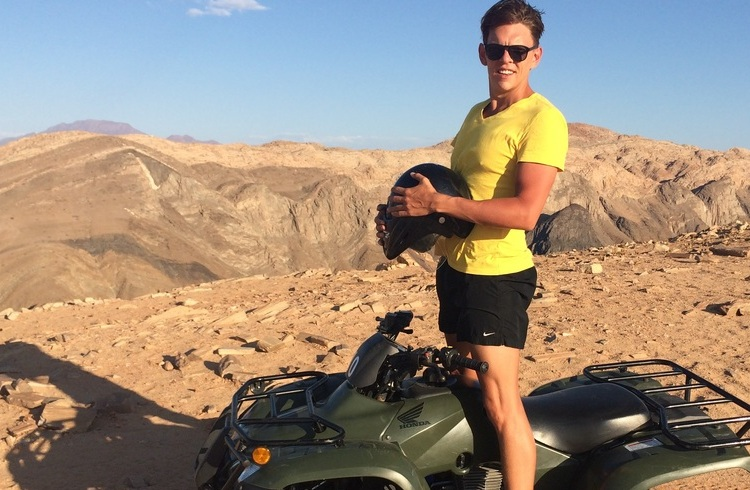
Daniel Scheffler is a travel writer who writes about cultural travel, identity and the human stories that shape how we move through the world. Scheffler is also the host of Without Maps, a travel podcast about how movement shapes identity, plus Wayfinder, an iHeart Media Original Travel podcast. He covers transformative travel experiences, with a focus on luxury travel, adventure travel and the deeper meanings behind where we go and why. His travel writing has also appeared in The New York Times and The Wall Street Journal, where he’s explored everything from slow travel to the evolution of place-based storytelling.
How did you get started traveling?
It was never really a choice — it was inheritance. My mother and my aunt were explorers before the word meant anything fashionable. Their father was a sailor, a man who arrived in ports around the world and, in the most magnificent detail I have ever heard of anyone, would drag a piano onto the beach. A piano. From a ship. Onto a beach. That image has lived in me my whole life. I grew up knowing that the world was something you moved through boldly, joyfully, and with a touch of the theatrical. How could I not travel? Also he always wore a hat, and tipped it like a gentleman.
How did you get started writing?
I have been a reader since I was a boy too short to reach the shelf — and I have never stopped. Reading and writing are, for me, the same hunger. I own more than 25,000 books. I drag them everywhere. I am ferocious about it. At some point the stories I was collecting on the road simply demanded to be written down. Travel gave me the raw material; a lifetime of reading gave me the language. The writing was inevitable.
What do you consider your first “break” as a writer?
I arrived in New York City with not so much — a lick of hope and a large South African smile. Through one of those glorious, improbable chains of connection (a friend of a friend of a friend of a friend), I found myself at lunch in the Condé Nast building when they were still in Times Square. I met every editor you can imagine, and at some point someone asked if I could write. I said, “But of course!” — with full conviction and perhaps a touch more confidence than was strictly warranted. Suddenly I had an assignment. That snowballed. Then The New York Times found me, helped along by a few incredible mentors and what I can only call wink spotters — people who see something in you and quietly open the door. After that, it all began to coalesce.
As a traveler and fact/story gatherer, what is your biggest challenge on the road?
I would be lying if I said there was one thing, and I would be ungrateful if I called any of it a burden. The challenges are real — logistics, access, the unpredictability of the world — but they are also the texture of the life. Every difficulty on the road has given me a story. I have made peace with that. The road is demanding and the road is magnificent, often in the same hour.
What is your biggest challenge in the research and writing process?
All of it is challenging and all of it is fabulous. The research can be bottomless — I am constitutionally incapable of stopping. The writing demands a discipline that does not always come naturally to someone who would rather be reading or traveling or talking to a stranger in a port town. But the challenge is also the point. If it were easy it would not be worth doing.
What is your biggest challenge from a business standpoint?
The business of being a writer is its own particular adventure — and not always the romantic kind. But I think of everything I do as part of the same endeavor. The writing, the speaking, the television work, the podcasts — they are all in service of the same thing: showcasing humanity, uncovering the best of us. Mae West said it best (I paraphrase): good boys go to heaven, bad boys go everywhere. I go everywhere. And everything I do grows from that restlessness, that curiosity. Business is just curiosity with an invoice attached.
Have you ever done other work to make ends meet?
I write. I speak. I do television. I have the podcasts. But I do not think of any of this as “other work” — it is all the same work, seen from different angles. The thread running through all of it is curiosity. Always curiosity. It is the only qualification I have ever needed, and fortunately it is inexhaustible.
What travel authors or books might you recommend and/or have influenced you?
Jan Morris is a travel writer whose prose genuinely blows my mind — the specificity, the tenderness, the intelligence of it. And I would argue that Don Quixote is perhaps the greatest travel book ever written, if you are willing to think about what travel actually means. But I should tell you I am also a Bret Easton Ellis reader, which surprises people. I have read everything — Middlemarch, the Russian greats, the classics — but what I return to, what thrills me, is Ellis. And Joan Didion is always there, always in my mind, a kind of permanent fixture. I am, at my core, a literary writer who happens to travel, rather than a traveller who happens to write.
What advice and/or warnings would you give to someone considering travel writing?
Read voraciously and without snobbery. Travel with your eyes fully open and your assumptions left at home. Understand that the story is almost never the one you went looking for — it is the one that finds you in an unexpected moment, usually when you are tired and hungry and slightly lost. And be patient. The world reveals itself slowly to people who deserve it. Show up. Stay curious. Say yes when someone asks if you can write. I mean be judgy too, but be smart. I always say if you’re witty you can be a little catty, but without the humor you’re just mean.
What is the biggest reward of life as a travel writer?
The biggest reward of my life full stop is time with my husband, Michael. But as a travel writer, it’s the people. Always the people. Every country, every city, every road I have ever been on — what I carry home is not a landscape but a human being. A conversation that changed something in me. A face I will not forget. The world is endlessly, overwhelmingly generous with its people if you go out to meet them honestly. That is the reward. That is all of it. And sometimes it’s heinous and other times it’s beautiful – and sometimes that happens at exactly the same time. But travel is the mirror, and I like to see myself as clearly as possible.