
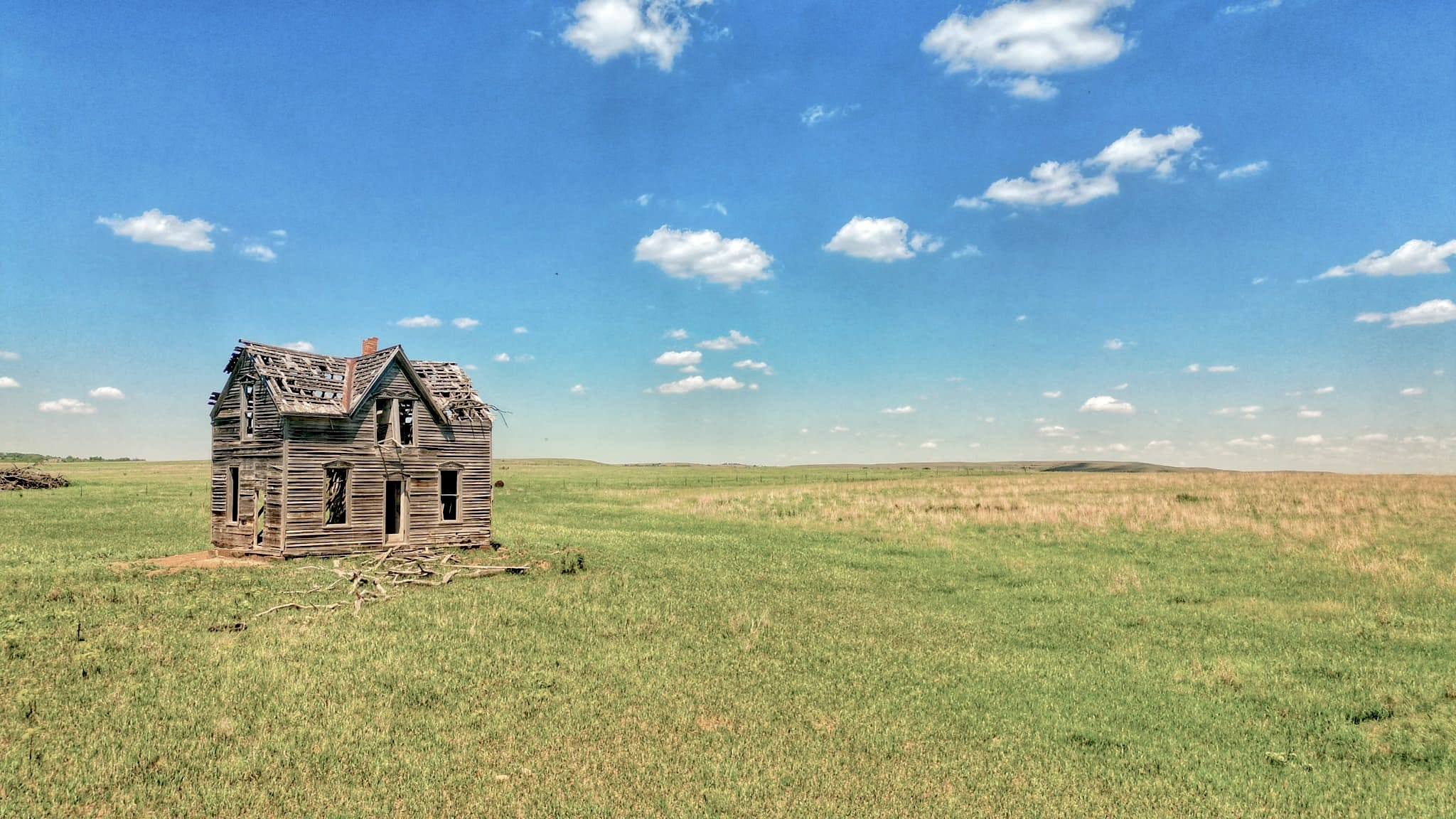
When I was a little kid, I savored seeing abandoned houses while driving with my sister and parents to my grandparents’ farm, two-and-a-half hours east of my childhood home of Wichita. I would spot these decaying old houses, stately and sagging, away from the road on old farm properties, and I would imagine myself living in them — moving in and finding ways to survive in this vestige of a world that came before me.
I guess I was imagining a future (or at least an alternative present) of living in the bygone infrastructure of an era that had passed, and maybe there is symbolism in that — the idea that we all make our future in the world that came before us.
At that same time in life, when I was still in my early years of elementary school, we knew we had arrived at my mom’s parents’ place when we saw what we called the Rock House. An old sandstone structure that must have dated back to mid to late 19th century, it was so decrepit that we were forbidden as kids from going inside the place. My sister and my older cousins sneaked inside on a dare, I learned later, but I was too scared and obedient to do so myself.
That house is where my mom, Alice, lived for the first few years of her life, probably during the same preschool era of life that I was experiencing when I first saw it. But even when mom was living there in the late 1940s, it was considered decrepit — too cold in the winter, and too hot in the summer, with a cellar full of water and black snakes. One of my grandfather’s quotes when they started looking for a better house to put on the property was that he “didn’t want the rats to chew on Alice.”
Eventually they found a house a dozen or so miles away, jacked it up onto a dolly, and, over the course of many days, moved it to its current location. When I was about seven years old, they rented a bulldozer and pushed the Rock House in on itself. Our landmark on the way in from Wichita, the signifier that we had arrived at the farm, was gone. I remember being sad about this, but eventually it just became the new normal.
Was the old Rock House the source of my fascination with the abandoned houses I saw by the side of the road every time I rode with my family through rural Kansas? Oddly I don’t think so. I think that desire is more hardwired. It’s a desire that we still exercise when, as tourists, we visit abandoned castles, a old funerary complexes — places that somehow speak to the inexorable passing of time.
But gazing into these places is not, I think, some adult existential reckoning. I think it is something more rooted in childhood. Some innate understanding that the world is not ours to keep, because it once was not ours to experience — that the world we inherit comes with a quiet consent of people who departed so long ago that we cannot imagine that they were young, like us.
Note: “Dispatches” are short vignettes, profiles, and mini-essays written and posted from the road, often in tandem with my Instagram or Substack accounts. I don’t host a “comments” section, but I’m happy to hear your thoughts via my Contact page.