
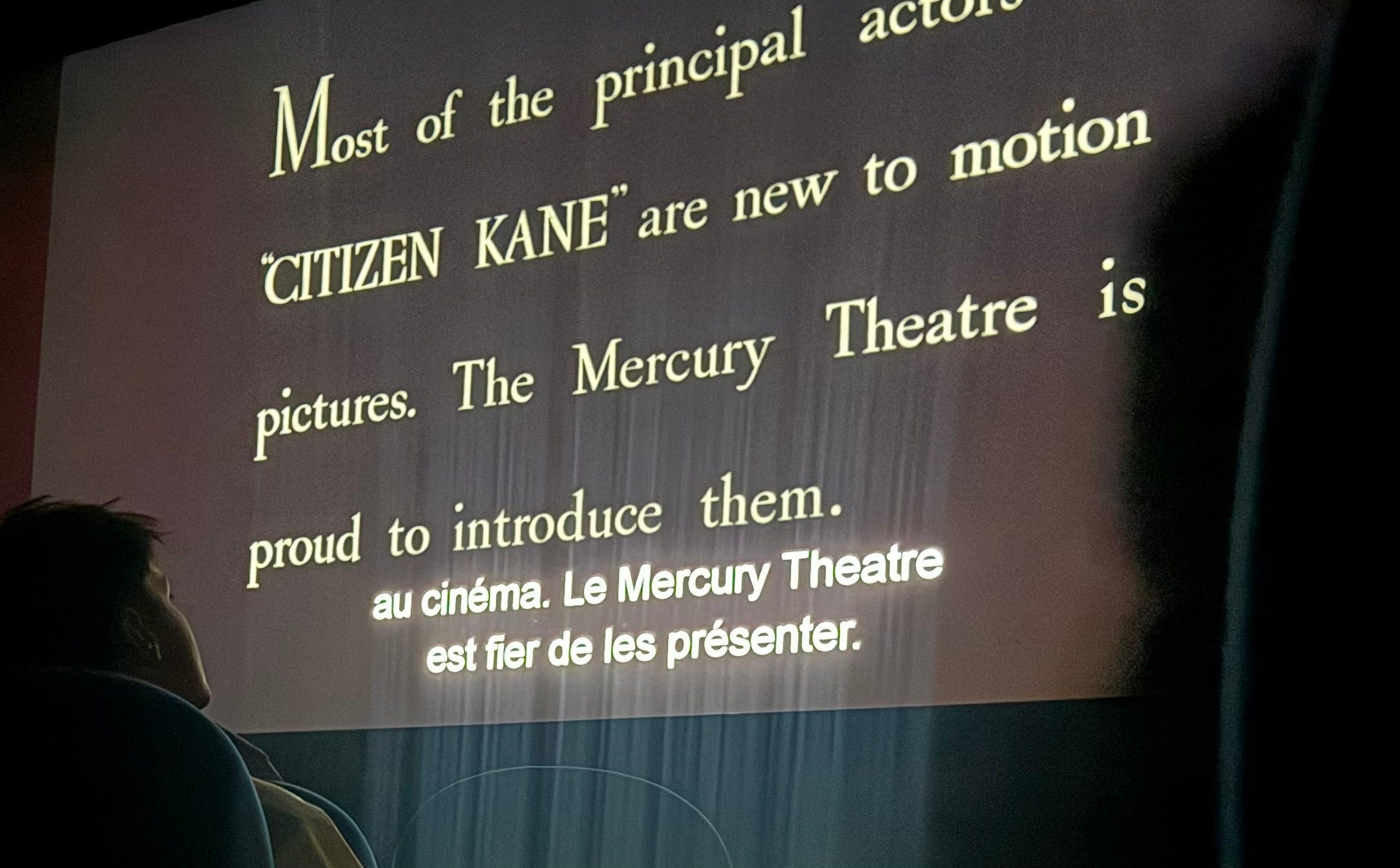
Of the many reasons I love returning to Paris each summer to teach my creative writing classes, one is the city’s distinctive local cinemas. They can be found all over the city, but they are particularly abundant in the Latin Quarter. I make a point of watching at least one revival movie there each summer. Earlier this year it was Mulholland Drive at Studio Galande. Last year it was Citizen Kane at Cinéma Le Champo. The year before that it was Full Metal Jacket at Filmothèque du Quartier Latin. In 2017 I went to Cinéma La Clef to watch I Am Not Your Negro (not a revival film, but amazing to watch in a tiny indie cinema just the same), then walked ten minutes down Rue Monge to Rue des Écoles, where I watched The Big Lebowski at Cinéma Le Grand Action.
Part of the pleasure of doing this lay in the fact that going into these cinemas felt like an act of travel: I went indoors in a city not my own, sat in the dark for the duration of a feature film, then stumbled back outside into a landscape made strange by the brief flight of cinematic imagination.
For this reason I have a list of movies that aren’t necessarily my favorite from an artistic standpoint, but were made more resonant by the very act of watching them in a distinctive place: Watching Titanic in Manila in 1998, while a young woman in front of me translated the Tagalog subtitles into her grandmother’s tribal language; watching Emir Kusturica’s Black Cat, White Cat in Budapest in 1999, while the college students who’d picked me up hitchhiking way back in Lithuania translated the Hungarian subtitles into English for me; watching The Green Mile in Cairo in 2000, as a cranky Muslim man in the audience yelled “Allah” every time the Michael Clarke Duncan character invoked the supernatural; watching Dude, Where’s My Car? in Mumbai in 2001 amid a jag of homesickness, and amusing the people around me by howling at goofy stoner jokes that didn’t translate for the local moviegoers.
Earlier this year, I watched the horror hit Backrooms, and part of what made it so creepy was that I watched it in a multiplex theater in a Colorado shopping mall. As the movie’s troubled protagonist explores the mysterious maze of empty office spaces beneath his workplace, there is something uncanny about the surreal, fluorescent-lit rooms and hallways he encounters. After the movie, walking past the mall’s shops — Men’s Warehouse, J.Crew, Home Depot, Trader Joe’s — I didn’t feel like I had reemerged in Colorado, but in a liminal space that wasn’t anywhere specific: I felt like I was still in the movie.
Around the time I was watching Backrooms in Colorado, a hail storm blew through Kansas and damaged the Salina Central Mall so severely that it had to be shuttered. I had been driving into Salina to watch movies at the AMC Cinema there ever since I’d been based in that part of Kansas, but I was oddly ambivalent at the notion that it was gone. This was, I think, because the cinderblock placelessness of shopping-mall multiplexes diminishes the filmgoing experience to a passive act of absorbing media. A narrative may play out onscreen, but the inherent interchangeability of the venue uncouples that story from any sense of cultural, geographical, or community context.
If the untimely death of Salina’s AMC Theater had a silver lining, it’s that is has revived local interest in the Salina Art Center Cinema, the city’s one-screen independent theater. I’ve always been a fan of the place, not just because it hosts occasional in-person Q&As with touring filmmakers, but because it’s the kind of place where you might bump into someone you know, and then walk outside for a drink downtown after the movie.
In this way, watching a movie in this cinema is like watching a movie in Paris (or Manila, or Cairo, or Mumbai). It is, simply put, an actual place — inseparable from the texture of its own neighborhood. You may pay money at the box office to gain entry, but what happens there goes beyond a consumer experience.
Note: “Dispatches” are short vignettes, profiles, and mini-essays written and posted from the road, often in tandem with my Instagram or Substack accounts. I don’t host a “comments” section, but I’m happy to hear your thoughts via my Contact page.
