
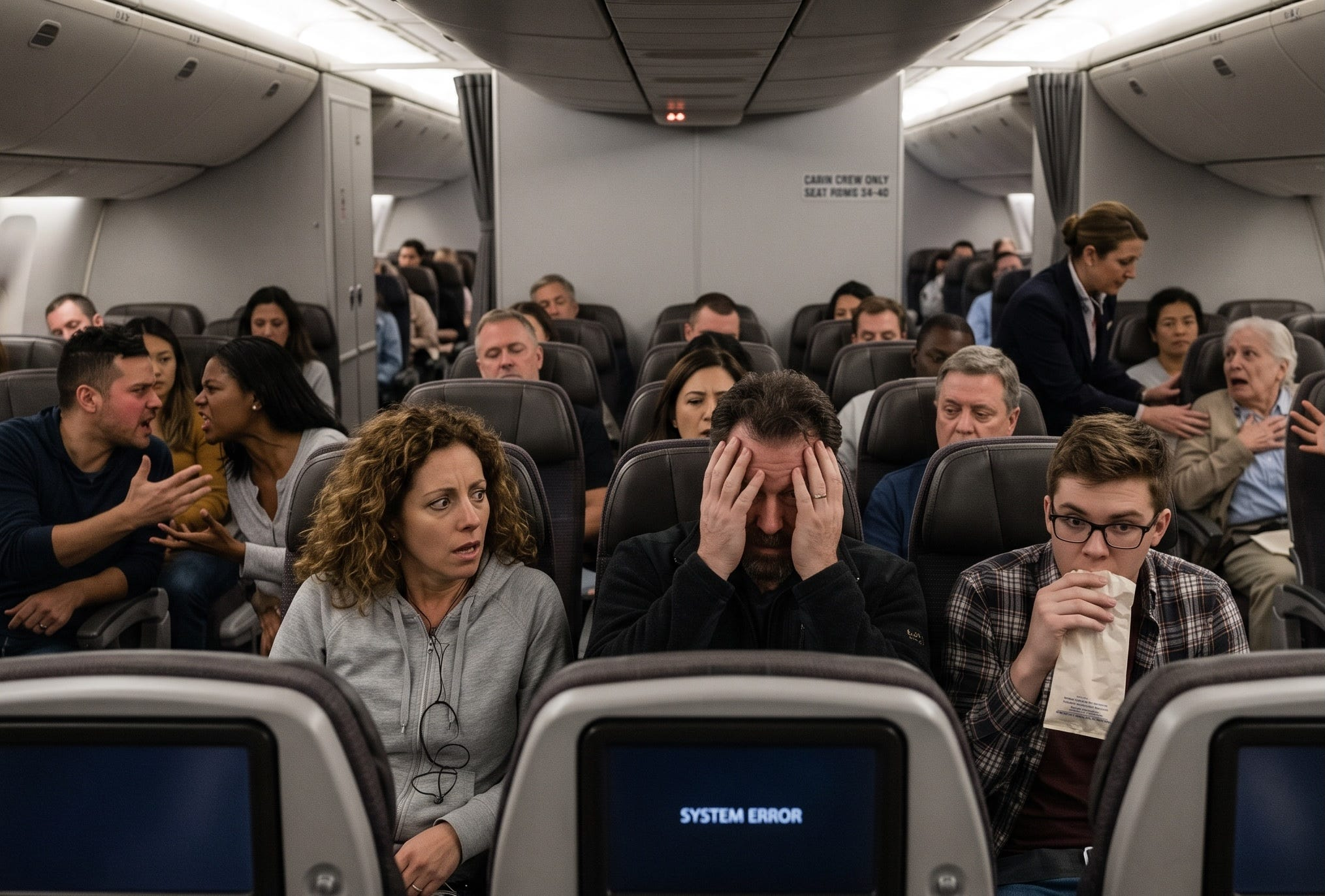
The premise for the upcoming Keanu Reeves / Kirsten Dunst disaster satire The Entertainment System Is Down is so delightful that I’m almost afraid to watch it when it comes out, for fear of it not living up to my reveries of what its plot might entail.
While most thriller movies set on airplanes involve an active onboard threat (terrorists in Air Force One, felons in Con Air, snakes in Snakes on a Plane), the inciting incident in The Entertainment System Is Down is whimsically circumstantial. According to a Deadline article, the movie, directed by Ruben Östlund, takes place on “a long-haul flight between England and Australia where the entertainment system fails and passengers are forced to face the horror of being bored.”
*
Before the dawn of the digital age, the most technologically strange thing about being on a plane was thought to be the plane itself — that is, the enforced placelessness that accompanied the rapid transit from one place to another. In his 1979 book The Old Patagonian Express, which begins with an impulse to take a train (rather than fly) southward across the Americas, Paul Theroux suggested that this jet-borne insensitivity to place was lamentable. “We are encumbered,” he wrote, “like lovers in suits of armor.”
Part of Theroux’s lament was that the experience of jet travel is stubbornly resistant to narrative:
There is not much to say about most airplane journeys. Anything remarkable must be disastrous, so you define a good flight by negatives: you didn’t get hijacked, you didn’t crash, you didn’t throw up, you weren’t late, you weren’t nauseated by the food. So you are grateful. The gratitude brings such relief, your mind goes blank, which is appropriate, for the airplane passenger is a time traveler. …Time is truncated or, in any case, warped: he leaves in one time zone and emerges in another.
The horror of being bored in a post-boredom world
What has changed since Theroux wrote this is that the plane itself in no longer the most time-bending part of the flight experience. Indeed, in an age of electronic distraction, passing the time by being still with our thoughts has become something of an anomaly.
In a recent Substack essay, Sven Birkerts noted that the whole concept of boredom now exists “in a world that has done everything to proof itself against boredom.” In an observation that feels like it would not have out been of place in the pitch-deck for The Entertainment System Is Down, Birkerts notes:
The new order of things maximizes distraction, fills each little crevice with stimulus, uses digital savvy to touch the world to life. The real threat now, never fully absent, is that the system might somehow freeze up and put you face to face with the fact that under the grid, under all the networks and all the options on offer, there exists a world without signals and nodes of connection. The idea unsettles. To be thrust back into the pre-digital world could be overwhelming. In the new dispensation, what I think of as the old world starts to feel like a dream woken from — one of those dreams that survives only in ragged traces as soon as you open your eyes.
The horror of other people who have nothing to do
Nearly ten years ago, I read a New Yorker article entitled “Doomsday Prep for the Super-Rich,” which described Survival Condo Project, a luxury underground bunker complex featuring private residential apartments and communal amenities meant to harbor wealthy preppers in the event of societal collapse. The high-security complex reportedly featured a library, a gym, an Astro-Turf “pet park,” a rock-climbing wall, and “an armory packed with guns and ammo in case of an attack by non-members.”
Reading that article, it was impossible not to imagine this facility devolving into Lord of the Flies-style chaos as its wealthy residents turned on each other amid their paranoid isolation, their internal social implosion echoing the societal collapse outside. (Were this scenario to become a movie, a fun twist might be that the societal collapse outside the silo turns out to be a false alarm, while the social chaos inside the silo becomes a manifestation of the fears that created it.)
According to early synopses of The Entertainment System Is Down, this “hell is what plays out when we’re stuck with other people” trope is very much how the movie’s plot will play out.
Still, it’s fun to imagine what the story might amount to were it not a disaster movie. In the hands of Wes Anderson, for example. the plot might involve a cabin of eccentric passengers improvising artisanal diversions while they obsess on existential anxieties and spar with dysfunctional family members. A David Lynch variation would no doubt involve dopplegängers and dream-logic. Richard Linklater would find a way to turn things into a naturalistic, casually philosophical two-hour conversation.
Boredom can be a gift of travel (if you see it as such)
If The Entertainment System is Down truly is a satire, it is most likely tweaking the 21st century compulsion to treat boredom as a travel hazard rather than a quiet gift of the journey. Philosophers have long extolled boredom as essential to creative thinking (Walter Benjamin called it “the dream bird that hatches the egg of experience”), and scientists assert that it allows us to tap into “a vast trove of memories, imagining future possibilities, dissecting our interactions with other people, and reflecting on who we are.”
Indeed, for travelers, boredom need not be seen as an irritant to be assuaged: At its best, travel boredom is an invitation to contemplate the events that have led up the journey, anticipate what happen next, and pay closer attention to the smallest details of each new place — even if that place happens to be an airplane cabin full of grumpy strangers.
Of the many novel things Paul Theroux discovered while traveling the Americas by train in The Old Patagonian Express, one was the ritual experience of boredom — which, he inferred, can’t be teased apart from the more invigorating aspects of slow travel. In a self-deprecating passage toward the end of the book, he states:
I spent the afternoon on that train as I had spent afternoons on trains all the way through the Americas. I remembered people who had been cruel to me; I rehearsed cutting remarks that I should have uttered; I recalled embarrassments in my life; I reran small victories and large defeats; I imagined getting married to someone else, having children, and getting divorced; I elected myself president of a banana republic and tried to cope with a noisy opposition; I went to medical school and set up a practice and carried out tricky operations; I told a long humorous story to a large gathering, but in the end the prize went to someone else. I died, and people talked very loudly about me. It was a fairly typical afternoon of traveling.
Note: “Dispatches” are short vignettes, profiles, and mini-essays written and posted from the road, often in tandem with my Instagram or Substack accounts. I don’t host a “comments” section, but I’m happy to hear your thoughts via my Contact page.