
I’ve come to the point where I feel nostalgia for videos I first watched on YouTube. Not traditional media clips uploaded to the platform, but clips I know only from having watched them on YouTube.
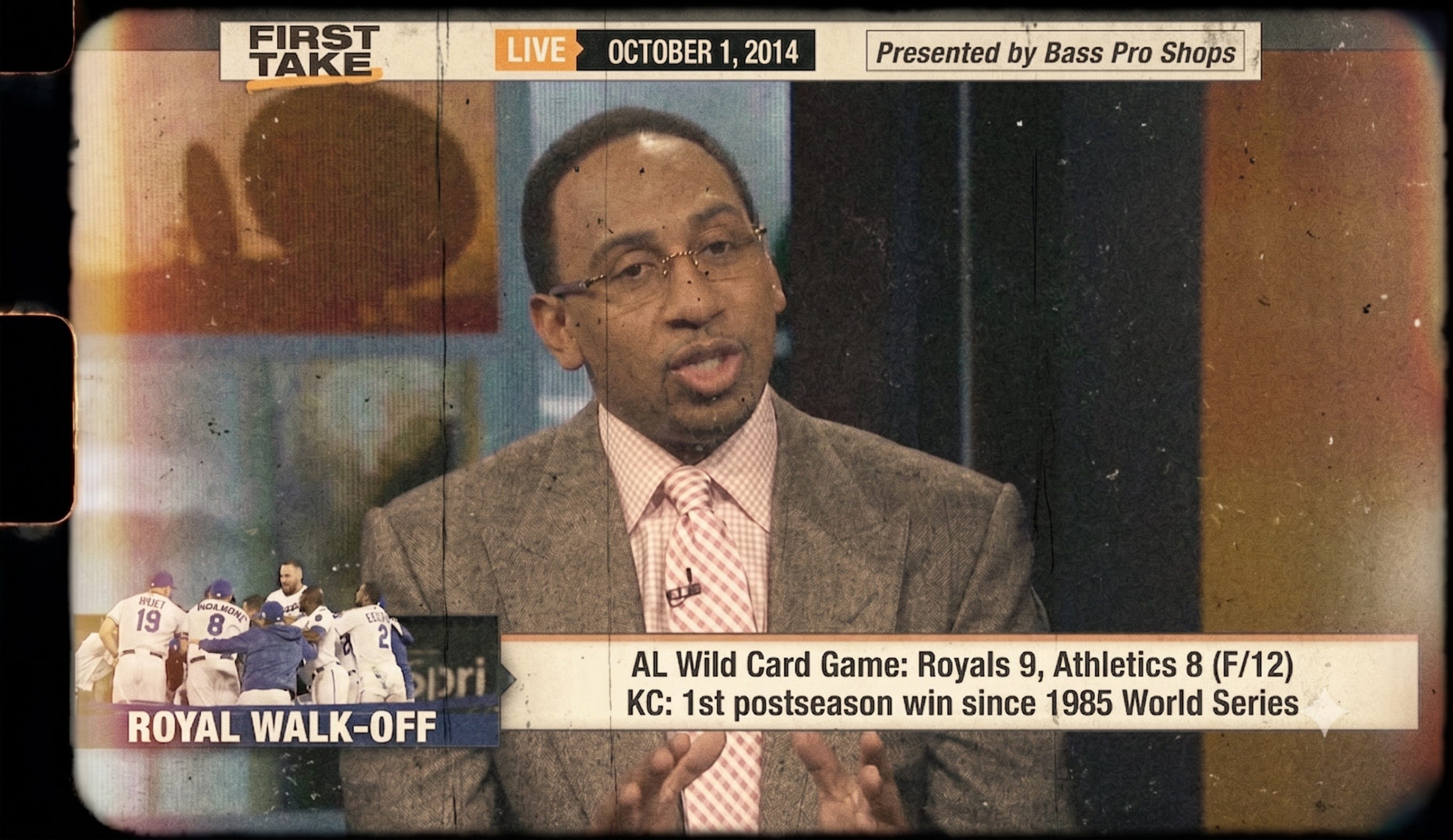
With the major-league baseball postseason now underway, I’ve been reminiscing about the 2014 American League Wild Card game — a thrilling 12-inning come-from-behind victory for my favorite team, the Kansas City Royals. I attended that game in person, and I later wrote about the experience in an essay about my Royals fandom for The Atlantic. Yet my favorite way to remember it over the years has been watching a fan-video that mashes up highlights from the game with an ESPN “First Take” commentary about how exciting it was to watch.
Topophilia versus “mnemophilia” in sports fandom
The first involves the in-person experience — the ritual of driving three hours to Kansas City from my home in north-central Kansas, and watching the game at Kauffman Stadium with my dad. This rite might be classified by what geographer Yi-Fu Tuan called “topophilia.” One common manifestation of topophilia, Tuan noted, is that sports stadiums become a place of emotional attachment in the lives of sports fans.
But I’ve developed parallel emotional attachment to the 2014 AL Wild Card game over time: A nostalgia that is evoked by a fan-video that remixed highlights from the game with Stephen A. Smith’s ESPN commentary and vintage footage of the Royals’ 1985 World Series triumph.
That fan-video has become strangely sacred in my memory — a kind of “mnemophilia” (love of memory) rite that is almost as resonant as the topophilic act of having watched the game in person.
I now get nostalgic for podcast music
In the post traditional-media world, it feels like we have come to consume (and re-consume) culture in a new way.
I remember listening to This American Life on public radio as far back as the 1990s. Then, in the early 2000s, when I was living in Thailand while writing Vagabonding, I would stream episodes on a dial-up internet connection in my apartment in the Andaman Sea port-town of Ranong. This amounted to a proto-podcast relationship to This American Life, since I wasn’t waiting for it on the radio so much as seeking out specific episodes and streaming them (sometimes more than once).
Years later, around 2007, I recall listening to This American Life on a road trip in California and hearing a song that made me feel full of longing for a previous time in my life. I couldn’t figure out where I’d heard that song, but it made me long for 2002, when I was in Thailand.
Turns out it was Penguin Cafe Orchestra’s “Perpetuum Mobile” — a song I knew not from the radio or a movie soundtrack, but from This American Life itself, which used the song’s cascading piano textures as recurrent signature in many of its episodes. I wasn’t longing for a memory that existed separate from This American Life; I was longing for a memory of having been in another part of the world, listening to This American Life on my laptop.
That was my first true moment of podcast nostalgia — a moment where I was nostalgic not for what was evoked by the podcast, but the experience of having listened to that podcast in another time of my life.
Making sense of 1980s songs I discovered in the 2010s
I’ve come to the point where listening to the New Order song “Age of Consent” reminds me of a very specific moment in my late bachelorhood in the 2010s. It was sweet time (in the way that most lived experience eventually becomes sweet in one’s memory), but it was also a lonely and uncertain time in a chapter of my life, right before I met and married Kiki.
As someone who was born in 1970, New Order songs should be something that I feel sentimental for because I listened to the band on cassette tape as a teenager. But while it’s possible I knew people who owned New Order tapes back in the day, I don’t recall ever listening to “Age of Consent” in the years following its 1983 release.
I came to love “Age of Consent” in the 2010s, after YouTube’s algorithm suggested it to me. It had probably noted that I was listening to similar songs from that era — bands like The Pixies and Jane’s Addiction, which had been influenced by New Order — so it computed that I might also like “Age of Consent.”
I remember thinking, as I listened on YouTube, that the song was beautiful. Now it reminds me not of crackling boom-box speakers in the 1980s (when the song was new), but of tinny laptop speakers in the house where I lived shortly before I met my wife.
Perhaps the nostalgia I feel while revisiting clips I first discovered on YouTube is the latest in a ritual that goes back to the earliest forms of mediation.
I suppose there was a time when people of previous generations were startled by the nostalgia that gripped them while listening to phonograph cylinders of songs they’d first heard performed in person, or rewatching a movie on Sunday-night television, decades after having first seen it at a one-screen cinema: Moments that didn’t evoke a memory so much as a mediated facsimile that both enhanced and complicated their relationship to the initial experience.
