
A few times each year, a reporter from some traditional venue (outlets like Reuters or the Washington Post or Foreign Policy) will reach out to me, as a veteran travel writer, for my professional perspective about some aspect of the travel experience. Since I find travel and tourism to be endlessly fascinating, these interviews are always interesting.
Because of the space constraints of traditional journalism, however, my comments sometimes don’t make it into the article. Fortunately, 21st century platforms like this blog help ensure that these requests for comment don’t amount to wasted energy.
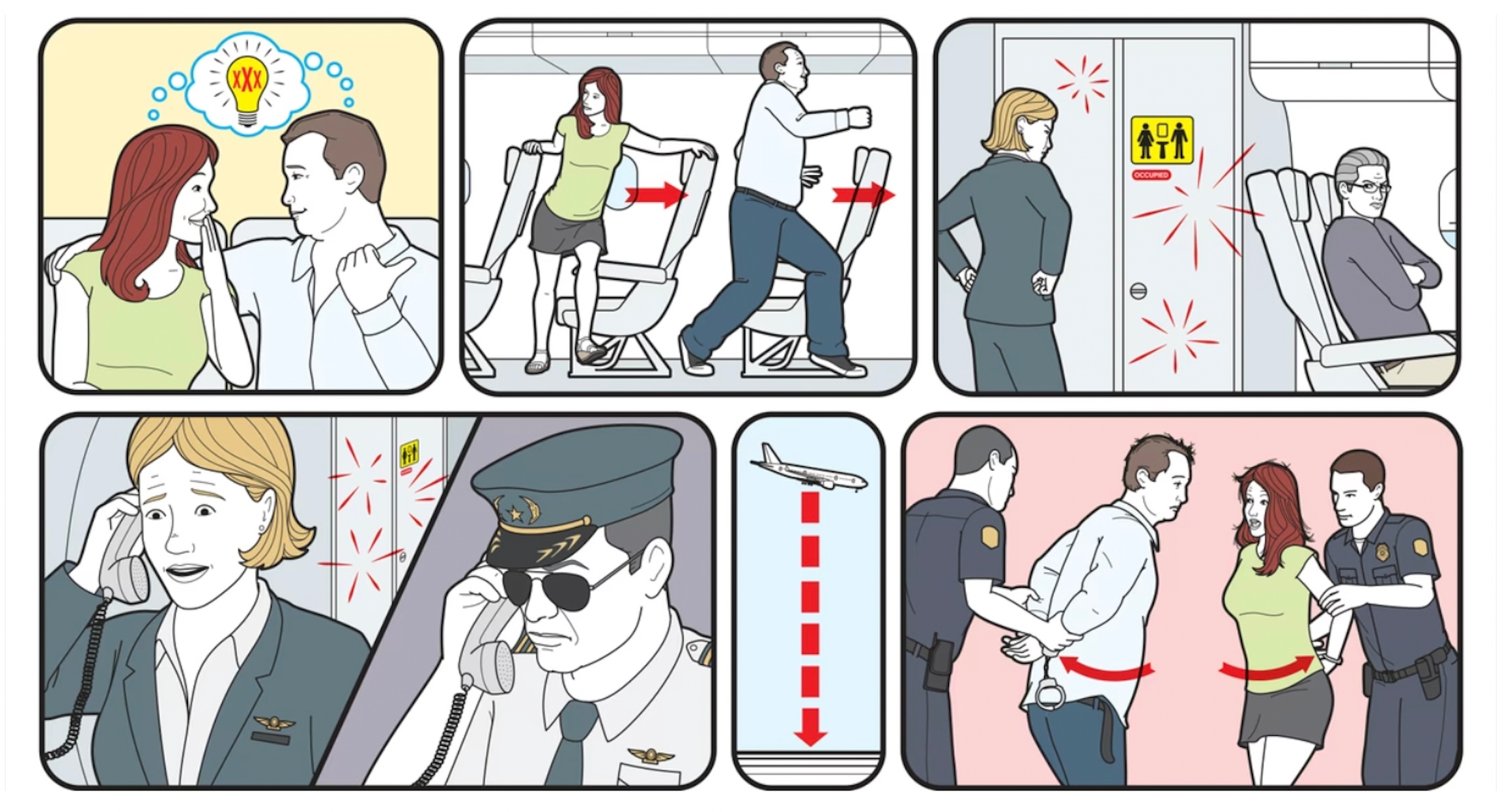
The following Q&A with Slate reporter Luke Winkie, conducted in June of 2025, touches on the 21st-century fate of the “Mile High Club” (the death of which I announced in a World Hum article nearly 20 years ago). My quotes never made it into Winkie’s article “The Mile High Club used to be the premier form of freaky sex. Then someone—or something—shut it down,” but I will share the full text of the interview here.
Have you ever encountered the mile high club in your life? Have you joined? Do you know anyone who’s joined?
I don’t have any first-hand experience with the Mile High Club — and to be honest I’m not really interested in joining, since sex in commercial airplanes doesn’t strike me as all that sexy. If I have been in proximity to a Mile High liaison I wouldn’t know, since it never occurs to me that it’s an appealing option.
One time, at a party in California, I met a young woman who claimed to have joined the Mile High Club with an attractive acquaintance on her flight in from Florida the day before. She seemed to regard it as something of an adventure, an assertion of sexual possibility in her early twenties. But it felt to me like she saw it more as an edgy “Bucket List” activity more than something that was sexually enjoyable. This might be fairly common — that is, the Mile High Club is a standardized category that certifies sexual adventure more than it is an organic expression of erotic desire. Not a spontaneous and visceral act so much as a considered decision to tick a box off a checklist.
I suspect that the most intriguing Mile High liaisons happen between strangers who’ve been seated next to each other on long-haul flights. In the movie Fight Club the Edward Norton character uses the term “single-serving friends” to describe the brief intimacy that occurs between seat-mates on flights — and while he meant it in the Platonic sense, I’m sure these “single-serving” connections sometimes have an erotic energy. Joining the Mile High Club with a stranger thus consummates a romantic mini-relationship with someone you’re unlikely to see again — and that can be sexy, even if the aesthetics of the flight leave something to be desired.
It feels to me that the mile high club was more of a fixture in the cultural imagination back in the 70s, 80s, and 90s than it is right now. Do you agree? When you think about why air travel in 2025 is so unconducive to the mile high club, what are the main factors that pop into your head?
I think the Mile High Club was a more purely erotic expression in the early decades of commercial aviation. There is something inherently sexy about transgression and exclusivity, so the ritual probably peaked back in the era when flying commercially was a rare act that came with luxury amenities. As flight became more common and less expensive in the late 1980s and 1990s, airplanes began to feel like another utilitarian space. I’m sure sex still happened on airplanes, but I suspect it was more of a heady respite from the drudgery of flying than it was a romantic embrace of some novel and exclusive ritual. As I wrote in my 2022 book The Vagabond’s Way, “in an era of cheap airfares, long security lines, and cramped seating schemes, having sex on a commercial flight [has begun to feel] as tacky and quotidian as having sex in a Walmart.”
Why do you think we’ve associated some romance with air travel historically? Why does the idea of hooking up on a plane sound, forever, far more exciting than doing the same thing on a train?
I think there’s something inherently escapist about travel, and a flight is filled with the expectation of other places. For this reason I suspect that most Mile High Club liaisons take place on the way to a destination rather than on the way back home. But the sexiness of transit has a lot to do with the aesthetics of one’s conveyance. A first-class flight with good food and lots of elbow room is sexier than a cramped budget flight full of cranky retirees and screaming children. Similarly, a train can absolutely be sexy when it involves sleeping rooms and lounge cars; less so when it’s a crammed commuter conveyance with people standing in the aisles and farting and staring at their phones. Buses have never been regarded as all that sexy, since they are so common and utilitarian — and in a sense they become a metaphor for the unsexineess of any form of conveyance that is too commonplace and practical.
Do you think flying will ever become romantic again? Or is the toothpaste out of the tube?
The sexiness of flying is inversely proportional to its utilitarian function. Commercial flights will continue to be less-than-sexy so long as they are cheap and cramped and crowded. But it’s possible that technology will make flying sexy again, if flying involves, say, air taxis (or digitally optimized dirigibles) with more privacy, amenities, and elbow room. The less a flight feels like something to endure en route to something more desirable, the more likely it will be infused with erotic possibility.