
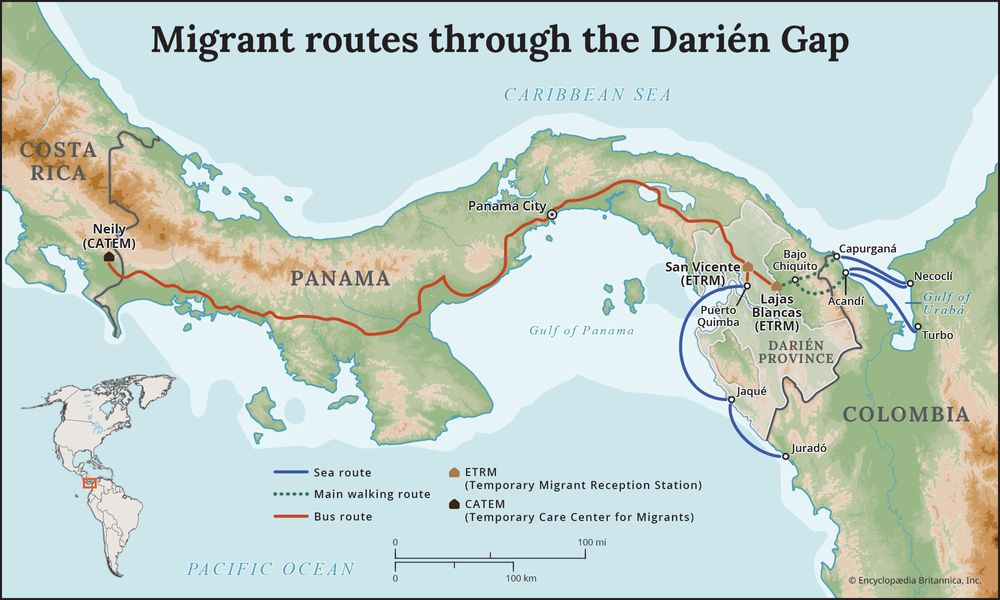
I’ve noted here before that I’m regularly interviewed by traditional news outlets seeking my perspective, as a veteran travel writer, about various aspects of travel and tourism. Sometimes my quotes don’t make it into those articles. One of the more interesting such articles in recent years was Laura Gottesdiener’s Reuter’s article, “For migrants, the Darien Gap is hell; for adventure tourists, it’s a magnet.” Laura and I talked for nearly one hour about the ethical and logistical issues surrounding wealthy ecotourists sharing Panama’s Darien Gap with migrant and refugee travelers. Due to length constraints none of my quotes make it into the article, but here are a few of my favorite outtakes from the conversation:
We pay money to have adventures that previous generations would pay to avoid
In the modern era, we pay lots of money to have adventures that previous generations would pay lots of money to avoid. We have this ginned up sense of danger, where we can feel the danger without really being in danger. You take a safari in a sports utility vehicle with trained guides and local people who know what’s going on. You’re getting the feeling of a natural experience without it really being that much of a natural experience. The market for “danger” and “exclusivity” is a real thing.
In my in my latest book, The Vagabonds Way, I give the example of Mount Everest. Mount Everest is full of people who don’t know a lot about Mount Everest, apart from the fact that it’s the tallest mountain in the world. The guides there have been very frustrated that people come out without a lot of mountaineering experience. They haven’t spent a lot of time in mountains in Alaska or Pakistan or or South America, but they just want to be able to tell their friends that they’ve climbed Mount Everest.
Sometimes the appeal of remote places lies entirely in the exclusivity of being there
Tour outfitters will tell you that wealthy clients are interested in cool wilderness or cross-cultural experiences, but they also want something that’s exclusive. They want something that other tourists aren’t doing. They don’t want to come up and see another guy from Indianapolis or or Mannheim or London in the same place.
It’s this postmodern conundrum of people wanting to feel special. I suspect a lot of people who take Darién Gap guided tours aren’t necessarily enthusiasts of the flora and fauna of that region; they just want some cool experiences in a place that’s also “dangerous and “exclusive.” It’s a consumer experience. It’s people without the time or expertise to actually go to these places and experience them in a nuanced and engaged way. It’s people without indigenous language skills, and without much scientific knowledge. It’s people with maybe not a lot of travel experiences, but they want to have an experience that feels special.
Some of the world’s most interesting travelers are migrants and refugees
Some of the most interesting travelers I’ve met are migrants and refugees. Some of the most fascinating travelers aren’t people who are wearing Gore-Tex and were helicoptered into a place. They were Sudanese refugees that I met in Damascus, and had learned new languages to stay alive over the course of making their way across five countries.
I’ve met old men in places like Myanmar who had very rough travel experiences as sailors or as refugees when they were younger. The guy who cut my hair when I lived in Thailand was from Myanmar. He was basically a refugee. And he fondly remembered his travel experiences, which which are absolutely not tourist experiences.
Twelve years ago, I went around the world with no luggage and I got a lot of newspaper articles written about me. But what I kept having to remind people about is that migrants are always traveling with next to nothing. I did this interesting thought experiment. It was it was fun, but I wasn’t doing anything that was that much more impressive than people who are traveling with maybe a form of I.D. and a change of clothes. So the migrant level of travel has always been out of the travel conversation because we always have this conversation at the consumer level. But at the end of the day, it’s a it’s a rarefied first world form of travel that not everybody has access to.
Recreational travel to places like the Darien Gap is part of the “tourist imaginary”
There’s a phenomenon that anthropologists call the “tourist imaginary” that is very central to all of this. You can’t really untangle the ethics of the tourist imaginary from these conversations because I think we we tend to front-load our own fantasies before we travel to places. When you go to the Darien Gap, you’re looking for that tourist imaginary, one that mihgt involve birds and wildlife, but not migrants from poorer parts of the world. There are very few places that are not in conversation with the globalized world. I think that part of what sells tours to the Darien Gap is the fantasy of going to a place in our modern world where we can feel pre-modern, in a way that’s sort of dishonest. The tourist imaginary fetishizes purity, and fetishizes a places that feel untouched, when in fact no place is.