
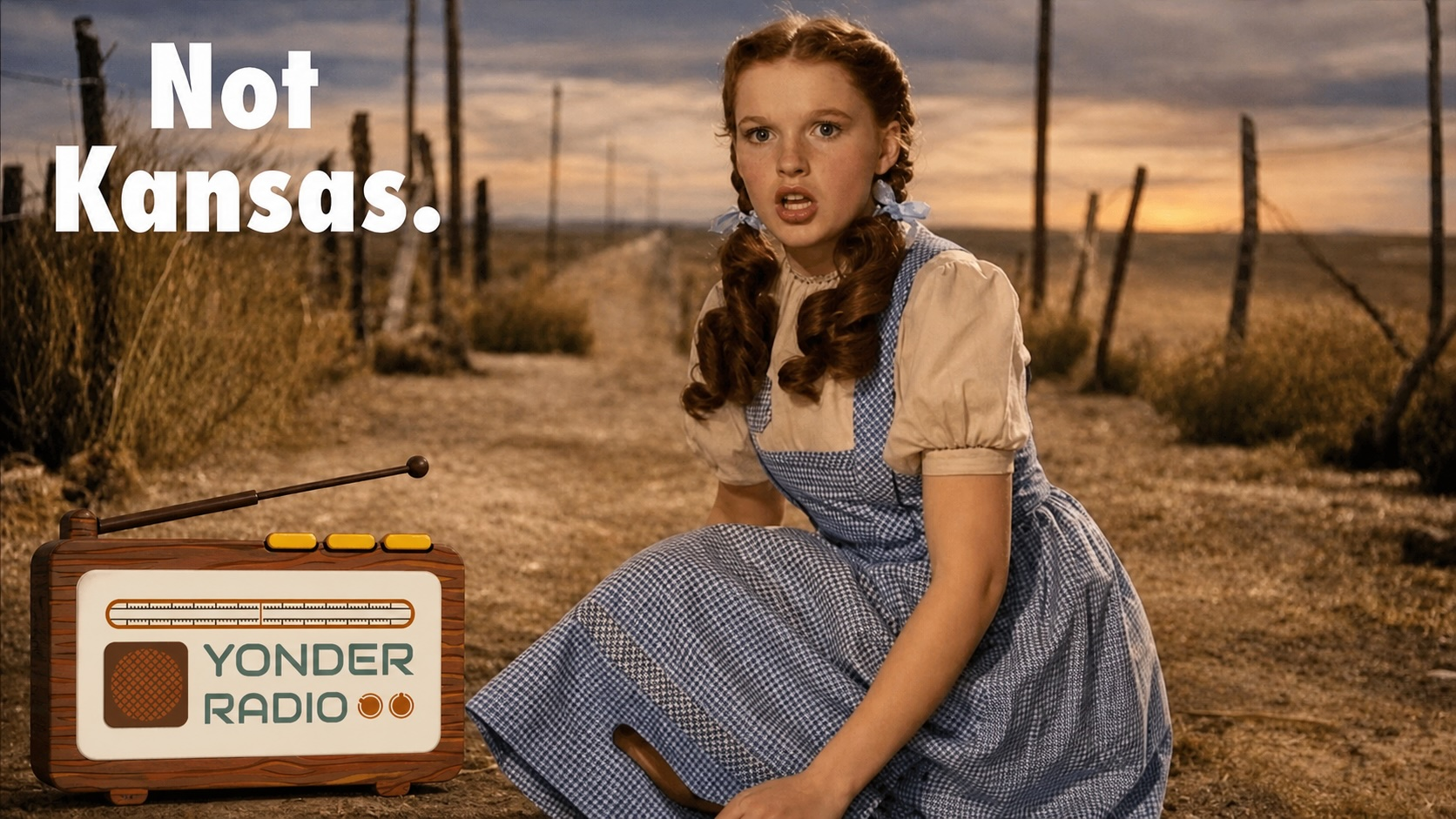
This week I appeared on Yonder Radio, an hour-long audio show and podcast produced by the Center for Rural Strategies, to talk about my feature-length found-footage video essay Kansas Never Plays Itself, which draws on a century of film to analyze how cinematic shorthand shapes the public’s imagination of places.
What’s the name of this video essay and what is it generally about?
The video essay is called the Kansas Never Plays Itself, and it’s a riff on Thom Anderson’s iconic 2003 essay film Los Angeles Plays Itself, which is an intriguing look about how Hollywood has misrepresented the very city that is the filming location of so many movies But Los Angeles Plays Itself is about a city that serves as an actual shooting location, whereas the most famous movie representations of Kansas are not even shot there. And those movies tend to treat Kansas as a generic rural place that people want to leave. As a person with a fierce pride from my home state, I wanted to explore why this was the case.
Can you discuss some particular representations of Kansas both give us the good and the bad and what makes this distinction?
I mean, there’s The Wizard of Oz. But there’s also Superman and there’s In Cold Blood. What these movies have in common is that the “Kansas” in these Iconic movies and movie franchises isn’t a place so much as an archetype. It’s like a symbolic stand-in for home. It’s a place where wholesome white people live innocent lives that are more or less boring, and they’re looking to find adventure elsewhere. So the central cinematic representation of Kansas isn’t an ugly one, like perhaps people from Georgia bristle at the movie Deliverance. But it is irritating and insipid, and not very representative of the place where I live.
As for good representations, there’s not a lot to choose from, which is part of why I made the video essay. A fairly exemplary Kansas movie is Gordon Parks’ semi-autobiographical movie The Learning Tree. It depicts the black experience of Kansas in the 1920s. So many other movies about Kansas would have you believe that there’s no black people in Kansas at all. The very title The Learning Tree. comes from the most famous line in the movie, where the protagonist’s mom urges him to think about his Kansas home in a nuanced way, even though he wants to leave it. She says “It’s not an all-good place. and it’s not an all-bad place either. It’s sort of like the fruit on a tree. Some’s good, and some’s bad. No matter if you stay or leave think of Kansas that way until the day you die. Let it be your learning tree.” And so I think the best distinction between a good representation and a bad one is whether this setting can encompass this kind of nuance.
Can you talk a bit about what is lost when a location is standing in for another place on screen?
What you lose is the intangible nuances. You lose the true cultural texture and diversity of a place, and you lose the subtle ways that people interact as they live their days there. You lose basically everything but the received assumptions about a place And oftentimes this leaves out the non-wealthy people of a community. When you are a film executive you often operate by the upper middle class assumptions of people who produce movies. Those assumptions can be condescending towards people who live in rural places. You end up losing the perspective of people who aren’t urban or suburban or wealthy.
What do you hope that audiences take away from your video essay Kansas Never Plays Itself?
I hope they’ll realize that any place in the world should not be understood through the lens of a single story and that all places contain multiple stories. I hope that people even if they’re not from Kansas will see their own home in it. I’d like to think that people could be from Queens and watch Kansas Never Plays Itself and think about the ways that Queens is overlooked in movies about New York. Because Hollywood Is hasn’t been very good at depicting all places in in the movies. I think that filming Kansas stories in Kansas will allow those stories to flow out of the landscape and the communities that the filmmakers experience there.