
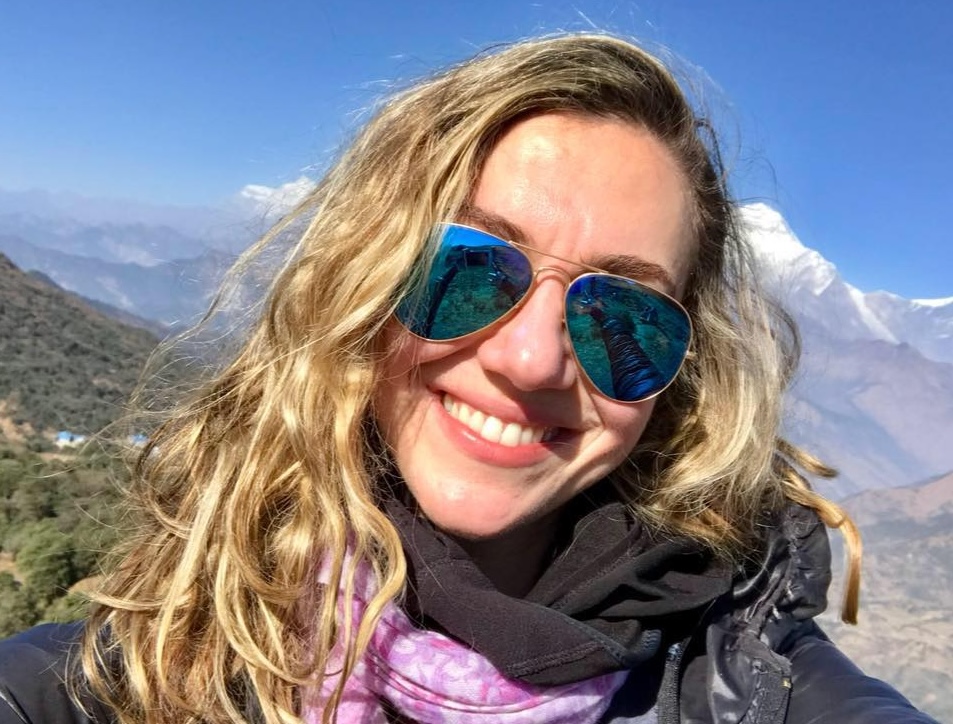
Erin Levi is a Connecticut-born, Montréal-based travel journalist whose work spans the Himalayas, Central Asia, and beyond. A polyglot and lifelong traveler, she has trekked to Sir Edmund Hillary’s favorite viewpoint of Mount Everest, sipped Chasselas and danced on tables with the Cent-Suisses, a historic Swiss Guard unit, during a once-in-a-generation Swiss winegrowers’ festival in Vevey, shaken hands with Bhutan’s king, fly fished in Montana, tracked down archaeologists in the Dominican Republic, and stayed up late watching leatherback turtles nest in Trinidad. Her work has appeared in The New York Times, TIME, BBC Travel, Lonely Planet, Virtuoso Magazine, Smart Luxury, Wine Enthusiast, and AFAR, among other esteemed publications. She also serves as English editor of The Bukharian Times.
How did you get started traveling?
I got an early start. By two, I’d already been to Alaska with my mom—our only mother-daughter trip to date. By three, I managed to get stuck in a pocket of quicksand in Canyon de Chelly, Arizona. And by four, I was celebrating my birthday in Italy and southwest France, my face smeared with chocolate gelato in Siena and my parents still laughing about how I entertained myself through a three-hour foie gras lunch at André Daguin’s Hôtel de France in Auch by befriending a little bug I named Frenchie, who even spent the night in my room’s antique desk drawer. (To everyone’s surprise, I even came away liking foie gras—sorry!)
We traveled somewhere new every year, and those experiences really shaped me. My vagabond dad, in particular, had an adventurous streak. He once took off for three weeks to trek Upper Mustang—back when it was nearly impossible to reach—and organized annual whitewater rafting trips for his college fraternity brothers (now he goes on golf adventures). A self-employed clinical psychologist, he worked hard, but he always prioritized travel, taking us everywhere from the wilds of Idaho’s Salmon River to the sun-scorched heart of Spain’s olive country—in the dead of July.
Twenty years after his Mustang adventure, I found myself meeting the daughter of his tour operator, Above the Clouds, randomly at a café in Patan—where I was living while working for a travel start-up called kimkim. It was one of those wonderful full-circle moments that travel often offers. Looking back, I think that mix of curiosity, slow travel, and insistence on making time (or the prioritization of) for adventure is what set me on my own path.
How did you get started writing?
I’m a storyteller and a polyglot. I never set out to be a writer—though I dreamed of writing travel stories from a young age, coveting my dad’s subscriptions to Condé Nast Traveler, National Geographic, and Gourmet. Writing happened organically as I chose some rather unusual study-abroad destinations: first Hanoi, Vietnam, and later Samarkand, Uzbekistan. I would hole up in internet cafés, sending email dispatches to friends—a lot more thrilling than the academic papers I was supposed to be writing—and the feedback was encouraging.
I began taking practical steps toward my dream when I became a travel publicist. PR wasn’t a career I’d ever considered—I had been on track for something international and bureaucratic, like working for the State Department or the UN—but an opportunity landed in my lap (thanks to my younger sister Julia). As I networked with travel writers, I realized my study-abroad experiences gave me some legitimate street cred. I connected with Matt Gross, then The New York Times Frugal Traveler, who had also lived in Vietnam, and he introduced me to David Farley, who was about to travel there for the first time. I enrolled in Farley’s “Intro to Travel Writing” class at NYU and began attending his Restless Legs reading series—which is likely how I met you, Rolf. Really, Vietnam opened the door for me.
That said, I sometimes wonder if I got it all wrong—maybe I should have been a photographer instead? Not only do they earn more, but I instinctively grab my camera before jotting down notes; I think visually first. When I was struggling to compile a Bhutan guidebook, I unearthed a “Guide to Paris” my sister and I made when I was 12 and she was 8: “Words by Julia, Illustrations by Erin.” It was a real ‘aha’ moment—and it made me think: why not do both?
What do you consider your first “break” as a writer?
My first-ever print story was about my summer studying Uzbek in Samarkand, published by a local magazine group in Connecticut (thank you, Debbie Silver!).
But my first real break came when I pitched Dan Saltzstein, then travel editor at The New York Times, a piece on an innovative Bhutanese tour operator, MyBhutan—and he accepted it. That was May 2016. Making it into the Times somehow felt more gratifying than my graduate diploma from St. Andrews. In that moment, I thought: maybe it wasn’t so crazy to quit my PR job to become a travel writer—maybe I could actually do this.
One of my career pinnacles came a few years later reporting on the Fête des Vignerons—a once-in-a-generation Swiss winegrowers’ festival—for BBC Travel, after first writing about it for the Time’s 52 Places to Go in 2019. I got to combine both my Italian and French skills with my journalistic profession. I really felt I was on the right path – particularly when mine crossed with Sebastian Modak, then the 52 Places to Go reporter and now travel editor at Off Duty.
As a traveler and fact/story gatherer, what is your biggest challenge on the road?
Speaking multiple languages usually keeps communication from being a problem. But I’m shy—which can be surprising to those who know me—and I often hesitate or overthink approaching people, even though that’s often the best way to uncover a story.
Timing is another challenge. It can either work for you or completely derail your plans. It’s a constant balancing act between planning ahead and letting things unfold organically. Recently, on a self-fashioned road trip through Puglia’s Salento region for a story I plan to pitch to BBC Travel, I realized I’d run out of time to visit one key city. Do I go back? Let it wait for another adventure? Or desk report it?
Personal relationships can take a toll, too. But also they can benefit – especially if you have friends scattered around the globe.
What is your biggest challenge in the research and writing process?
When I’m seeking out untold stories, one challenge is tracking down information that exists offline rather than online. For example, a recent story idea is based on a book that isn’t even available in the U.S.—so having access to it gives me an edge.
In the writing process itself, word limits are sometimes a struggle. I do my best to stay within them, which often takes more time, but it’s worth it—it ultimately makes me a better writer.
And as someone with so many ideas, I also wrestle with prioritization and being strategic about who to pitch so I can get the best placement and remuneration. Talking things through with fellow writer and editor friends helps; Kathleen Rellihan has been a great soundboard.
What is your biggest challenge from a business standpoint?
Surviving! The time spent researching, pitching, interviewing, writing, and editing—let alone traveling—often outweighs the pay. (I need to get more assignments for each trip.) That said, there’s no greater feeling than seeing something you’ve relentlessly pursued published—and hearing about the impact it makes. Ideally, I’d love to land a print magazine feature, both to earn more per word and for the sense of accomplishment it brings. It would be a major career milestone for me, and childhood dream come true.
Have you ever done other work to make ends meet?
Yep! I’ve worked as a server—most recently at the Tavern at Graybarns in Silvermine, CT, a beautiful, upscale New American restaurant where my travel expertise often came in handy when discussing dishes and wines and connecting with patrons. While I enjoyed being on my feet and away from a screen, it was a humbling experience. I’ve also worked as a publicist for a creative agency in Brooklyn, DCX Growth Accelerator, assisting with social activist campaigns. They were also integral in my quest to save Afghanistan’s only black metal band, Rig Veda, from the Taliban.
Now, I serve as editor of The Bukharian Times, the paper of record for a post-Soviet diaspora community in Queens, NY. I manage the bimonthly English section, sometimes covering travel in Central Asia, but mostly profiling community members and writing about local events. Having a steady gig allows me to pursue the stories I’m truly passionate about.
What travel authors or books might you recommend and/or have influenced you?
One of the joys of being in this industry is actually knowing and befriending the people behind the books. Some of my favorite travel books and stories are by friends – Matt Gross, Tony Perrottet, David Farley, and icons I’ve met like Pico Iyer, and yourself, Rolf. (In fact, I think I last saw you both together at Travel Con in Memphis!?)
Along those lines, I love Eliot Stein’s new book Custodians of Wonder: Ancient Customs, Profound Traditions, and the Last People Keeping Them Alive.
Another favorite, which I came across via travel bookstore Idlewild Books: Broken Glass, a novel set in a run-down bar in the Congo—funny, poetic, stream-of-consciousness-style writing, without a single period. It’s the greatest run-on sentence ever written.
On my night table: Togolese author Tété-Michel Kpomassie’s An African in Greenland, and Peter Matthiessen’s The Snow Leopard—the book that inspired my Dad’s trip to Mustang in ‘99.
What advice and/or warnings would you give to someone who is considering going into travel writing?
Advice: Develop a niche expertise or beat. For me, being a Bhutan expert has served me well. Editors seek me out and it’s easier for me to break into new outlets. For example, I just wrote about Bhutan’s foray into the wine world for Wine Enthusiast. I’m not a wine writer—but now I hope to sell another WE story. But it doesn’t have to be a place that’s so far away or difficult to explore—it can also be your home turf.
I remember Farley saying to take advantage of where you live and become a local expert for publications like Time Out or Lonely Planet—or even those abroad. Build clips close to home, then branch out. Most outlets these days are looking for local writers, anyway.
Warning: Have a skillset to fall back on, and/or another income stream. Payment—often up to 45 days after publication—can feel downright archaic. When my Dad learned this, he warned, “You’re going down the wrong path, Erin.” But it’s an interesting path, isn’t it? Sigh.
What is the biggest reward of life as a travel writer?
The biggest reward is connecting with people from around the world and uncovering stories with sharing. It’s helped me cultivate a mindset that digs deeper, inspires others, and highlights the best of humanity—an almost radical act in today’s divisive times. Travel writing expands my worldview, collapses time by living richly and intensely, and offers the joy of making a positive difference.