
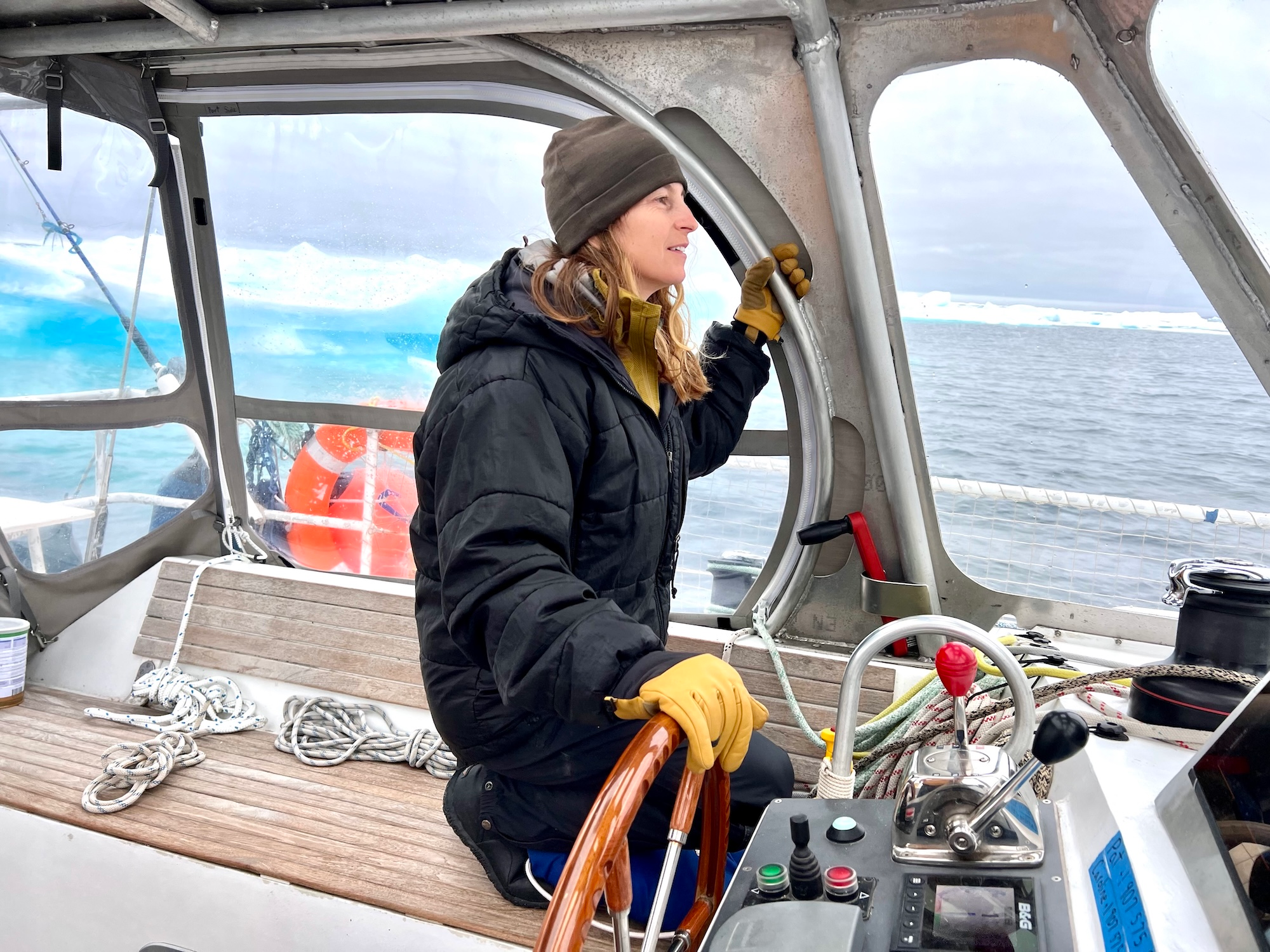
Caroline Van Hemert is an Alaska-based writer and wildlife biologist. She’s the author of The Sun is a Compass, winner of the Banff Mountain Book Award. Her essays and articles explore the intersections between science and adventure travel, and have been published in the New York Times, Washington Post, Outside, Vogue, High Country News, and more. She recently sailed the Northwest Passage with her family, providing material for her current book project, Upwellings, featuring tales of resilience, hope, and surprise endings in the natural world. In addition to her creative work, she studies wildlife health and climate change in the Arctic.
How did you get started traveling?
I grew up in Alaska with parents who valued travel, both locally and abroad. We would often hike or ski into remote cabins or go camping in our backyard mountains. As a child, I was a reluctant outdoorsperson, preferring to travel by way of books rather than tromping through the snow with my younger brother and sister. Despite my bookworm-ish ways, my parents’ wanderlust eventually rubbed off, and I graduated high school at age 17 to travel solo in Europe and northern Africa. As a young adult, I became somewhat obsessed with backcountry adventure, which dovetailed with my budding career as a field biologist. I’ve built an off-grid log cabin on a glacial fjord; hiked, skied, and paddled 4,000-miles across Alaska; and chased birds to many far-flung field sites. Becoming a parent later changed the nature of my adventures, but not the desire to explore wild places. In 2025, I sailed the Northwest Passage in a 43’ aluminum sailboat with my husband and 9- and 11-year-old sons, dodging sea ice, spotting polar bears, and meeting fascinating people along the way.
How did you get started writing?
Like for many authors, reading has always been my gateway to writing. I’ve never gone anywhere without a book in my backpack. However, until I published my debut memoir, The Sun is a Compass, in 2019, I’d primarily written for scientific journals. This changed in part as a reaction to my fatigue with academic research. After I finished my Ph.D. in biology, my husband and I set out on a 4,000-mile human-powered adventure through Alaska and northern Canada, which offered a break from the lab and provided the impetus for The Sun is a Compass. I’d earned a master’s degree in English a decade earlier but had all but abandoned this part of my professional life for science and was eager to return to creative endeavors. After the physical trip, I spent several years on a self-taught journey in book writing and publishing. I learned more through that crash course than any degree could have offered!
What do you consider your first “break” as a writer?
In spring of 2019, I published a travel memoir—The Sun is a Compass—as well as a front-page travel article in The New York Times about sailing with children. This was the first time I’d received any public attention for my creative work, and it felt like the beginning of an exciting and terrifying new career stage. This writing “break” came via a long road of soliciting literary agents, writing and rewriting chapter drafts (which numbered in the hundreds), and toiling on a project with no guarantee of publication. I originally wrote the book without a contract or clear plan for how it would find its way into the world. I was fortunate to eventually land with a wonderful agent and editor who helped shepherd me into the world of book publishing. I’ve since had the opportunity to write for a variety of outlets and am working on my second book, this time under contract. I’d like to say that the path to literary success has since become easier, but I’ve learned that freelancing is a challenging venture no matter how much experience a writer gains.
As a traveler and fact/story gatherer, what is your biggest challenge on the road?
For nearly all of my professional writing life, I’ve had young children in my periphery, both at home and on the “road.” My husband and I have long been adventure partners; over the past decade, we’ve had to reenvision what this looks like as parents. Our first big family adventure was a 1,200-mile sailing trip from Washington State to Alaska via the Inside Passage. At the time, we had two children in diapers, one of whom had just learned to walk. The thought of writing while at sea was laughable.
My kids, who are now 9 and 11, continue to offer both inspiration and near-constant distraction. They help me experience travel and the natural world in richer, more meaningful ways. They also, however, require a lot of attention and care, especially when we’re traveling in remote locations. As they’ve gotten older, they’ve become great travel partners and are much more self-sufficient, but they’re still kids with interests and aspirations very different from our own. Rarely can I just sit back and observe, or pick up my laptop to write, just because the mood strikes me.
What is your biggest challenge in the research and writing process?
I love research, and as a PhD-level biologist, it comes easily to me. My biggest challenge is avoiding the temptation of getting sucked down too many rabbit holes of scientific minutiae. Cool facts can be great sources of inspiration but they can also distract me from actually putting words to the page. I also have a tendency to get stuck on old writing drafts, with the occasional bad habit of recycling stale ideas even if they’re not working. I’ve learned that I’m better off starting fresh than trying to work with a paragraph or page I’ve seen a dozen times before. Contrary to my background as a scientist, I’ve very much an exploratory writer, meaning I don’t map out where I’m going in advance. I know some writers who outline all of their projects before they begin, but that’s not my style. As with any good travel adventure, I’m not seeking a destination so much as an experience.
What is your biggest challenge from a business standpoint?
To date, writing hasn’t paid the bills for me. I work as a freelancer, not a staff writer, and my travels aren’t endorsed by any companies or sponsors. This means I don’t have the obligations that some writers do in terms of producing specific stories for specific purposes, but it also means that all of my articles must be pitched and my travels paid for out-of-pocket. This approach is partially by choice as I’ve prioritized the other part of my professional life, which is in science. However, I sometimes dream about having the time and budget to focus exclusively on travel and science writing.
Have you ever done other work to make ends meet?
I’ve never not done other work to make ends meet! I have a PhD in biology and have been studying birds and other wildlife in Alaska since I was 19. I value this part of my professional life equally, but I often found that my writing time got squeezed out by other work commitments. I resigned from my research job several months ago, so this will be the first year I’m focused exclusively on writing. I’m not sure how long I can sustain this arrangement financially, but between several grants, freelance articles, and a book-in-progress, I hope to have at least six months of relatively uninterrupted writing time (besides the usual interruptions of life and family, of course!).
What travel authors or books might you recommend and/or have influenced you?
I’ll gladly read anything that transports me to a new place or introduces me to new ideas, but I’m especially drawn to travel writing that includes elements of science, memoir, and adventure. I think of travel writing as encompassing the act of going places but also of looking more closely at one’s own home. My coming-of-age books as a young biologist were strongly place-based, like Arctic Dreams by Barry Lopez and Refuge by Terry Tempest Williams. I read a lot of sailing literature in advance of our Northwest Passage journey, and North to the Night and A Voyage for Madmen especially stand out. Some of the other recent travel/natural history combos I’ve enjoyed include Owls of the Eastern Ice, Soundings: Journeys in the Company of Whales, and Entangled Life.
What advice and/or warnings would you give to someone who is considering going into travel writing?
I wouldn’t begin a writing career of any sort unless I loved the process. Getting paid a living wage for travel writing seems to be increasingly difficult. There are many opportunities to write for free (or a small honorarium), and some outlets that pay reasonably. These can be great opportunities to reach new audiences, but as a freelancer, it’s difficult to sustain a steady income. Holding down a more standard job and writing on the side seems to be the approach most writers have to take. That said, writing is one of the most satisfying things I’ve ever done, and I love experiencing the world through words. I’ve also found great inspiration and community by participating in writing residencies and festivals, so it’s worth applying for these opportunities even as a relatively new writer.
What is the biggest reward of life as a travel writer?
I’ve found the greatest rewards in travel writing, and writing generally, by making connections with readers. That’s the great power of storytelling—by sharing experiences and learning from others, we feel our own humanity more deeply. The letters and emails I’ve received from people who’ve somehow been touched by the words I’ve put to the page motivate me to keep writing, even when it feels hard and isolating.
I also love the curiosity that comes with experiencing new places and exploring new ideas. Increasingly, I’ve found my writing niche in the overlap between science and adventure travel; as a biologist, I love bringing a sense of discovery to the page. Surprises in the natural world inspire my writing, as well as my passion for adventure. I would never have explored the bizarre life of a sea sponge, for example, if I hadn’t stumbled onto one washed up on an Arctic beach.