
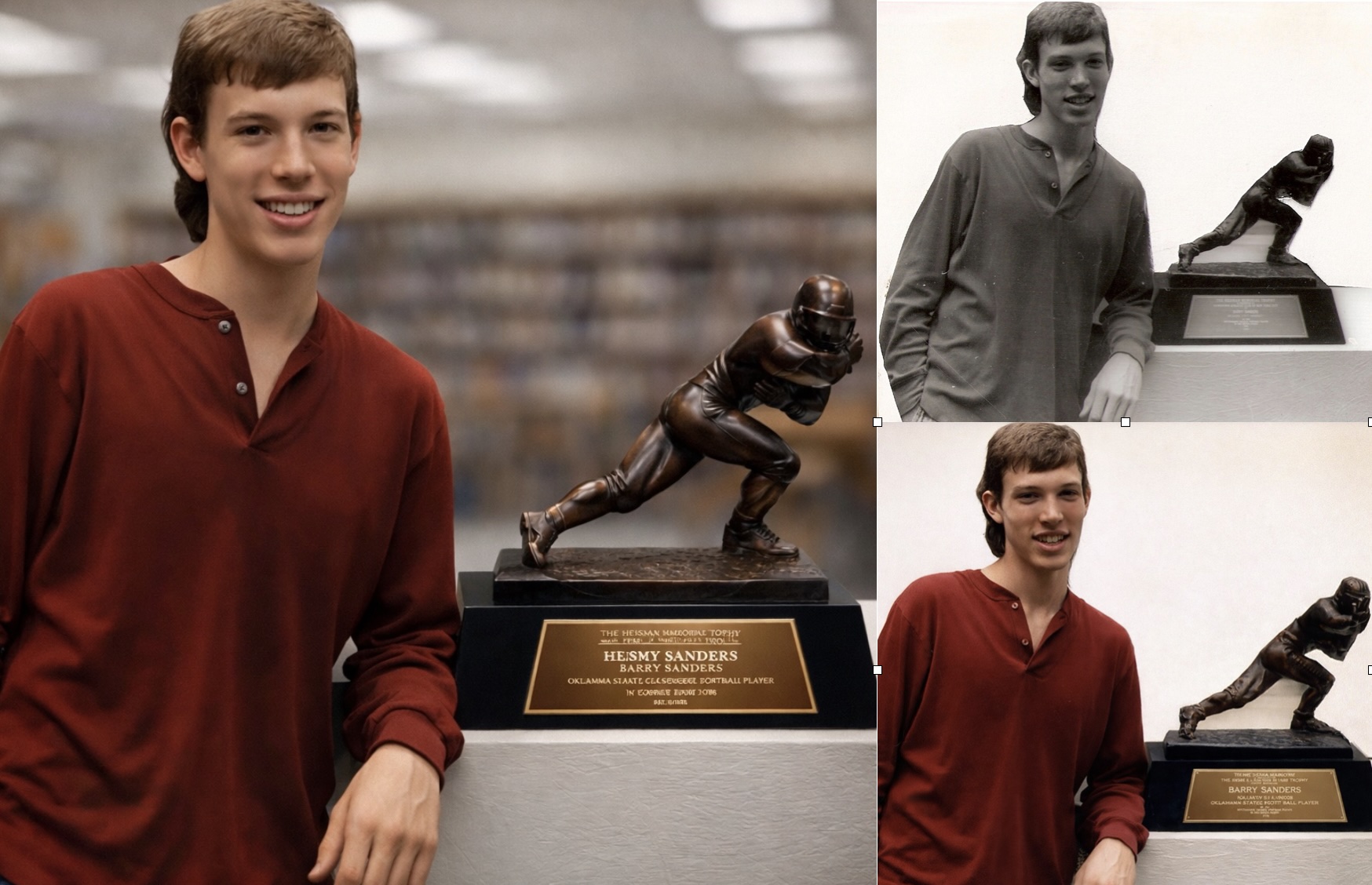
Here’s a curious look into AI image enhancement technology, in relation to how we once captured images. It’s a story that dates back more than 37 years.
In early 1989, not long after Kansas native Barry Sanders won the Heisman Trophy as the top player in college football, I had the chance to pose with his award in the library of Wichita North High School, where Barry had graduated three years earlier (and where I was the current sports editor of the student newspaper).
I forget which student photographer took the original black-and-white photo — but, when it was later developed in the school darkroom, I was crestfallen that the photo’s background wound up so muddy that one could barely distinguish me (and the Heisman) in the foreground.
Using the most cutting edge (pun intended) technology of that time in history — a pair of scissors — I carefully cut the muddy background out of the print and glued it onto a white sheet of paper.
It was an improvement, but it still wasn’t a very good photo — in part because my eyes were closed, and you couldn’t see much detail on the trophy. I taped it into my senior-year scrapbook, but every time I saw it I remained disappointed at how it looked.
A few days ago, while browsing the photos I’d digitized from that scrapbook, I spotted the Heisman shot and wondered if AI might make the image clearer and more satisfying.
The first AI pass added color (a red that was remarkably similar to the hue of the shirt I was wearing back in the day), and made the trophy look a lot sharper and more detailed. But the backdrop was still blank-white space, so I asked AI to approximate high school library bookshelves in the background.
This made for an impressive improvement, but 1989 Rolf’s eyes were still mostly shut, so I asked AI to open them. The first try didn’t work (it looked exactly the same as the previous image), so I asked it to integrate my old “Meyer & Williams” senior class portrait to make my face look better.
This process did open up my eyes, and it made my face look faintly more angular and handsome than in the original photo — though my new mouth seemed to belong to a slightly different person. Still, I’m not that picky (and the stakes here were pretty low), so I considered the experiment a success.
But as I looked closer at the new photo, I saw that Barry Sanders’ name on the trophy had been changed to “HEISMY SANDERS,” so I asked AI to change it back to the way it was before. Yet, for some reason, the AI decided to re-spell the new name as “BARIY SANDERS.”
Thus ended my AI experiment. I’m sure I could have fine-tuned things for hours, and wound up with a Platonic Ideal image of that school-library moment from 1989, but I have more pressing things to do here in 2026.