
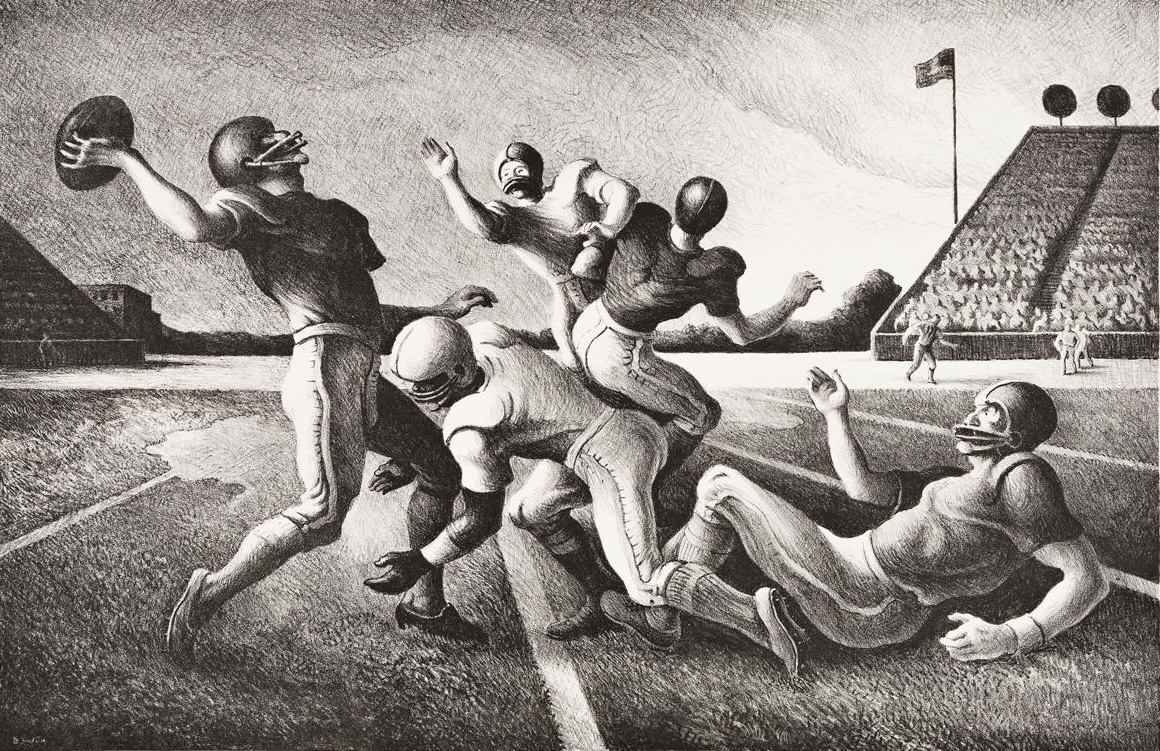
1) On the way Americans call football “football” for no cogent reason
Americans call football “football” because that’s what Americans want to call it. We offer no cogent clarification as to why this is, nor do we insist that other nations do the same, nor do we spend much time considering how this might seem to anyone who isn’t us.
2) On why Americans care more about football than, say, track and field
Every four years, the United States dominates track and field at the Olympics. For two weeks, it’s on TV for six hours a day, followed by a four- year period when almost no one in the country cares about track at all. There’s always been befuddlement over why this happens, particularly since (a) track is a popular spectator sport in Europe, even in non-Olympic years, and (b) Americans traditionally love things that Americans are good at. But Americans don’t need to care about track, because we have football. Football is applied track and field. Football is track, but with purpose and drama and an unreliable narrator disguised as an oblong leather spheroid
3) On how football is a way to connect to how the warlike world used to be
Football is not just a replacement for war. It’s a way to connect with how the warlike world used to be, based on values that were once everything and are now nothing. What modern football simulates is the bygone version of warfare imagined by Sun Tzu. That feels good to people, and especially to men.
4) On how football is so well-suited for television
Television defined the last half of the twentieth century, outperforming all other mass media combined. This was already understood by the onset of the 1970s, prompting countless network executives to kill themselves in the hope of creating something impeccably suited for sitting in front of an electromagnetic box and remaining there for as long as possible. This typically entailed thoughtful consideration over the content of TV: what a program was about, how it was written, and what personalities were involved. But what’s even more critical, and far harder to manufacture, is the form of the program: the pacing, the visual construction, and the way the watcher experiences whatever they happen to be watching. How a person thinks about television is a manifestation of its content; how a person feels about television is a manifestation of its form. And there’s simply never been a TV product more formally successful than televised football. This was an accident. But it turns out you can’t design something on purpose that’s superior to the way televised football naturally occurs.
5) On the way that even mediocre football games can be eminently watchable
The gap between the best AC/DC album, the best Metallica album, and the best Guns N’ Roses album is minuscule, and the case for which one is the best of the three can go in any direction. How- ever, the difference between the best AC/DC song and the worst AC/DC song is relatively minor, which can’t be said about the other two groups. Its innate form compensates for any failure of function. The reason football is such an amazing television product derives from this High Voltage utility; even a mediocre game is eminently watchable.
6) On the tendency of people to obsess over the visual language of football uniforms
When someone without a strong rooting interest watches a football game, they’re watching a dehumanized battle between groups of colors, with the experience dictated by which colors are involved. Slovenly dudes who hate fashion will still obsess over the visual language of football uniforms. The Platonic ideal is Ole Miss hosting LSU, assuming Ole Miss wears their powder blue jerseys and LSU wears white tops and yellow pants. Clemson (in all-orange) versus UCLA is a matchup that has never historically occurred, but would be deeply satisfying if it did. …SMU looks amazing when they go all white, as does Colorado. I dislike heavily monochromatic patterns, but a few still work due to the tonal depth: North Carolina, Texas, Penn State. Alabama employs a dismal shade of crimson, but they compensate by putting their players’ numbers on the side of their helmets, a timeless accent that overcomes a lot. There are a handful of programs I support primarily because of their aesthetics: Tennessee, Wyoming, Sam Houston. That might sound nonsensical, and in a different sport, it would be. But when the game is college football, I’m not necessarily rooting for the players, whose names I might not recognize and whose faces I cannot see. I’m rooting for the institution itself, making the people wearing the uniforms less meaningful than their visual representation. This is not a flaw. This is a feature.
7) On the suburbanite, class-based nature of American soccer fandom
The American soccer fan is a different caricature: a well-educated progressive whose nontoxic sensitivity allows them to appreciate a more beautiful game. Regardless of where they live, they’re envisioned as white suburbanites from blue cities, though they choose to see themselves as citizens of the world. … For the U.S. soccer fan, part of the sport’s appeal is America’s international inferiority at the men’s game, providing a rare opportunity to see the United States as an underdog on the world stage. Most critically, the American soccer zealot feels habitually mocked by fans of American football, prompting them to see anti-soccer critics as both xenophobic and dumb (an argument easily illustrated by our unwillingness to call soccer by its proper name). This has become the U.S. soccer community’s de facto relationship to football: as that of an oppressed underclass, informed by a global mentality. But for this to make symmetric sense, American football needs to see soccer in similar terms, either by affirming the accusation (“Yes, we are your oppressors”) or smugly denying it (“You are not oppressed in any way”). That has never happened, in either direction. The master-slave relation- ship has never been consummated. Instead, football views soccer the way most Americans view the metric system: as an alleged inevitability that’s okay for people in other places, but which fails to reflect our own specific connection to the world.
8) On the way American culture fixates on the tastes of people in their twenties
A middle-aged man in constant interaction with other middle-aged people, much of my daily conversation fixates on strangers younger than myself. That’s always whom middle-aged people are talking about whenever they discuss the state of the world: people in their twenties they will never actually meet. This is not a complaint or a problem. It’s just life, and it was life long before I was born. Things classified as hot are things that are popular with people in their twenties. A “famous celebrity” is someone who’s famous to someone who’s twenty-one. Whenever low-grade futurist monologues about the future of America, what they’re describing is how Americans in their late twenties are assumed to be living already. This has been true since the nineteenth century, though you don’t fully recognize it until you’re at least discuss the state of the world: people in their twenties they will never actually meet. This is not a complaint or a problem. It’s just life, and it was life long before I was born. Things classified as hot are things that are popular with people in their twenties. A “famous celebrity” is someone who’s famous to someone who’s twenty-one. Whenever a low-grade futurist monologues about the future of America, what they’re describing is how Americans in their late twenties are assumed to be living already. This has been true since the nineteenth century, though you don’t fully recognize it until you’re at least forty, which means every middle-aged adult is forever forming opinions about the credibility of a demographic who can’t grasp how they’re already destined to lose the power they don’t realize they possess.
9) On why we fixate on things that happened before we could experience them
Like a prospector who didn’t reach California until 1855, my obsession with football started after the peak had already passed. It was a relationship sustained by television, molded and manipulated by books and magazines and newspapers. My belief system came from overheard conversations and misinterpreted myths. I always wanted to be older, to actually remember the things I had to learn secondhand. Many of my favorite players were retired before I turned ten. I had pictures on my bedroom wall of legends I never saw play. I will always view the 1970s as football’s zenith, and that’s because was barely there. If I’d been born ten years earlier, I’d likely think the same thing about the sixties. Tomorrow can never matter as much as yesterday. The great football games I’ve seen can’t match the great football games I’ve missed, and I’ve missed so many.
10) On the way fiction can capture the texture of realness more than nonfiction
When a story is presented as nonfiction, every detail is questioned and mistrusted. One glaring error and all the cards collapse. But when a story is fictionalized, the details don’t matter as much as the essence. It only needs the texture of realness. And North Dallas Forty feels as real as any sports movie can feel, no matter how many details are wrong.
11) On the way nonessential pleasures make workaday subsistence fulfilling
Did the 1975 Indonesian invasion of East Timor matter more than the Oklahoma Sooners winning their second-straight national title that autumn? Sure. Does the murder rate in Chicago matter more than the effectiveness of Caleb Williams on third down? Of course it does. But this is an impractical, annoying way to think about existence. It’s hopeless to view every single thing through the lens of the trolley problem hypothetical, where the only moral endgame is identifying the greater tragedy. There has to be some recognition that things like sports, art, fashion, and all other pleasure-based pursuits are the nonessential notions that make workaday subsistence fulfilling, even if every isolated example seems superficial and dumb. There’s no reason to value life if we’re not going to value living. Football, and particularly watching football on television, can be dismissed as wasteful and empty. But what that dismissal fails to grasp is that the best version of anything is the way most people find meaning in personhood, and televised football is the best possible version of both the game and the technology.