
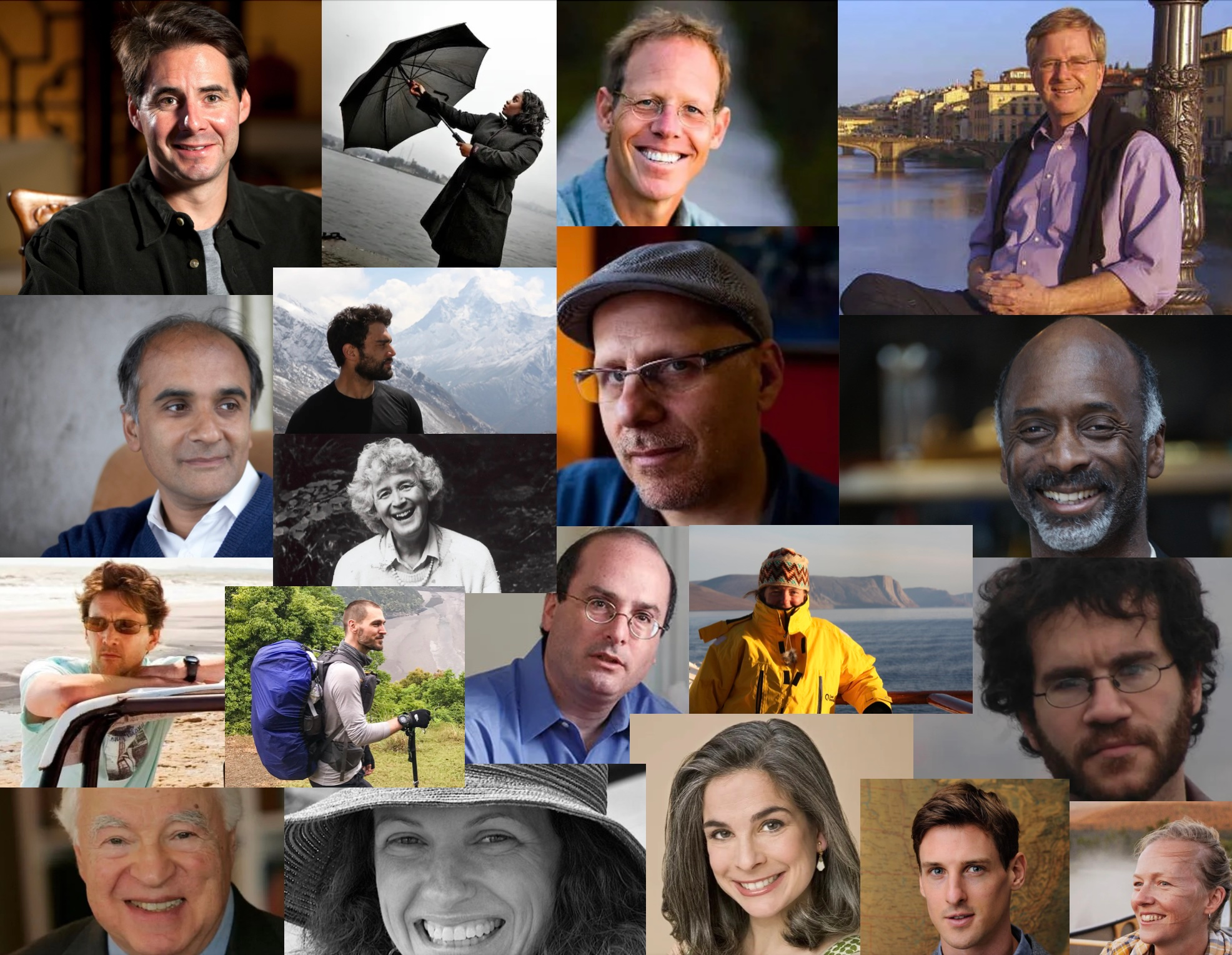
This month marks the 25th anniversary of my travel writer interview series at RolfPotts.com. Indeed, I’ve been interviewing one travel writer a month since November 2000, which means I’ve now featured upwards 300 travel writers, from A-list icons like Simon Winchester and Pico Iyer and Pam Houston, to up-and-coming travel bloggers and new-media creators.
This project predates podcasting, YouTube, and social media — and harkens back to the earliest era of “blogging” (a word I was not aware of in 2000), amid the dialup-internet era. So far as I can tell, my travel writer interview series is one of the oldest ongoing, regularly updated features on the internet.
How (and why) the interview series began
My idea to start interviewing one travel writer a month is an offshoot of my old biweekly “Vagabonding” travel column at Salon.com. In that era before online comment sections and social media, readers reached out to me via a Hotmail address that was included in my Salon bio. Two reader questions came up again and again. The first was, “How are you able to travel the world for such a long time?” The second was, “How does one become a travel writer?”
At this point my personal website, RolfPotts.com, existed mainly to aggregate my online travel stories, so I decided to expand its content to address those two reader questions. To unpack the first question — how I was able to travel for such a long time — I wrote a ten-point “Vagabonding Suggestifesto” (“manifesto” sounded too portentous, so I framed it as a list of suggestions). This travel philosophy was eventually discovered by an editor at Random House and expanded into my bestselling first book, Vagabonding.
The second question — how to become a travel writer — was trickier to address, since I could only speak to my own limited experience. Thus, I elected to reach out to other travel writers with a list of ten basic questions about their own experiences as travelers and writers. To this day, I ask those same ten questions of everyone I interview, be they world-famous or early in their careers.
Who I’ve interviewed (and what this has led to)
My first interviewees were either travel writers who also wrote for Salon (people like Shopping for Buddhas author Jeff Greenwald), or writers who’d reached out to me after reading my work (people like Lonely Planet: Thailand guidebook writer Joe Cummings). Whenever I found a travel writer with a website (or even just an email address at the end of a story) I reached out and asked them to be a part of the series. Over the years, I’ve interviewed guidebook legends like Tony Wheeler, Rick Steves, Hilary Bradt, and Bill Dalton; bestselling authors like Patricia Schultz, Eric Weiner, and Peter Hessler; narrative nonfiction icons like Jan Morris, Ted Conover, and David Grann.
Over time, many of the travel writers I interviewed became my friends. Because I was living in Asia early in my career, and didn’t have many connections in the U.S., I often sought out and socialized with my travel-writing interviewees in places like New York and San Francisco. These folks began to see me as something of a de facto expert on the genre — and the fact that I had a growing database of interviews with travel writers led to some interesting opportunities.
The most significant such opportunity came when Best American Travel Writing series editor Jason Wilson was unable to accept the offer of a summer teaching gig at the Paris American Academy in 2002, and he offered up my name as an alternative. I accepted the guest-lecturing slot that year, an experience that eventually led to the creation of the Paris Writing Workshops, which I still teach each summer. Often, my in-person and Zoom guest-lecturers in these Paris classes — people like Eddy L. Harris, Kathleen Hughes, and Andrea Sachs — are folks I first got to know when I asked them for an interview on my website.
Interviewing such a wide variety of writers over the years has given me new insights as to what travel writing is (both in the literary and consumer sense) as a genre. Some of the people I’ve interviewed came into travel writing after having established themselves in other genres: Andrew McCarthy was an actor before he wrote about travel; Miranda Kennedy a radio reporter; Gary Shteyngart a novelist. Others have expanded their pursuits well beyond travel writing: Karl Taro Greenfeld now writes for television; Lola Akinmade Åkerström is now best known as a novelist; Tom Bissell writes video games, and was in the writing room for the latest season of the Star Wars prequel series Andor.
How things have changed (and where they might go next)
My interview series has been around for so long now that many of the people I’ve featured have since died (people like Tony Horwitz, Matthew Power, Tom Miller, Andrew X. Pham, and Arthur Frommer). Others have left travel writing and moved on to different creative and vocational pursuits. My own relationship to travel writing has evolved greatly in the quarter-century since I first started conducting the Q&As — in part because the way everyone consumes media has changed so much during that time. Many of the magazines I dreamed of writing for in 2000 no longer exist (at least, not on paper), and many of the platforms I now write for — podcasting, YouTube, social media — didn’t exist back then.
One day I hope to compile the best insights and advice from these hundreds of interviews into a travel-writing craft book (a task that will no doubt require a research assistant or two, given the volume of content I’ve amassed). Whatever the case, I will likely continue this Q&A series for as long as people are willing to participate, since the task isn’t particularly labor-intensive, and I enjoy learning a little bit more about travel writing with each interview I do.
A full archive of these travel writer Q&As can be found here.