
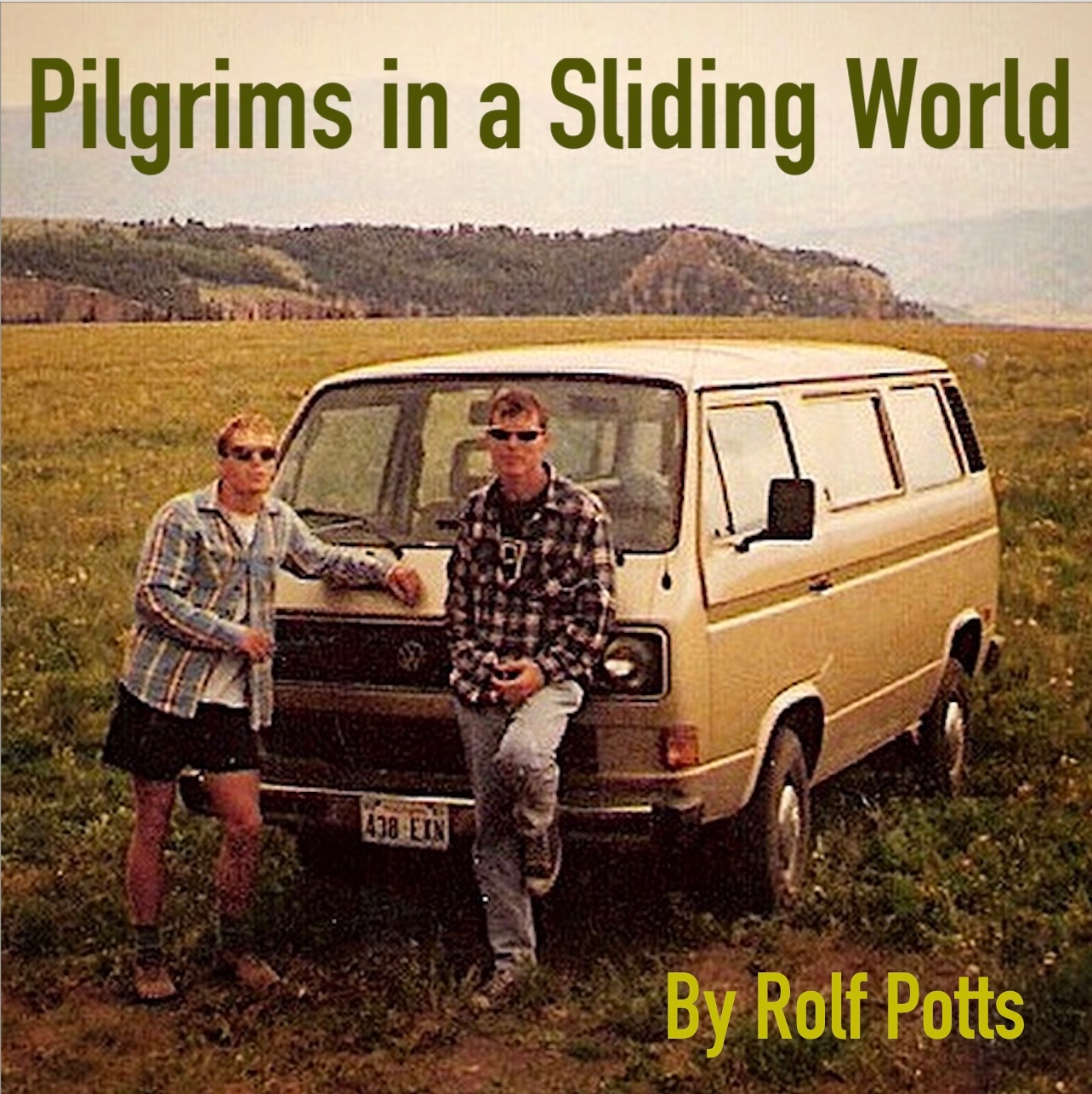


I: Pilgrims in a Sliding World

For almost as long as I’ve been making my living as a writer, I’ve been telling folks about the role that failure has played in my development as an author. Specifically, my failure to write an insightful and coherent book about my first vagabonding experience – an eight-month van journey around North America undertaken when I was twenty-three years old.
The working title for that never-published first book was Pilgrims in a Sliding World, and I toiled at it for more than two years before abandoning it and moving to Korea to work as an “English as a Foreign Language” teacher in my mid-twenties.
It was while living in Korea that I cannibalized sections of Pilgrims in a Sliding World to land my first travel-writing byline, a Las Vegas essay for the then-prestigious online magazine Salon, as well as a second travel byline, a Joshua Tree essay in the dialup-era Ur-online lit-magazine Eclectica. Years later, I remixed parts of its Houston chapter for my 2016 book The Geto Boys, which appeared in in Bloomsbury’s music-themed “33 1/3” series. But, for the most part, my Pilgrims in a Sliding World manuscript has spent the past three decades sitting in a box in my closet.
On revisiting a never-finished manuscript
In 2019 I re-read this never-finished 70,000-word narrative to prepare for a Deviate episode entitled “Van Life before #VanLife: Rolf unpacks his very first vagabonding journey.” In so doing, I realized it was a much smarter and more nuanced book than I’d been giving it credit for.
Which is not to say that my attempt at a first book was worthy of being published. It attracted a smattering of interest (and, ultimately, polite rejections) from a few publishers and literary agents, and I am desperately grateful, years later, that it never saw the light of day.
Pilgrims in a Sliding World was, quite naturally, a coming-of-age road-trip memoir: a depiction of a young man exploring his own country by Volkswagen Vanagon, pushing his comfort zone, and seeking out new experiences – all while fixating on what adult life might have in store for him.
The book’s first chapter lays out its thesis in this way:
Too often, I think, we allow ourselves to be unwittingly dragged into adulthood behind job security or marriage or monthly payments on matte-grey home entertainment systems.Then we discover that we are adults in relation to our home entertainment system instead of ourselves.
If youth is a rehearsal for adulthood, I’m a willing victim of stage-fright: a person who has seen the script and sensed that—behind all the flowery language—the primary dramatic themes of adulthood are suspiciously similar repetition and banality. Perhaps my time here on the road is like improv in the green-room: a last-minute attempt to rework the script, so that—even if my play turns out to be a disaster—I’ll at least be reciting my own lines.
Starting today, I am going to travel around the United States for the next eight months. I don’t have a destination; I just want to buy some time. In keeping this journal, I hope my experiences might yield clues, parts of a greater sum, fragments of a formula that will allow me to make peace with my future.
On clever prose (but a vague story-arc, and low stakes)
The title Pilgrims in a Sliding World was taken from Robert Creeley’s 1983 poem “The Faces.” No doubt superimposing my own fixations onto Creeley’s words, I assumed the metaphorical “sliding world” of the poem represented a contrast to the adult world of fixity and (seeming) finality. In trying to embrace “the time it never / mattered to accumulate, the fact that / nothing mattered but for what one / could make of it / …a sly but / insistent yearning to outwit it / all, be different, move far, far / away, avoid forever the girl / next door” – I was really hoping to embrace all the unseen possibilities that my own life offered.
Occasionally aphoristic and consistently overwritten, Pilgrims in a Sliding World never exuded all that much insight or self-understanding. Its author clearly liked language, and wrote decent sentences, but he did not yet have a sense for narrative arc or big-picture story-structure. His best insights and passages made more sense as clever journal-snippets than as building-blocks in a coherent narrative.
Indeed, the central shortcoming of Pilgrims in a Sliding World was that its young narrator didn’t seem to know himself very well, even as he endeavored to depict himself and his life-concerns on the page. He had a weakness for overanalyzing everything (writing sentiments that were simultaneously articulate, yet not-all-that-well articulated) as he catalogued experiences in roadside diners and at urban festivals, at hardscrabble inner-city housing-ministries and on craggy national-park mountain trails, in the company of Trappist monks in Massachusetts and intimidatingly cute college girls in Florida.
Lesson #1: No work is lost (and “failure” has lessons to teach)
Ultimately, the stakes of Pilgrims in a Sliding World were pretty low. As a middle-class, college educated American, it was clear that my narrative anxieties – while authentic enough – were not something to be confronted and vanquished so much as endured and outgrown.
Nearly a decade after I first sat down and attempted to write Pilgrims in a Sliding World, my first published book, Vagabonding, made a much more focused and articulate case for how a long-term journey might identify and expand life’s possibilities. And while its themes and prose were far superior to what I’d attempted with Pilgrims in a Sliding World, Vagabonding would not have been possible without my unrealized efforts to create a first book.
I will never offer the entire text of Pilgrims in a Sliding World up to reading public, but I will share some snippets of its prose here in an attempt to examine how and why it did not (and where, on occasion, it did) work as a book.
II: The Author is a Character

When teaching my creative writing classes in Paris, I typically begin my memoir-themed craft lecture by writing these words on the whiteboard:
Author | Character / Narrator
The vertical line between “Author” and “Character/Narrator” is in part meant to underscore the fact that – in analyzing a person’s writing – we’re not talking about the individual who wrote it (the “author”); we’re discussing how that individual evoked his or her own narrative persona through the writing itself.
Indeed, on the page, the person telling a nonfiction story appears both as a “character,” who participates in the story’s action as it happens (without knowing how things will turn out); as well as the “narrator,” who analyzes and makes sense of things as the story plays out. At the risk of oversimplifying how all this works, one could say that the “character” persona is used to make real-time discoveries in the story, and the “narrator” persona makes retrospective sense of that character’s discoveries.
Writing nonfiction from this “double perspective” is a task that has been masterfully explained by the essayist Phillip Lopate, but I stumbled into my own understanding of creating the “I character” by attempting to write Pilgrims in a Sliding World.
23-year-old Rolf as the narrative “I character”
Part of the challenge of reducing yourself to the size of a “character” on the page is deciding which parts of your persona you will explain (or dramatize) for the reader. In Pilgrims in a Sliding World I never quite settled on a consistent mode of describing myself. Often, I wound up “performing” a version of myself that belonged more to other books than to my own life.
One evocation of the “I character” that stands out in retrospect is this faintly charming attempt to describe what I looked like back then, which appeared in the book’s opening chapter, “Face the Muzak”:
Someone once told me that I was not handsome enough to pass for Jesus. I think he was trying to say that if a children’s book of Bible stories were illustrated with a Jesus who looked like me, devout people would consider it somewhat blasphemous. My body cannot compensate for my haircut, either: somehow, I am simultaneously tall, big-boned, and skinny. With my shirt off, I look like someone who was meant to be muscular, but acquired a heroin habit instead of lifting weights.
This description appeared in a section describing how I’d cut my grunge-chic long hair short to avoid drawing unwanted attention to myself while living out of a van. Yet, clever as the Jesus analogy was, my physical appearance had less narrative relevance than clearly stating my goals and motivations for taking an eight-month van trip across America.
Unfortunately, I mostly evoked my young persona through vague angst at the prospect of adulthood, and never set up coherent personal stakes for the journey itself.
When The Catcher in the Rye goes On the Road (with no clear reason)
Critic Harold Bloom has written about the “anxiety of influence” some writers have in the face of the books that inspired them, and I appear to have written Pilgrims in a Sliding World under the anxious influence of a previous generation’s iconic road-trip and coming-of-age novels.
Jack Kerouac’s On the Road was a book I no doubt hoped to model in some sense, but my own travels were far more deliberate — and far less manic and ecstatic — than Kerouac’s Dean Moriarty and Sal Paradise characters. This meant that my narrative conflict was more pegged to a J.D. Salinger / Catcher in the Rye sense of lost idealism in the face of the adult world.
In Chapter Three of the book, for example (which I entitled “Burrowing Through the Topsoil” — a metaphor for my limited understanding of everything I’d encountered in California), I described a group of kids at a Monterey playground with a tone that evoked Salinger’s Holden Caulfield reflecting on his own childhood:
Sentimentality, it seems, is nothing more than a litmus test that tells us what we can no longer be. For eight-year-olds, life is predicated on motion, not analysis. Still, I hope that somewhere in me, a few molecules or neurons or fugitive sand-grains remain of my third-grade starter culture: free of pubescent testosterone and post-adolescent cynicism—capable of simple belief, and content with the idea of the future as a distant and safe cartoon reality where everyone works in a nonspecific office, and life is funny and makes sense.
Beyond reflecting on the recent memory of childhood, however, I used a kind of Cather in the Rye energy to channel my exasperation at the adult world I encountered as I traveled through California. In Berkeley, for example, I declared my narrative irritation at the arrogant and standoffish “counterculture” types I’d encountered there:
Three days ago, I was under the naive impression that hippies were gentle idealists living transcendental transient lifestyles. In the past two days, however, I’ve seen mostly cannabis-choked paranoiacs, humorless black-market capitalists, and self-righteous demagogues who seem to be rebelling against a society that ceased to exist twenty years ago. It is possible that I haven’t met a representative sampling, but the hippiedom I have seen so far strikes me as silly and ineffectual—a sentimentalized shadow of a past age, like the Daughters of the American Revolution, or the Benevolent Order of Elks.
Thirty years after having written this, it now feels peculiar that I sought out the countercultural corners of Berkeley (places like the ’60s-hippie relic People’s Park, or the all-ages punk club 924 Gilman), when — apart from my flirtation with Seattle’s grunge scene one year prior — I didn’t consider myself a denizen of counterculture scenes.
In retrospect, it’s clear that I sought out countercultures in California for the simple reason that I assumed they were the purest manifestation of America’s youth-zeitgeist. This probably had more to do with the self-celebratory Baby Boomer youth narratives I read growing up than with my own interests (which included, but were not limited to, professional sports, DIY journalism, theological philosophy, indie filmmaking, and the natural history of the Great Plains).
In reflexively seeking out out California’s countercultures, I was — for no good reason — creating a fictionalized sense for what the “I character” version of Rolf really wanted to seek as he drove across North America.
Lesson #2: “Show, don’t tell” is still good narrative advice
The over-analytic (and overly self-conscious) Catcher in the Rye version of the Rolf character reappears again and again in later chapters of Pilgrims in a Sliding World. At one point, in a chapter that takes place in the Virginia wilderness, he admits to something of a moral breakdown: “I feel like I don’t believe in hope as much as I refuse to believe in despair, ” he declares. “At some point, I chose to avoid hypocrisy by believing in nothing. But. Perhaps I am realizing that believing in nothing is hypocrisy itself.”
This sentiment utilizes a rather clever turn of phrase — but it feels like the person who wrote it knew that the turn of phrase (rather than the sentiment itself) was why he’d chosen to declare it. As a young writer, he was besotted with phrases that “sounded like writing,” and this tended to make his narrative voice less convincing.
Ultimately, my favorite depictions of myself in Pilgrims in a Sliding World occurred when — instead of analyzing everything I’d experienced — I simply depicted myself having an experience. In creative writing workshops this is known as “show, don’t tell,” and its good narrative advice.
Take for instance this section from Chapter Seventeen (entitled “Alienation By the Numbers”), which took place in a dive-bar in the Alphabet City neighborhood of New York’s East Village:
Sophie’s proved to be a warm, claustrophobic respite from the cold night. I bought a beer, then stood at the back wall as a group of guys and girls my age puffed on cigarettes, chatted, and waited their turn at the pool table. I was so taken by the desire to talk to someone that I became shy and skittish. Twice I bummed cigarettes with the intention of striking up a conversation, but I could never think of anything to say. My solitude was like a manifesto instead of an invitation. I smoked the cigarettes, but only because it gave me something to do. After four dollars’ worth of Sophie’s bargain beer, I left to find a phone booth and make a long-distance call to Skye. I hung up after two rings.
This narrative sequence, which evokes loneliness without ever saying I was lonely, feels truer than the pages and pages of self-declaration that appear elsewhere in the manuscript.
It also hints at another character — “Skye,” a young woman I’d met weeks earlier, in Florida (and with whom I was still somewhat fixated, even as I was writing about her a full year later).
III. On Depicting Other People

Indeed, just as the “I character’ is a selective persona that doesn’t comprehensively depict who the author is in real life, writing about other people involves choosing which aspects of those people’s personas will best serve the story.
In travel writing, it also involves choosing which people (of the hundreds of folks one encounters over the course of a long-term journey) to include – or not include – in the narrative.
Not everyone you meet on the road merits a mention in your narrative
Modern travel writing is heir to some of humankind’s oldest literary forms, from the mythic second millennium BC Mesopotamian Epic of Gilgamesh, to the picaresque misadventures of Miguel de Cervantes’ seventeenth-century Don Quixote (thought by some to be the antecedent to the modern novel).
The term “picaresque” is sometimes understood as “an episodic recounting of adventures on the road” – and the challenge of episodic travel tales is that, apart from the protagonist and his or her companions, most of the people described in the narrative only appear in certain scenes, and don’t have a recurring connection to the rest of the story.
An early example of this in Pilgrims in a Sliding World is the appearance of “Michele,” a friend of a friend, and the young women she hung out with in Los Angeles’ wealthy Brentwood neighborhood:
After dinner, we all moved outside to an exquisitely-gardened backyard patio, where the girls smoked cigarettes and chattered like sitcom versions of characters from some Salinger novel. I could barely keep up with all of the talk, so I mostly just sat and pretended that I was an anthropologist sent by the lower-middle classes to study the behavior of rich people. The manic conversation centered vaguely around their attempts to get fake IDs earlier in the day, but occasionally deviated without warning into tangents about serial murderers, their parents’ sex lives, or their obsession with stealing packets of sugar from expensive restaurants. Dramatic and boisterous, the girls talked as if they were dictating to some unseen scribe—emphasizing certain words so deliberately that I could almost feel the italics.
As prose, this was an imaginative (and factually honest) description of how I perceived Michele and her Brentwood friends, but it begged the question of why – apart from the fact that I did, indeed, meet them in real life – I chose to include them in the narrative.
At a certain level I think I was dazzled by having social access to the kinds of houses I’d previously seen only from the outside (i.e. the kinds of houses whose yards I’d mowed and raked in wealthy corners of Seattle while earning funds for the journey the previous year). But beyond the novelty of low-stakes upper-class voyeurism, my experience in Brentwood didn’t serve any deeper or more nuanced narrative themes.
Depicting your friends carries its own set of narrative challenges
In rereading the pages of Pilgrims in a Sliding World, it’s remarkable to see how much of its social interactions centered on friends I’d known well before the trip began. This included my college friend Jeff, who’d accompanied me for the entirety of the eight-month van journey.
The fact that this is the first time I’ve mentioned Jeff in the context of my never-finished first book is telling, since from the beginning Jeff wasn’t wild about being depicted in its pages. Unlike, say, Neal Cassady, who was happy to appear as “Dean Moriarty” in Jack Kerouac’s On the Road, Jeff wasn’t interested in being mythologized.
I introduced Jeff in the early pages of Pilgrims in a Sliding World in this way:
Jeff is the type of person who would be offended if you told him that he couldn’t make two parallel lines intersect, but he’d never get around to proving otherwise. Jeff can take a neutral object, such as a supermarket cabbage, and convince you for several minutes that the object is the funniest thing you have ever seen in your life. …Jeff is a remarkably creative and intelligent person who is bound and determined not to use such talents to any end that might be construed as constructive. I secretly suspect that he considers apathy to be a moment-by-moment form of immortality.
Again, this was an imaginative (and factually honest) description of how I perceived Jeff, but, in the pages that followed, I never quite showed what Jeff was like – in part because I knew that the real-life Jeff valued his privacy. Part of the reason that Jeff didn’t savor the thought of me writing about his antics was that – like any exuberant young person who knew a more-responsible life lay ahead of him – he wanted embrace the joys of being young without having someone record and dramatize those ragged-edged joys for a reading public.
Should I have considered this before trying to write a book about traveling with Jeff? Probably, but at the time I didn’t have an objective sense for what I was doing; I was just giving long-term travel – and book-length narrative travel-writing –a try, optimistically improvising everything as I went.
Seriously, depicting friends effectively is a tough thing to do
Someone who would have been happy to have been depicted in his full youthful glory was my friend H-Man (aka Brian, an old college track teammate), who took a Greyhound bus several days out of Oregon to meet Jeff and I for Mardi Gras that year in New Orleans.
This is how I introduced our friend in Chapter Eight (“Enter the H-Man”) of Pilgrims in a Sliding World:
If H-Man could participate in any endeavor for more than a week without self-destructing, Jeff and I would have bought a Winnebago and taken him with us around the country. Unfortunately, our friend lives like a phoenix, continually re-animating himself from the ashes of his most-recent experience. H-Man is the kind of guy who impulsively gets obsessed with strange things, like Norse mythology or middle-aged women or jigsaw puzzles or the MTV Music Video Awards. In addition to lukewarm Pabst Blue Ribbon, his obsession at this particular moment is a spontaneously-conceived postcard project which requires that we all write absurdly cheery messages to people back at our old college. The one condition to sending the postcards, H-Man says, is that we only mail them to people who don’t like us.
As flamboyantly quirky as H-Man could be, my sense for what he was like formed years before the trip began. The few days he spent with us in New Orleans (while entertaining enough) couldn’t compare with the antics I’d witnessed as his classmate in Oregon, or as his apartment roommate during my landscaping stint in Seattle.
Moreover, what I didn’t yet understand when writing Pilgrims in a Sliding World was that – whatever H-Man and Jeff might have been like in day-to-day life – my friends did not merit mention the pages of my book unless they could serve its broader, big-picture narrative (and, as often than not, they didn’t).
Lesson #3: Travel books require reporting (not just recollecting)
Ultimately, a central problem with depicting your friends on the page is that you know them too well. You can describe them in a way that might make sense to people in your friend-group, but that doesn’t mean the reading public will be interested.
Granted, Jack Kerouac’s On the Road featured a narrator traveling across America with different combinations of friends. But readers tend to forget that Kerouac wasn’t merely recounting hijinks with his buddies: He was making a case for a new definition of freedom and connection and heroism in America.
Moreover, On the Road was a roman à clef (i.e., a fiction closely tied to real-life events), which meant that Kerouac could bend events and characters to fit his narrative goals. In this way, Kerouac was able to retroactively give his characters a sense of purpose – that is, a quest in their travel – and a sense of purpose is what keeps a picaresque road-narrative from getting too vague and random.
Since I never properly articulated my quest in Pilgrims in a Sliding World (apart from my vague desire to put off adulthood and see what might be possible in life), I populated it with a seemingly random assortment of people I’d met along the way. Since I was a young person looking to have fun and ostensibly prolong my youth, I tended to spend time with a lot of other young people looking to have fun.
The thing is, you can’t populate an effective travel book with a random assortment of friends and people you partied with. You have to find a sharper sense of what your “quest” is, to travel more intentionally, to meet people – ideally people who aren’t all that much like you – whose lives and perspectives might make your quest worth writing about.
In short, you have to get out and do some actual reporting – to move past mere recollections of people who crossed your path, and seek to meet (and depict) people who can make your quest worth taking, and your story worth telling.
(You’ll also want to quote them effectively, which is something I’ll touch on next.)
IV. On Recounting Dialogues

When I teach my travel memoir classes each summer in Paris, I often do a lecture based on Thomas Swick’s “Roads Less Traveled: Why so much travel writing is so boring.” This essay astutely outlines seven key things that tend to be missing from generic travel stories, including imagination, insight, and humor.
Swick notes that mediocre travel stories tend to be devoid of people (apart from, say, tourist-sector employees like bartenders and taxi drivers) – and that when people do appear in travel stories, they are observed without being quoted.
This absence of “dialogue” tends leave travel narratives (even ones that might otherwise be full of interesting observations) feeling dry and lifeless.
Oddly enough, Pilgrims in a Sliding World had decent (if not entirely effective) dialogues, and that’s something I’ll explore here.
Not all amusing road conversations belong in your travel book
If there was a weakness to the dialogues I recounted in Pilgrims in a Sliding World, it was that they revealed me to be a pretty unimaginative young traveler. As I pointed out in my entry about depicting other people in travel narratives, the travel writer must get out of his comfort zone and meet people who can yield insights about the journey’s (and, by proxy, the narrative’s) greater themes.
All too often, the dialogues in Pilgrims in a Sliding World went something like this:
“Are you a narc?” Lucas asked me. “Because I smoke a lot of pot.”
“I’m not a narc.”
“I don’t sell any pot. I grow some, but I don’t sell any.”
“Okay.”
“I only sell a little pot. Plus, I grow some.”
“Okay.”
Lucas swayed and squinted at me. “You wanna buy some pot?” he asked.
“No.”
Lucas seemed confused. “Did I ask if you were a narc?”
This conversation, which appeared in Chapter Thirteen (“Channel Changers and Missing Persons”) took place at a Spring Break party in Panama City Beach, Florida. It was amusing enough, I guess, but ultimately it was little more than a low-stakes recollection of a low-stakes exchange with an extremely drunk young person.
Because I was a young person at the time – and because young Americans in the 1990s tended to meet new young people at parties – a lot of my dialogue thus consisted of humorous (and accurate enough) recounting of party chatter.
Take for instance this exchange from a bar near the University of Virginia campus in Charlottesville, as recounted in Chapter Fourteen (“Malfunction”):
Henry lined up shots of Jaegermeister for all of us, and we tipped back the licorice-tasting liquid in honor of Bart’s future.
“Why were you writing in a notebook?” Dale asked me.
“That’s my journal. I write down things that happen to me.”
Dale swayed on his seat and grabbed me by the arm. “I want you to write about me. Do it now!”
I brandished my journal, pen at ready. What do you want me to say about you?”
“Say that I make good money. Say that ambition isn’t worth the trouble because the only thing that happens is you get successful at something that nobody else cares about.”
I started to write all this down.
“No! Shut up!” Dale said. “Don’t write about me. I’m drunk. Write down that we need a war, so everyone can have jobs.”
I wrote this into my journal.
Dale leaned in toward me. “Women want to be lied to. That makes them feel good, because they’d rather feel good than know the truth. Then—if they find out the truth—it isn’t a problem that you lied because they just get mad, and that makes them feel good, too. They don’t care what they feel as long as they feel something.”
“Do you want me to write that down, too?”
“No!” Dale said, looking around fearfully. “That’s a secret, and you can’t tell anyone, because it took me too long to figure it out.”
While this conversation touches on issues like gender dynamics and the frustrations of middle-class working life in America, it is, once again, little more than the depiction of a random exchange between myself and an extremely drunk person who didn’t reappear in any other part of the narrative.
Hence, while these dialogues were colorful enough, they didn’t touch on any broader travel or life themes that might have justified their inclusion in the book.
Ideally, dialogues will evoke bigger themes about places, society and life
In the initial installment of this series about my never-finished first book, I noted that one chapter of Pilgrims in a Sliding World later found new life as “The Mystical High Church of Luck,” a Las Vegas-themed Salon essay that was my first real byline as a travel writer.
As it happened, only a part of that original Pilgrims in a Sliding World chapter made it into the Salon essay. This exchange between myself and a random stranger named Russ at a bar in the Flamingo Hilton, was edited out:
“I’ve decided I’m not drinking while I’m in Las Vegas,” I said. “I figure the odds are already stacked against me while I’m sober.”
Russ mockingly frowned at me. “You’re not drinking?” he said, as if it pained him. “How old are you, anyway?”
“Twenty-three.”
“Twenty-three?! You’re a man! This is America! In America men prove their manhood by fighting and drinking. I don’t want to fight you, so it looks like you’ll have to drink.” Russ pushed the shot-glass back over to me and smiled, as if in challenge. “Come on,” he said. “Be a man.”
I stared down at the tequila and paused, trying to think of a clever comeback. “In America,” I said, “we start drinking as thirteen-year-olds because we think it will make us more like men. Then, when we drink as men, all we’re doing is acting like thirteen-year-olds.” I pushed the shot-glass back in front of him.
Russ howled with laughter. “Touche! Touche!” he exclaimed. He pounded me on the back and yelled over at the bartender. “Hey! Give the Zen-master here another shot of tequila!”
I ended up cutting out this dialogue before I submitted the chapter to Salon for two reasons. First, it was, once again, an amusing exchange with a stranger that didn’t have any stakes in the broader narrative of the book.
Second, it let the “character I” off the hook: As with so many other inconsequential dialogues in the book, the Rolf character played the even-keeled straight-man to a drunken (if somewhat pithy) stranger.
By contrast, look at this bit of exchange that did make it into the Salon essay:
“Give me a casino where the bartenders wear T-shirts and rubber flip-flop sandals and give you warm beer in cans, and the barmaids dress up in cut-off jeans and fuzzy bedroom slippers and bring you Halloween candy as a consolation when you go on a losing streak, and everyone who wants to gamble has to first go up to a microphone and tell the story of their first kiss, and people only get free drinks if they make ironical allusions to the laws of entropy or the Articles of Confederation or the Pauline definition of love. Shit, Jeff. Let’s open the place up ourselves. We’ll call it Jeff’s. Or better yet, we’ll just hang an electronic reader-board out front, and whenever a customer wants to change the name of the place, we’ll change it. What do you think, man?”
Jeff didn’t even pause. “I think it’s time we left Las Vegas.”
The person delivering this rant (which, in the Salon essay, begins a full two paragraphs earlier than what I quote here) is the Rolf character. Which means that I was not recounting the drunken musings of a random stranger: I was examining my own foolishness and frustrations in the face of Las Vegas.
Moreover, since my rant came in the wake of my own quixotic failure to outwit the gambling-industrial-complex in that city, it revealed something true about how outsiders experienced it (and how Las Vegas was quite literally designed to outwit even the most determined cynics).
Tip #4: Be true to what was said (but make sure it serves a broader purpose)
In the early weeks of the North American van journey that I recounted in Pilgrims in a Sliding World, I recall wishing I’d brought a tiny tape recorder, so I could surreptitiously document all of the conversations I was having. At the time, I think I was nervous that I would end up misrepresenting certain conversations when I tried to write about them later.
In revisiting those written conversations here, however, the shortcomings of the dialogues weren’t the result of verisimilitude so much as thematic irrelevance.
One of my more effective dialogues in Pilgrims was a simple exchange between myself and the officer who’d been assigned to accompany me on a police “ride-along” through the city of Houston:
After filling out a bit of paperwork and sitting in on a second-shift personnel meeting, I was introduced to my assigned officer, a coolly composed, athletic-looking 27-year-old black patrolman named John Waldon. Having grown up near the neighborhoods he served, John went about his job with an alert sense of courtesy and competence.
“Did you always want to be a cop?” I asked James.
“Not really. I always wanted to be a professional gospel singer.”
“Why did you change your mind?”
“I didn’t change my mind. If you saw me in church you’d never believe I was a cop. Most of my friends outside of work are women. When the workday is over I don’t want to think about being a police officer; I just want something soft to hold on to.”
This exchange, which later reappeared almost verbatim in my 2016 book The Geto Boys, was effective because it was about more than it was about. In recounting John’s seeming ambivalence about his job (even as I depicted him being quite good at it), I was hinting at the nuanced realities the young black police officer faced by making his living by patrolling he very neighborhood streets where he’d grown up.
In plays and screenplays, it’s often said that the most effective dialogue is contains sentiments that are either expressed awkwardly or left unspoken – and this also holds true in nonfiction prose.
In Chapter Ten (“Junior High Visions of Adulthood”), for example, I was able to use an exchange with a young busker I’d shared a meal with in Memphis to hint at the unspoken presumptions that underpinned my entire North American van-trip:
We sat in the van and compared road notes as we ate. “Tomorrow, you should go over to the Marriott hotel and hang out in their indoor pool room,” I said to Kevin. “We were in there for four hours today, and nobody ever figured out we weren’t staying there.”
Kevin looked at me like I was crazy. “I ain’t going in no hotels I don’t pay for! Especially the Marriott.”
“It’s easier than it sounds. All you do is act real casual.”
“You can act casual all you want. Black men don’t get away with that shit.”
In depicting myself cheerily oblivious to an unspoken social dynamic as I spoke with Kevin, I was able to illustrate the concept of “racial privilege” in America without ever using the phrase.
Next up, I’ll explore the places where I bent (or fabricated) the truth in recounting the events of Pilgrims in a Sliding World – and why, at several levels, it would have been more effective for me, as a storyteller, to simply stick to facts.
V. On Veering From the Truth

Indeed, travel books have always had an unreliable relationship to facts – in part because, in journeying far from home, the traveler is both prone to misunderstand what he sees in distant places, and also tempted to invent or exaggerate details that are unlikely to be fact-checked by the home audience. As the protagonist the eighteenth-century comic adventure novel Baron Munchausen’s Narrative of his Marvellous Travels and Campaigns in Russia declares, “a traveler has a right to relate and embellish his adventures as he pleases.”
So did Pilgrims in a Sliding World veer from the actual truth of what happened to me as I traveled across North America by van?
At times, yes, it absolutely morphed into passing moments of fiction – and that’s what I’ll explore here.
Inserting half-truths into your book’s inciting incident book is a bad idea
The line between fiction and nonfiction is a common concern in travel- and memoir-writing circles, since “creative nonfiction” narratives don’t typically hew to the same rigid rules as news journalism. As writer and actor Andrew McCarthy shared with my Paris writing students last year, memoirists often bend timelines and conflate events in the interest of a more satisfying and coherent narrative – but depicting incidents that never happened means that your narrative has veered into fiction.
The incidents and details of Pilgrims in a Sliding World feel largely true (if at times slightly impressionistic), though it appears as if I let myself veer into fiction at certain moments when I was unsure if my real story was worth articulating.
In the book’s opening chapter (“Face the Muzak”), for example, I describe a dream I’d had in the summer of my twentieth year, when I worked at a summer job stocking shelves at a Dillon’s supermarket in Wichita. In a faintly overwritten section where I describe working ten-hour “graveyard” shifts five nights a week (calling myself “a Sisyphean stagehand for the nightly Muzak opera of blandly choreographed shopping carts”), remember things this way:
In the dream, I was standing in a large, open indoor space that was full of chairs and people. I wasn’t sure how long I’d been there, but I somehow knew that it was The First Day of the Rest of My Life. None of the people had faces, and no one was doing anything; everyone was just standing around while a tinny Muzak version of “Pomp and Circumstance” played cheerily and endlessly over a loudspeaker. Although I recall feeling mildly panicked that The First Day of the Rest of My Life was so drab and listless, I didn’t do anything worthy of a film-rights bidding-war, like blow up the loudspeaker and blast my way out of the room with a machine-gun. Instead, I just stood there as the Muzak played relentlessly.
As far as omens go, the dream certainly wasn’t of the angel-with-a-flaming-sword-telling-me-to-take-my-first-born-and-flee-to-Egypt variety. Nonetheless, I awoke with a feeling of dread that has never quite left me. The dream suggested that my future—my American Dream—had been boiled down to a loop of Muzak: a plastic rehashing of the old, written for people to ignore. My accomplishments-to-be, which had always comforted me in their bright and blurry hope, were to amount to monotonous pre-recorded filler.
Three decades after writing this, the “dream” in question strikes me as deeply suspicious – in part because I’ve always had difficulty remembering my dreams, and in part because the details of the dream feel too specific and detailed.
In retrospect, it’s clear that my book’s central thesis – a young man resolving to travel North America for eight months, out of vague ambivalence about his future in the face of the American Dream – was never articulated in a way that reflected my real life. (And while Muzak was indeed piped in to that Dillon’s store each night, I suspect I shoehorned this detail into my hypothetical dream because “Face the Muzak” made for a catchy chapter title.)
Indeed, instead of honestly examining my own ambitions and anxieties in the face of adulthood, I appear to have invented a nocturnal dream that (somewhat improbably) symbolized those anxieties.
Conflate real incidents if you must, but don’t make them up entirely
Comedian Ari Shaffir has talked about how we invariably dream up the best comebacks to perceived insults when we’re walking home from the incident in question – and it feels like some scenes from the early chapters of Pilgrims in a Sliding World belonged more to after-the-fact imagination than to what actually happened in real life.
Take for example this exchange from Chapter Two (“Looking for Mat-Makers”) of the book, which supposedly depicts an encounter with a young woman who accused me of being a “narc” while I was waiting in line outside of 924 Gilman Street, Berkeley’s legendary all-ages punk-rock venue:
“Name ten Bay Area bands,” she demanded.
I looked her in the eye. “Deathmuffin, Asphalt Pudding, Thunderjelly, Bubblehammer, Glory Rub, Greasepack, Somebody’s Liver, Stencil, Flesh Melon, and Platonic Fellatio,” I said, making up the names as I went along. I’ve always found obscurity to be a virtue among punk elitists.
“I haven’t heard of any of those bands!” the girl screeched.
“Somebody shut that bitch up!” yelled a guy further up in line.
“Yeah, man,” somebody else said. “She’s probably the one that’s the fucking narc.”
Clever as those hypothetical band names were, I don’t think I made them up in real-time. Moreover, I have no real-life recollection of anyone accusing me of being a narc that night in Berkeley.
That said, I do recall feeling faintly unwelcome amid the cliquish, performatively hip alt-culture denizens of Berkeley – and my experience there reminded me of similar experiences I’d had at indie music venues one year before in Portland and Seattle.
In retrospect, my earnest Midwestern demeanor and outdoorsy-jock fashion-sense didn’t play well in the hipster scenes of the West Coast – no doubt because the alternative music world of the early-mid-1990s was rapidly becoming mainstream, sending scores of musical tourists (who no doubt looked a lot like me) into formerly obscure corners of that subcultural universe.
Instead of taking the time to honestly unpack this dynamic, however – instead of entertaining the idea that the punk-rock hipsters I met there had their own insecurities (or, just as likely, social nuances I’d never considered) – I ginned up a symbolic confrontation for the pages of my book.
Tip #5: The truth tends to work better than whatever you might make up
The essays collected in my second published book, Marco Polo Didn’t Go There, all contain endnotes that explore how each essay was created. Some of these endnotes touch on notions of narrative verisimilitude to the lived events in question. At times I point out how and why I had rearranged timelines, condensed conversations, and left certain people unmentioned from a scene in the interest of telling a better, more coherent story.
What is not permitted in the interest of telling a better story, of course, is describing incidents that never happened – and it is for this reason that I’m grateful that Pilgrims in a Sliding World never became my first published book. Granted, the untruths that found their way into its narrative weren’t all that egregious, but they also didn’t make the narrative any more effective than the truthful events I’d described elsewhere.
For this reason, I’m glad I got this insecure tendency to make up events out of my narrative system, since doing the hard work of staying true to facts (and plumbing the subtleties) of what actually happened is not just more ethical – it also makes for more effective, relatable, and satisfying storytelling.
VI. On Depicting Places

Having recently looked at moments of Pilgrims in a Sliding World that felt less-than-effective (or less-than-honest), I might also highlight a few moments where my never-published first book worked well as travel narrative. Often this happened in its evocation of place.
Evoking places can include detailing the expectations you took with you
In noting that I did a decent job of portraying places in my never-published first book, I am not saying that I had mastered the concept (and perhaps no writer can ever do that). Any place one visits is, after all, so complex and intricate that it can never be described comprehensively.
This is in part because any attempt to describe a place is in competition with one’s expectations of that place. That means it can’t hurt to be candid about how those expectations can affect your experience of a place. Take for example this outtake from Chapter Four (“Notes from Everyplace”) of Pilgrims in a Sliding World:
One cannot grow up outside of California without concocting largely mythological expectations of Los Angeles. Part of this LA myth comes from the ghost reality created by the entertainment industry. In television and the movies, LA is always the dramatical setting whenever setting is not important. Consequently, LA is a generic catch-all, an Everyplace, a geographically-tangible reference point for America’s electronically-automated collective unconscious. The rest of the myth comes from news stories—tabloid and otherwise—that depict the city as little more than an arena for varying combinations of riots, wildfires, earthquakes, traffic jams, freeway shootings, celebrity scandals, cosmetic surgeries, and daylong poolside cocaine parties. The synthesis of these two myths turns Los Angeles into a town fit for the Old Testament, an Eden where no conflict lasts more than ninety minutes combined with a Sodom that is always burning.
In using humor and imagination to outline my expectations of Los Angeles, my depiction of the actual experiences I did have there (which didn’t involve cocaine parties, but did involve the 1994 Northridge Earthquake) were more grounded in a sense of expectations-versus-reality balance.
Elsewhere, in Chapter Sixteen (“Platonic Gigolohood”), I satirized the expectations-versus-reality letdown of America’s Civil War battlefields by evoking the language of Abraham Lincoln’s Gettysburg Address:
Indeed, Mr. Lincoln: we cannot dedicate, we cannot consecrate, we cannot hallow these battlegrounds—but we can, apparently, score a nifty profit by marketing them for souvenirs. I saw enough battle-themed shirts, posters, flags, bumper-stickers, shot-glasses, knick-knacks and videotapes in local gift shops to stock a theme-park. Every major Civil War general seemed to have his own line of merchandise. What do we do with our war heroes in America? Apparently, the same thing we do with our sports heroes: we put them on t-shirts. I half-expected to find a silk-screened depiction of Robert E. Lee slam-dunking a basketball.
How you describe a place is tied to how (and when) you experience it
One perennial challenge of describing famous places and festivals is that they have already been exhaustively described by other writers. Novelist Evelyn Waugh touched on this travel-writing challenge in his 1930 book Labels: A Mediterranean Journal. Pointing out that Paris has already been described in “overwhelming variety,” the famous French city “has become so overlaid with successive plasterings of paste and proclamation that it has come to resemble those rotten old houses whose crumbling frame of walls is only held together by the solid strata of wallpapers.”
At times, my evocations of place in Pilgrims in a Sliding World were in competition with Waugh’s “wallpaper-strata” effect. For example, my descriptions of New Orleans were competent enough, but – no doubt because I visited the city during Mardi Gras – everything I recounted (people catching beads from parade-floats, drunken women flashing their breasts, etc.) seemed kind of obvious.
By contrast, my most effective descriptions of festivals came when I employed hyper-specific details from my own experiences in a way that evoked a broader sense for the event itself. Take for instance this description of a Florida Spring Break scene from Chapter Ten (“Junior High Visions of Adulthood”):
Every aspect of spring break in Panama City Beach is catered toward fulfilling a junior-high vision of ideal adulthood: quickie romance, fun rides, and tons to drink. When we arrived from Pensacola at mid-day, sunburnt groups of college refugees were openly drinking cans of beer as they walked the main drag. Reader boards at bars touted wet t-shirt contests, sumo wrestling, bikini contests, and free drinks. At a mini-mall, a man in a clean shirt and a necktie handed out free shots of tequila mixed with cinnamon schnapps as a promotion for a liquor store. “This’ll fuck ya up good,” the necktie man said earnestly, in the same tone of voice that he might recommend a grade of motor oil. Overhead, a bubble-domed helicopter swooped around, giving sightseeing tours of the gulf. Bungee-jumpers dove and dangled from a crane. Garish pastel souvenir shops and gaudy miniature golf courses lined the highway. Collegians darted through the streets on rental mopeds and miniature crotch-rocket motorcycles. Over the gulf, parasailers floated above boats and swimmers and jet-skiers. On the beach, Coca-Cola had set up a huge playground of Velcro obstacle-courses, mud-wrestling rings, and several booths of carnival-like games. A beach DJ played mostly heavy-metal pop songs from the eighties—music so unhip it nearly went full-circle and became hip again. The beach revelers cheered and sang along with songs popular when they were in junior high.
Tip #6: “Telling details” are better than broad generalizations about a place
In the end, employing broad generalizations about places in the pages of Pilgrims in a Sliding World proved less effective than focusing on “telling details” that showed what it was like to experience the place.
Take for example this evocation of teens and preteens hanging out at a Gainesville shopping mall from a different section of Chapter Ten:
In front of me, a sneering pair of young girls saunters past, extravagantly ridiculing someone named Heather. They pass a pre-pubescent boy, who stares down at his shoes as he scuffs his way across the floor, entranced by the sound of his own movements. An adolescent couple follows a few paces behind, their hands somewhat desperately entwined in warm certainty. At the edge of the floor, three girls with curveless preteen bodies flaunt so much lipstick and eye-liner that they look like little boys in drag as they solemnly primp in a display-window reflection. Near the entrance of a clothing store, three junior high boys in low-slung ballcaps have entered their tenth minute of standing around uncertainly with their hands in their pockets. More kids drift past my bench—all of them looking around, few of them shopping. They have come here to partake in a time-honored tradition of weekend nights in America, an ongoing quest for Friday night epiphany. They have come here to have a good time, whatever that is.
Perhaps my favorite evocation of place from Pilgrims in a Sliding World didn’t even involve a public space – it recounted the experience of hanging out in front of a muted TV at four in the morning with a trio of University of Georgia students who’d invited me to crash at their place after we’d all been thrown out of an Athens bar at closing time. As I wrote in Chapter Thirteen (“Channel Changers and Missing Persons”):
Ashley turned on the TV and muted the volume; Jacinthe put some CDs into the stereo. We all wrapped-up in blankets and sat on the couch—chomping gum, talking, listening to Pink Floyd and Smashing Pumpkins, and staring at the flickering TV like it was invented to be seen and not heard. Watching a muted television can be remarkably soothing and entrancing, like watching a campfire. Without noise, TV’s inherent state of hysteria turns on itself; the images blend together and become tranquil. Channel-changer in hand, an ad for 1-900 phone-sex gives way to a pro-wrestling match, which becomes an infomercial wherein Ricardo Montalban hawks GrillMasters: we know that we don’t have to buy into the manipulative and the goofy and the false. A flickering image of Zapruder’s JFK assassination translates into an episode of the A-Team, which evolves to a PBS documentary about the Civil War: we know that history inseparable from myth and fiction and subjectivity. CNN pictures of a flood flip to the solace of a telephone number flashing under a preacher in his pulpit, which blinks away to alternately somber and chipper newscasters: we understand that inspiration and information is always tainted by its messenger. We all sat in the warm trance, falling asleep one-by-one on the giant, L-shaped couch.
As evocative as this scene was, it also hinted at the fact that my travel experiences were inseparable from the age at which I was having them. Next, I’ll explore how the pinched parameters and occasional neuroses of how my young manhood limited the scope and insight of my never-published first book.
VII. Neurotic Young-Manhood

Admittedly, I didn’t feel all that young at the time, but – 30 years later – the person I portrayed on the page comes off as so youthful and naïve as to be downright neurotic.
This tension is encapsulated in a North Carolina section from Chapter Fourteen (“Malfunction”), not long after I’d parted ways with an old friend named Casey, who’d told me that my earnest belief in her a few years earlier had helped her deal with mental illness. Apparently, this revelation unsettled me:
My brain hung heavy as we drove, semi-formed thoughts smacking into my mind like bugs. In reminding me of something I’d done at age nineteen—some good thing I’d done at age nineteen—Casey had opened up a small hole in my psyche, and what I saw through that hole bothered me. What I saw was the shadow of a slightly-different me; an incomplete post-mortem of belief; faint echoes telling me that—perhaps—I have become less of a person than I was at age nineteen.
Three things about this paragraph stand out to me. First, it’s overwritten, and a bit clunky with its metaphors. Second, it alludes to a nebulous conflict without attempting to clarify what exactly it was. (What psychic shift made me feel like I was becoming “less of a person than I was at age nineteen?”; decades later I have no idea, and I suspect the young narrator wasn’t sure either.)
The final thing that stands out is young Rolf’s perspective on himself as he sees himself getting older. It’s easy, I think, to forget the ways we make sense of ourselves by comparing ourselves to who we think we were before.
I’ll admit that’s exactly what I’ve been doing here, of course. That in mind, I’ll try not to be too hard on the young version of me that wrote Pilgrims in a Sliding World, even as I identify where he was lacking as a memoiristic storyteller.
Writing that reads like “writing” should probably be rewritten
When I teach my travel writing classes each summer in Paris, one of my craft lectures draws on novelist Elmore Leonard’s “10 Rules of Writing,” which ultimately asserts: “If it sounds like writing, I rewrite it.”
Writing that “sounds like writing” often lurks in the very passages a given writer is most proud of having written – and it’s obvious that young Rolf was smitten with figurative language that ultimately did little more than draw attention to itself. Take for example this paragraph from Chapter Seven (“Walking My Corpse Through Texas”):
Hangovers are like shadows of bad judgement—tedious epiphanies that remind you, in no uncertain terms, that you are an idiot. To say that I woke up hung-over in San Angelo would be to say that Egypt had a bug problem during the biblical Plague of Locusts. I felt like I was living through death. I slid out of the van to walk off my nausea—muscles aching, nasal passages jammed with phlegm, skin flushed with feverish heat, brain rattling inside my head like a sodden lump of clay. Every time I coughed, I saw psychedelic fireworks. I took a couple steps, then staggered back to the safety of the Vanagon. I felt like my entire body had been guillotined off below the feet and discarded.
This over-wrought attempt to describe a hangover was clearly hyperbolic – and while I’m certain it was an attempt at humor, its syntax drew attention to itself without being all that funny.
Elsewhere in the book, my prose stretched its metaphors and symbolism far beyond the breaking point. In describing driving through an isolated stretch of Big Sur coast in Chapter Three (“Burrowing Through the Topsoil”), for instance, I observed how the massive yellow barrenness of the land contrasted starkly with the enormous, deep-blue expanse of water to the west. “Nothing else holds my attention in this dreamland between San Francisco and Los Angeles,” I declared, “just yellow, blue, and a small highway carved into the contours where the colors crash against one another.”
This passage might have worked as a poetic evocation of what driving down California’s wilderness coast felt like, had I not immediately plunged deeper into the realm of hyperbole, symbolism, and metaphor:
Sometimes I feel as if I need help with my strokes here in the yellow part of the world. As I travel, I am nagged by the idea that I might be missing something as I splash from place to place—that my choices are a desultory collection of uninformed guesses. I am tempted to trade my freedom of choice for the deep-blue finality of the ocean—so that I could simultaneously touch the colors of every shore instead of burrowing through my own limited perceptions like a mole in the topsoil. Unfortunately, such omniscience is not an option. Daunting as it may be, free-will is my most potent weapon in this life. Often, this makes me feel like a monkey at a typewriter—whimsically punching keys in the hope that I will end up with something worthwhile.
Over-writing aside, this passage reveals how – three chapters into the book – I was still trying to find new ways to express the book’s inciting conflict (and professed reason for making the journey): I.e., my own ambivalence about my future in the face of the American Dream.
Unlike some of the other sections of the book, which recount experiences I only faintly remember outside of the book itself (and/or the journal entries that informed it), I clearly remember the emotions I felt while driving the Big Sur coast, as well as the task of trying to write about it. I recall being particularly proud of this section:
To the west, the ocean is ablaze with a flat and smokeless flame, dancing across the deep-blue. The futures we will never see are burning as we burrow through this multi-colored world. Motion is a simultaneous act of creation and destruction: the pure vision of this life rises from the ashes of what we will never experience. Beneath the late-day glow, I suspect that even the ocean is grieving. The ocean is grieving at its own deep-blue omniscience: it is grieving because all it will ever do is wash away at the shores it touches. It is grieving because all it will ever be is the ocean: it is grieving at the loss of possibility.
In the fading light, the land and the ocean open up and drop into grey: they become nothing. From this nothingness comes a fearsome sense of freedom, an unexpected intimacy with America, an intuitive sense of beginning. For a moment—somewhere in this gaping synapse between California’s megalopolitan concrete kingdoms—future and past become void in the terror and beauty of motion: Jeff drives, and I breathe in.
The existential tenor of this passage owed a lot to a quote from Spanish philosopher José Ortega y Gasset (which, fittingly enough, I’d recently discovered in a Details magazine essay by musician Gordon Gano): “The youth, because he is not yet anything determinate and irrevocable, is everything potentially. …Feeling that he is everything potentially, he supposes that he is everything actually.”
In a sense, I concocted that “ocean is ablaze” passage to make sense of the Big Sur experience for myself (and, decades later, that feels like a worthy effort, even if it didn’t quite weave its way into a publishable narrative).
Writing that’s trying to sound smart has a way of working against itself
An early reader of the various Pilgrims in a Sliding World chapters was my sister Kristin, and one of her most witheringly helpful suggestions was that some of my insights came off sounding like “Deep Thoughts” by Jack Handey, from Saturday Night Live.
Having my insights compared to the absurdist faux-wisdom of late-night sketch comedy was humbling, to be sure, but it helped me become aware of the pitfalls of trying too hard to sound smart – of straining for profundity, rather than quietly evoking something profound.
Often my writing flirted with depicting things in a true way, before eventually veering into half-basked philosophizing. Take for example this passage from Chapter Seventeen (“Alienation by the Numbers”), about the mix of exhilaration and loneliness I felt while walking around Manhattan alone at night amid my first-ever visit to New York:
As I took the nearly-empty #6 subway to the East Village, I felt a vague sense of adolescent exhilaration—as if I were a fourteen-year-old sneaking out of my house to meet a girl or vandalize my junior high school. I felt as if something new was about to happen. …I stopped on the corner of Fifth Avenue and looked at the tidy illuminations of the buildings. All the man-made order seemed just efficient enough to eliminate the need for God and just chaotic enough to preclude the significance of everybody else. I thought of pigeons roosting in skyscrapers and dreaming of forests, of heaven parceled by landlords. I felt dull and delusive, like my heart was thumping out a secret code that translated into nonsense. One hour alone in the streets of New York and I was already lonesome.
Not long before that episode, in Chapter Thirteen (“Channel Changers and Missing Persons”), I did a nice job of describing the simple camaraderie and connection that came with building a campfire in the North Carolina forest, only to ruin it with this attempt at existential sagaciousness:
Jacinthe has instructed us to turn away from the flames and watch our shadows dance. As I watch the light flicker out toward the trees, it occurs to me that shadows are not merely a fleeting, secondary phenomenon. Shadows are darkness, and darkness is a constant. When we recall our lives, we recall the events lived in the unshadow—in the light, in the sun. And what is this campfire but a small portion of the sun that has been trapped in these branches—now escaping to warm us and remind us of the darkness that dances behind us. It occurs to me how profound a blessing the sun is. I think of the wild odds that conspired to make this world as it is, and—in an instant of childish fear—I wonder what would happen if those odds suddenly gave out on us. What would happen if the sun decided on this night to go away and leave us cold? This is a foolish supposition, but knowing that does not stop me from turning to face the fire again.
It is perhaps telling that I’d tried to shoehorn an attempt at profundity into a campfire sequence that involved cute a pair of cute young women (Jacinthe, and her friend Ashley) that my friend Jeff and I had met in Georgia a few days earlier.
At the time, I’d enjoyed a flirtation with Ashley, even as I was longing for a young woman named Skye whom I’d met one month before in Florida. You’d never guess at this romantic tension Chapter Thirteen of Pilgrims in a Sliding World, however, because I was too busy trying to draw cosmic significance out of the campfire.
Tip #7: Balance narrative analysis with narrative vulnerability
I find it curious that popular culture invariably portrays young men as mindless, sex-obsessed horn-dogs, since I was awkwardly chaste and honorable in the presence of attractive young women when I was 23 (and I suspect many young men are).
This is not to say that I was a good romantic prospect at that age, since my own self-consciousness invariably proved frustrating to the women I was trying to woo.
For a hint at this dynamic, consider the analytically honest (if circuitous) way I foreshadowed my dalliance with Skye in Chapter Twelve (“Deathbed Smile-Quest”):
In pursuing romance, you get to know yourself while getting to know someone else. All of the hypotheses you make about who you are get put to the test when you are presenting yourself to another person. It can be like getting your life audited. I have spent the last day here in Ocala trying to make sense of my audit. Such audits rarely go well for me. Sometimes I feel like I should write apologies to all my ex-girlfriends, although I’m not exactly sure what I should be sorry for. Perhaps my flaw is that I have fooled myself into thinking that I have good intentions without actually having good intentions. This is as bad as it can get, because I spend all of my time trying to prove something that does not exist. To me, women are like members of a magical culture that I can respect and fear—but never properly comprehend. If I said this to the girl I have been thinking about all day, she would tell me I was just trying to invent a flowery way to say I was scared of commitment. She probably would be right. Her name, by the way, is Skye.
Part of the challenge in depicting my love life at that age was that I overthought everything. Writing about Skye was difficult for me because I still longed for her, even as I tried to make narrative sense of her a full year later. Toward the end of Chapter Twelve, I mused that my short Florida romance with her “was perfect, because it was all spark and no realism; we didn’t worry about the future because we both knew I was just passing through.”
The thing is, Skye wound up coming to see me later that year in Denver, and then again at Yellowstone – two incidents that never made it into Pilgrims in a Sliding World because I abandoned the manuscript before I made it that far into the journey.
Hence, in trying to write about Skye, I was trying to tell a story without really knowing the ending. The moments that do evoke something real about my interactions with Skye aren’t the ones drenched in analysis, but in straightforward vulnerability. Take this sequence that comes just after the vaguely articulated angst I described above, in Chapter Fourteen (“Malfunction”):
My call to Florida woke Skye. I bantered cheerily and stupidly—the whole time thinking I should tell her that what had happened between us a few weeks prior was really meaningful to me. Thing is, I didn’t know if that was even true. I didn’t even care if it was true. What I really wanted was for her to say it to me; for her to give me a sign that I had passed some test that I’d never taken. Skye, of course, was friendly and realistic. If she couldn’t solve my malfunctions, she was at least doing a better job of dealing with my lifestyle than I was. We talked pleasantly about nothing, then hung up.
In depicting myself in a vulnerable, less-than-idealized way, I was able to evoke something honest about the real emotional texture of my journey – something that no amount of portentous analysis could replicate.
Had I been more willing to embrace this narrative vulnerability (and more willing to make myself look unsympathetic), Pilgrims in a Sliding World would have been a much better book.
Curiously, some of the philosophical reflections that appeared Pilgrims in a Sliding World foreshadowed the travel ethos that underpinned my eventual first book, Vagabonding. I’ll look at those parallels next.
VIII. The Seeds of Vagabonding

At a certain level that makes perfect sense, as Pilgrims in a Sliding World was an attempt to recount my first-ever vagabonding trip (eight months by Volkswagen Vanagon across North America), and I had already begun to accrue the lessons and form the philosophies that underpinned my eventual authorial debut.
Some of the prose from Pilgrims in a Sliding World quite literally mirrors what I would later write in Vagabonding. For example, when I observe in its introduction chapter that “we allow ourselves to be unwittingly dragged into adulthood behind monthly payments on matte-grey home entertainment systems” – I’m literally remixing a Laurel Lee line (“cities are full of those who have been caught in monthly payments for avocado green furniture sets”) that would later appear in Vagabonding.
The “monthly payments” line was in fact a nod to Laurel (who was my teacher back in college), but as the subsequent chapters of Pilgrims in a Sliding World played out, many contained my own observations about work, simplicity, and adventure that would ultimately be echoed in Vagabonding.
Early examples of my vagabonding approach to work
For instance, the second chapter of Vagabonding (entitled “Earn Your Freedom”) focuses on the merits of working up to save travel funds. “The best litmus test for measuring your vagabonding gumption is not found in travel,” I wrote, “but in the process of earning your freedom to travel. …Work is not just an activity that generates funds and creates desire. It’s the vagabonding gestation period, wherein you earn your integrity, start making plans, and get your proverbial act together.”
I go on to assert that working-class jobs (carpenters, waiters, truck drivers) are as viable for seeding travel budgets as office jobs – and no doubt this conviction is tied to the fact that I’d earned my earliest vagabonding money working with my hands. As I wrote in the first chapter (entitled “Face the Muzak”) of Pilgrims in a Sliding World:
Most of [my travel budget] has been gleaned from the small contributions to society that I have made over the last three years. If you happened to buy canned tuna from the Dillon’s supermarket at 13th and West street in Wichita three summers ago—I was the one who put it on the shelf. If you happened to move into a vacant apartment unit at the Villa Felicia in Portland two summers ago—I was the one who repainted the walls. If you happened to admire the landscaping at the Costco wholesale outlet in Kirkland, Washington at any time in the last eight months—well, that was Jeff and me both. Our trip depends on these countless blank moments—which smelled of gasoline, floor wax, compost, white latex paint, sawdust, and hope.
Early examples of my vagabonding approach to simplicity
Regarding the importance of simplicity to long-term travel, I stated in the preface to Vagabonding that “this book views long-term travel not as an escape, but an adventure and a passion — a way of overcoming your fears and living life to the fullest. In reading it, you will find out how to gain an impressive wealth (of travel time) through simplicity.”
This sentiment owes a lot to this line from the first chapter of Pilgrims in a Sliding World:
Modest resources used cleverly can go a long way when you live in a country where even poor people have things they don’t need. To realize that you are separate from what you own is to find buried treasure in your own simplicity.
Early examples of my vagabonding approach to adventure
I’m similarly declarative — and evocative of Vagabonding — in my Pilgrims in a Sliding World perspective on adventure, which appears in Chapter Seven (entitled “Walking My Corpse Through Texas”):
Adventure is not cinematic explosions and high-speed chases; adventure is merely doing things that most people wouldn’t. Adventure is taking on a lifestyle of extroversion, asceticism, diplomacy, and vagrancy. Adventure is striking up conversations with people whom we wouldn’t normally talk to, as well as people who wouldn’t normally talk to us. Adventure is embracing the random: exploration of unfamiliar places, contact with unfamiliar people, attempts at unfamiliar experiences.
If that feels familiar, note that, years later, Chapter Seven of Vagabonding (“Get into Adventures”) declared:
The secret of adventure is not to carefully seek it out, but to travel in such a way that it finds you. To do this, you first need to overcome the protective habits of home and open yourself up to unpredictability. …More often than not, you’ll discover that “adventure” is a decision after the fact — a way of deciphering an event or an experience that you can’t quite explain. In this way, adventure becomes a part of your daily life on the vagabonding road.
Lesson #8: Over time, we write our way into what we have to say
The strength of Vagabonding is that is struck an effective balance of philosophy and anecdote, whereas Pilgrims in a Sliding World fixated on random details and (sometimes half-baked) observations at the expense of an overarching narrative. Yet, in a certain sense, my failed attempt at writing Pilgrims was a way of working through the issues and themes that later (with the help of more life- and travel-experience) came through in Vagabonding.
It also put my travel life into conversation with my writing life, which is something I’ll address in the final installment of this series.
IX. The Journey was the Point

This half-finished book amounted to more than 70,000 words of narrative. The fact that many published books aren’t that long (Vagabonding weighed in at just 50,000 words) hints at the fact that I was never able to achieve a proper sense of narrative scope while trying to recount my North American adventures.
Nearly three decades since I abandoned it, Pilgrims in a Sliding World is fascinating for me to reread – but perhaps no more so than the daily journal entries I kept during the experience. The trip itself had transformed my way of being in the world, yet I never effectively captured this transformation in the pages of Pilgrims in a Sliding World.
This shortcoming need not be viewed as a bad thing. The fact that the journey had changed my life was a reward in and of itself – and this new way of seeing benefited my writing life in the years that followed.
Most moments from a journey will never appear in the book (and this is OK)
One reward of revisiting a long-forgotten work is its newfound ability to surprise you. Almost thirty years after having written it, my favorite moment in Pilgrims in a Sliding World may well be his meta flourish from Chapter Seven (“Walking my Corpse Through Texas”):
In the midst of Kafka’s “In the Penal Colony”—right on the page which describes a machine designed to carve the names of crimes into the flesh of criminals—I found a dried yellow speck of orange rind. As I scraped it from the page, it occurred to me that whoever once owned the book has probably long-since forgotten the details of eating that orange. Consequently, that orange hints of a more profound tale than anything Kafka ever dreamed up—a story so commonplace and forgettable and true that nobody ever bothers to tell it. It is the unadorned story of moment-by-moment life—an unstory that buoys the more interesting episodes of our lives.
I confess that I have betrayed and falsified the slings and arrows of my moment-by-moment experience. Despite fleeting encounters with punk-rock hipsters, gambling-casino idiosyncrasies, and 6.7-magnitude earthquakes, my true experience has been dominated by a long sequence of orange-rind moments that will never find a place in my journal. My journalistic oversights could go on forever: buying powdered milk in Coos Bay, Oregon; sharing a bag of peanuts while driving through Humboldt State Redwood Park in California; visiting a shopping mall in Sacramento; choking down bad-tasting water from a tap at a Santa Barbara beach; using the Treasure Island casino restroom to shave; stopping for gas and beef-jerky in Flagstaff; shooting baskets with a semi-deflated playground ball in Tempe; giving the time to a stranger in Alamogordo; showering in the athletic locker rooms at Texas Lutheran College in Seguin; going for a four-mile run this morning in Galveston. None of these instances are really worth writing about, but they are all just as real as Las Vegas lights and Big Sur sunsets.
This reflection on the inevitable reductiveness of storytelling underscores the fact that no piece of travel writing can come close to containing the rich, non-narrative scope of the travel experience itself.
Tip #9: In the end, taking the journey counts for more than writing it
To this day, I consider the events I attempted (and ultimately failed) to recount in Pilgrims in a Sliding World to be the best travel experience of my life – in part because nothing can compare to your first open-hearted, life-transforming vagabonding journey.
Moreover, no endeavor to write a travel narrative is ever lost, since it gives you a useful perspective on (and intensified attention to) the reality of the travel experience itself. And, when embraced mindfully, the real-time experience of a journey is invariably its truest reward.
Ten chapters into my never-finished first book, while observing teens interact in a Gainesville shopping mall, I posit that adolescence “is not training for some distant contest, but a revelation of training as the contest itself. …Youth—in time—is quarantined to memory, but adolescence remains. We are always growing up.”
My failure to publish (or even finish) Pilgrims in a Sliding World was not just a key step in my maturation as a writer – it was a reminder that, as writers, we are always “growing up,” always trying and failing and trying again, always reinventing how we might better endeavor to convey the experience of being alive.