
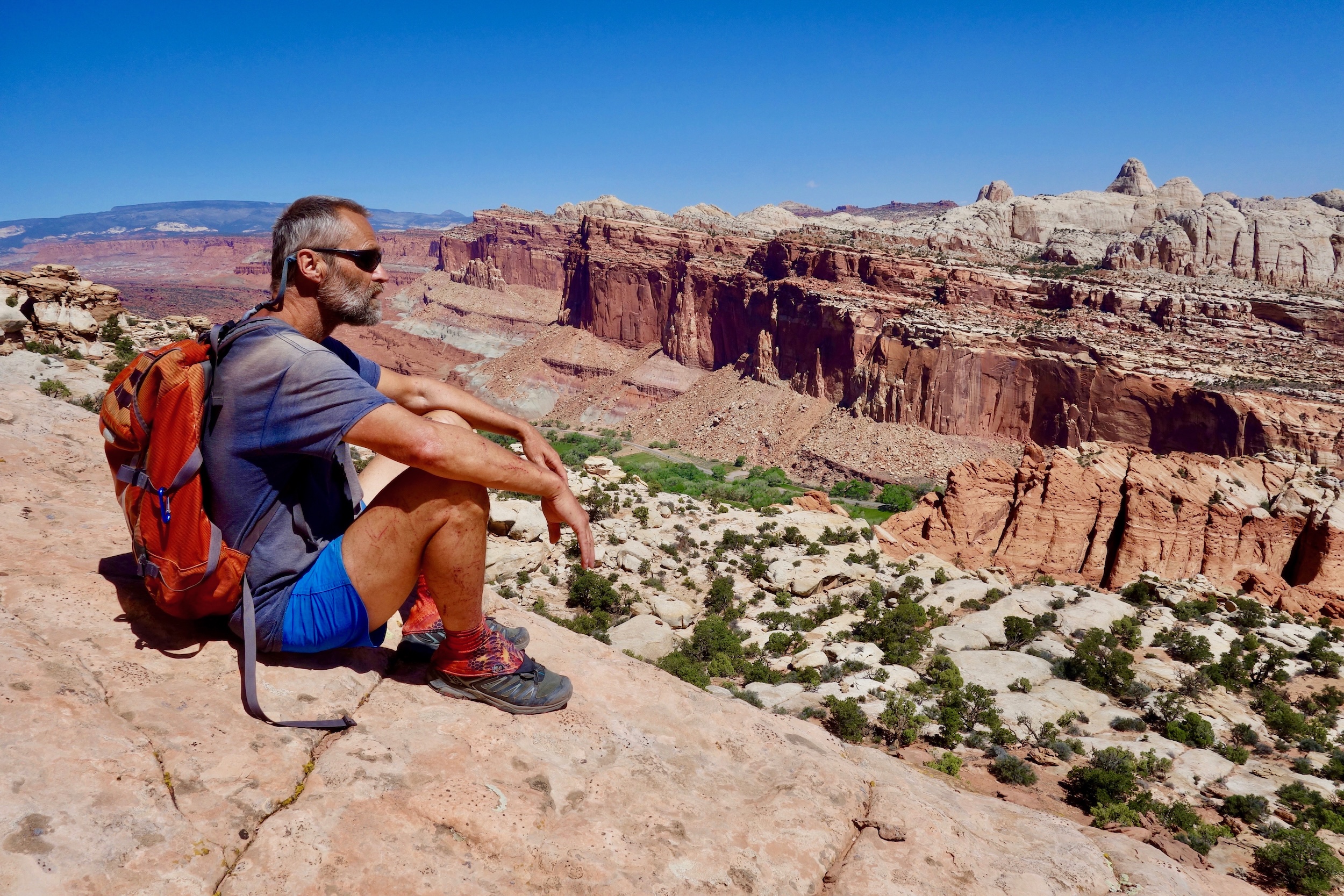
Trained as an anthropologist with a degree from the University of Alaska Fairbanks, Michael Engelhard worked for twenty-five years as a wilderness guide and outdoor instructor in Alaska and on the Colorado Plateau. Recent books include the National Outdoor Book Award-winning memoir Arctic Traverse as well as What the River Knows: Essays from the Heart of Alaska, and the Grand Canyon essay collection No Walk in the Park. His writing has also appeared in publications like Outside, Sierra, Backpacker, National Parks, Audubon, Globetrotter, and Times Literary Supplement, with more than a hundred articles in Alaska magazine. Engelhard currently lives in Moab again, finishing a book about Nome, where he also has been a resident.
How did you get started traveling?
After my military service, I spent half a year in 1982 traveling the Southwest, Mexico, and Guatemala, using trains, buses, and hitchhiking. I spent time with biologists and fishermen on an island off the Yucatan Peninsula that was only occupied seasonally; got robbed in a cantina; weathered a lightning storm in a cave by the sea; was taken in by a Hopi Indian family in Arizona; and got picked up by members of the Hells Angels (who were driving a van). On that trip, I fell for the canyon country and have been returning to it ever since.
How did you get started writing?
Years ago, I read somewhere that when they dammed the Colorado River at Glen Canyon, 120 canyons were flooded. That number—what did it mean? It seemed so abstract and bothered me like a pebble in a boot. So, I set out to explore the same number of Colorado Plateau canyons within a year. (I even quit a job to be able to do so.) During my hikes, I kept a journal. Before long, I realized that the damming of the river had been only one, perhaps the most noticeable, damage inflicted upon this place. Forms of development that include mining, condos, cattle grazing, and industrial tourism were further fragmenting wilderness. I thought this might be a story people would want to hear, and, eventually, it resulted in my first book, Where the Rain Children Sleep: A Sacred Geography of the Colorado Plateau. My background as a cultural anthropologist informed these essays with a counterpoint drawing on the practices and beliefs of the Southwest’s indigenous peoples.
What do you consider your first “break” as a writer?
I had given up on the publication of that manuscript—who wants to read about 120 different canyons? Then, one day, I walked into the local bookstore (Moab’s Back of Beyond). The manager knew me and suggested I talk to a German fellow who appeared desperate. Turns out, he was a photographer needing a text for a coffee table book about the Colorado Plateau for which he had a contract. I adapted some chapters from my manuscript for it, which encouraged me to again pursue publication of a greatly revised version of the original journal.
As a traveler and fact/story gatherer, what is your biggest challenge on the road?
I haven’t driven a car since 1982, since the army made me, but hitchhiking has become harder –it reflects a change in American society, perhaps. People may consider you a loser, not that you may not drive as a choice. While time-consuming, this travel mode always exposed me to people from other walks of life, characters whom I normally would never have encountered. Now, a little longer in the tooth, I have to arrange transportation beforehand, with some loss of spontaneity and the element of chance eliminated.
What is your biggest challenge in the research and writing process?
I am loving facts and anecdotes, especially odd or obscure ones, and my writing always has had a strong educational component (which also marked my work as a wilderness guide and outdoor instructor in youth programs). So, I have to watch for information overload and to not come across as a schoolmarm at the expense of story. I can get lost in the research, especially with the rabbit hole of the Internet, and sometimes have to wrench myself away from that to start on the meat of the writing.
What is your biggest challenge from a business standpoint?
One is being considered a “regional writer” who limits himself largely to Alaska and Colorado Plateau settings. But I firmly believe that in order to not just scratch the surface, I have to fully dedicate myself to a few select regions. Another is that a lot of print outlets for my work have dried up, gone belly-up. And the readers’ expectation of free digital content affects what publishers are willing to pay for work appearing online—often significantly less than the rate for print articles.
Have you ever done other work to make ends meet?
I take on writing work, like book reviews or more straight-out journalism assignments, that I normally wouldn’t do. I’ve also augmented my income for twenty-five years with guiding trips, though I’ve also enjoyed those for other reasons.
What travel authors or books might you recommend and/or have influenced you?
William Least Heat-Moon’s Blue Highways comes to mind right away, a descendant of Steinbeck’s Travels with Charlie. I loved Bill Bryson’s A Walk in the Woods, and his In a Sunburned Country. Blue Latitudes and Confederates in the Attic by Tony Horwitz also are favorites. In general, I like to infuse my writing with humor to sweeten some of the bitter environmental pills. (And because that’s just who I am.)
What advice and/or warnings would you give to someone who is considering going into travel writing?
The same I would give to a person who is considering going into any form or freelance writing: Don’t quit your day job. Don’t expect to get rich. Reflect on why you want to do this. The romance of the open road soon pales in the light of travel expenses and logistics, closed-off strangers, crappy food, and hard beds.
What is the biggest reward of life as a travel writer?
The sense of discovery and, when things click, the immersion in worlds other than your own. Travel really does broaden your horizon if you let it. And the mental distance of writing about it (after sifting through all the impressions) creates perspective. You realize: the way you do things is not the only way, the “natural way,” or necessarily the best way. Returned to your home environment, you will also (briefly) see the familiar anew.