
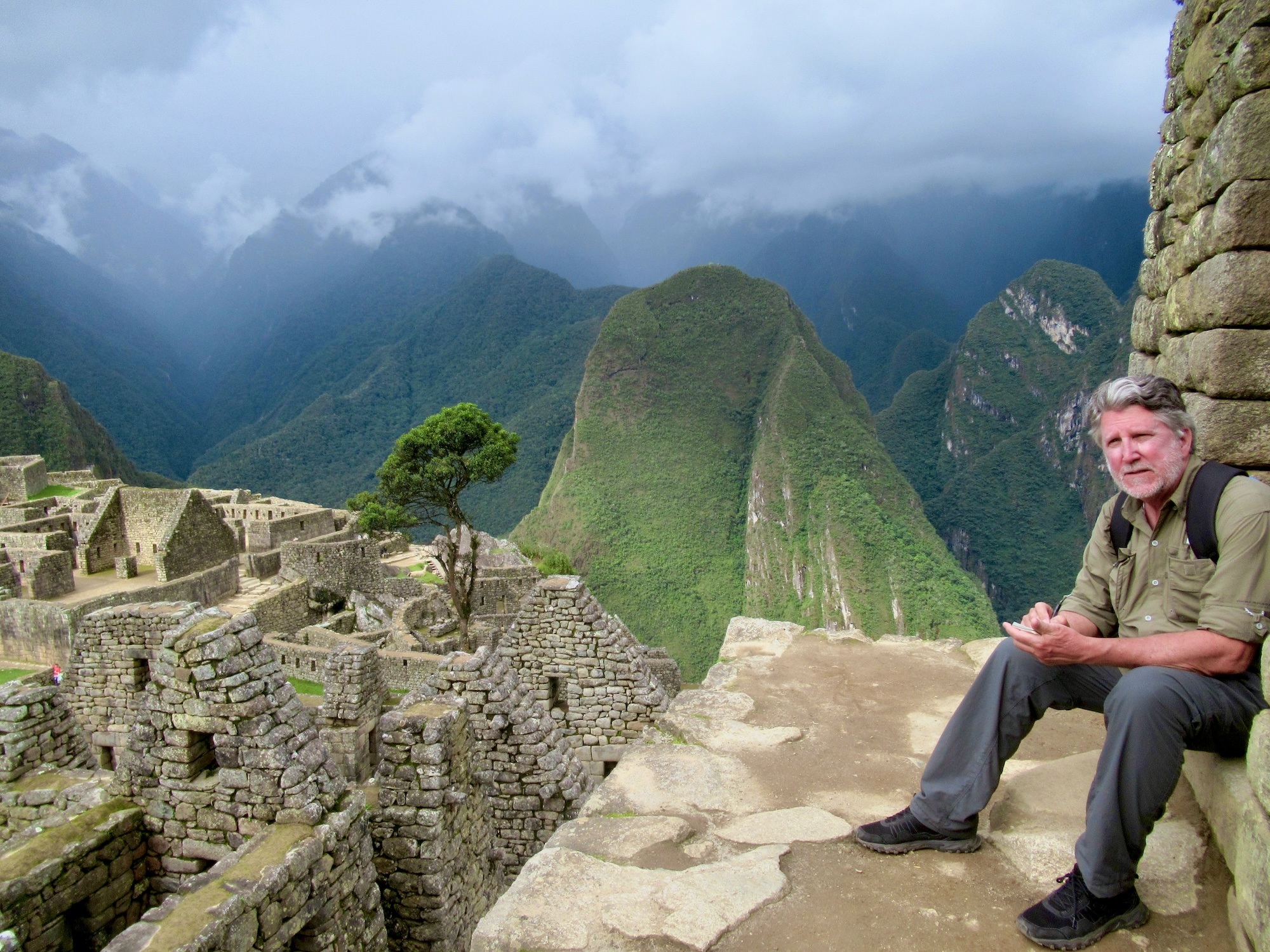
Mark Orwoll is the author of four books, including Just One Little Hitch (Pleasant Villain Press, 2024), a travel memoir. For 30 years he was on the editorial staff of Travel + Leisure magazine, most recently as the International Editor. He has won numerous accolades over the years, including the Silver Award in the 2025 Lowell Thomas competition’s Travel Journalist of the Year. Born and reared in Southern California, he now makes his home in the Lower Hudson Valley of New York. He also plays the mandolin—poorly, but with gusto.
How did you get started traveling?
When I was a kid in L.A. in the Sixties, I never went anywhere except to surf at Huntington Beach. One time my family made a day trip to Tijuana, where I bought a pair of huarache sandals (the soles were made from old tires) because the Beach Boys, my heroes, sang about them in “Surfin’ USA.” When I was 10 my parents sent me to my cousins in Grand Junction, Colorado, for the summer. Sixty years later, I’m still not sure what I did to deserve that. In high school, armed with a driver’s license, my no-account pals and I would make camping trips to the Sierras, where we could drink wine, smoke weed, drop acid, and try not to get eaten by a bear, far from the prying eyes of our parents. But apart from strolling along Avenida Revolución in T.J. that memorable afternoon as a boy, I didn’t travel outside the United States until I was 22. Quite an inauspicious start for someone who later made a living in travel journalism.
How did you get started writing?
If my mom was still alive and you met her today, the very first words out of her mouth would be, “Did you know Mark could read when he was just three?” It’s true. I love words—always have—so writing was a natural fragment of that passion. I remember that my classmate Craig Chafin at Escalona Elementary School in La Mirada, a very smart boy who later became a psychiatrist and then killed himself, was named Student Writer of the Year three years in a row. So unfair! I knew even then that I was a good writer. It should have been me! I just wasn’t as good at sucking up. (I’m still not.) My first year in college, I wrote an essay that was so charming, so descriptive, so full of interesting characters that my English professor gave me an F, certain that I had cribbed it. (This was, ahem, before Chatbot.) I wasn’t sure whether to cry or punch him, but I told him I’d write an even better essay and he’d have it in the morning. I did, he gave me an A, and I was off and running.
What do you consider your first “break” as a writer?
The San Diego Reader is the alternative weekly in America’s Finest City. Back in the Seventies, it was more radical than it is today, a muckraking paper, but in fact it was more sea level than underground. There’s a reason I’m telling you this, so hold on. I was working nearby at the mighty Chula Vista Star-News as a street reporter after graduating with a journalism degree from San Diego State. That’s where I covered my first murder trial—a young guy named Billy Lee Chad had whacked someone, which is what happens when your parents name you Billy Lee Chad—and everything about it was new to me: the majesty of the courtroom, the officious bailiff, the judge’s gavel and black robe, and the foxy court stenographer who, to this day, I swear, had eyes on me. An old man being voir dired during jury selection told a tale about his alcoholic son-in-law being mean to his daughter and how his late wife would have been broken-hearted. Then he started to cry. Interesting story, but nothing that the Star-News would ever print. So I wrote it up, with a giant dose of Dickensian melodrama, and sent it to the Reader. They loved it and asked me to do more, which is hard to do when you already have a full-time job with another paper. But I did, and the Reader kept publishing my freelance pieces. Then I got a job offer with a bigger paper, the El Cajon Californian, but the editor there said I couldn’t also freelance for the Reader. When I told that to Jim Mullin, the editor of the Reader, he hired me to work full-time for him. So I have to say that I got my big break from a murderer, a juror’s alcoholic son-in-law, and the erudite, sagacious, and perceptive editor of the San Diego Reader, Jim Mullin, because that’s where my feature-writing career really began. And if Mullin had been my elementary school principal, he surely would have nominated me for Student Writer of the Year.
As a traveler and fact/story gatherer, what is your biggest challenge on the road?
My biggest challenge on the road? How to cram two-weeks’ worth of clothing into a carry-on the size of a My Pillow. Honestly, though, my biggest challenge is getting away from whomever is sponsoring my trip and setting off on my own. I have a talented travel-writer buddy, Bruce Northam, who gets to know the locals by having his haircut wherever he goes. Me? I go to bars and hang out with the dissolute but highly talkative citizens. I say “talkative” because getting good quotes is at the heart of any story. I hate to read travel pieces that are merely full of description. Landscapes, ooh! Five-hundred-thread-count sheets, ah! Tell me instead about the widow who runs the bush-rum bar in Dominica, the man raised as an orphan in Namibia and who became a licensed safari guide, and the winemaker in Uruguay who’s also a champion arm-wrestler. By the way, I went on a walking safari with that Namibian safari guide one morning. Before we set out, he loaded several bullets the size of my baby finger into a rifle, which he then slung over his shoulder. I asked him if that was really necessary. “It’s for your safety,” he said. Then he looked me in the eye and added, pointedly, “And mine.” I’m so pleased with that quote, I can’t tell you. Get the damn quotes, travel writers!
What is your biggest challenge in the research and writing process?
Researching background information is so much easier now than when I was a cub reporter. We had to use reverse phone books, microfiche, and endless phone calls. And that was just to make sure you didn’t misspell “Bill Jones.” Today all you have to do is say, “Alexa, shouldn’t I know how to spell ‘Bill Jones’ by now?” (Answer: “I’m not quite sure how to help you with that.”) The potential trouble, of course, is verifying your easy-to-find but maybe dubious online sources. Handy information isn’t necessarily accurate information. My biggest challenges in the writing process are YouTube, email, my local brewery (yo, shout out to Soul Brewing in Pleasantville, NY), errands that my wife needs me to do, and other such quotidian distractions. But when I actually sit down and focus, I’m a monster. Trust me, you don’t even want to be in the same room with me.
What is your biggest challenge from a business standpoint?
I was on the staff of Travel + Leisure for 30 years before I took early retirement at age 62. I had a regular salary, stock options, a company-match 401K, and all the other perks of corporate indentured servitude. So when I decamped from office life, I was well set-up, financially. That’s why today I can earn freelance writing fees in the high two-figures and still afford to pay for a pizza and a bottle of wine on Friday night while at the same time keeping Con Ed off my back by recompensing that damnable institution for their hugely outrageous gas-and electric bill every month. I worry more about younger folks and how they can possibly support themselves as freelance writers. It’s a terrible scene. If you make $500 for a story, it’s remarkable. Pop the Champagne (well, cheap Prosecco…) Oh yeah, and one other thing: Why don’t editors respond to sincere, topical, and, may I say, very well-written queries? I recently sent pitches to 10 editors without getting an acknowledgement that they’d even received it (no less actually read it) before a brilliant and perspicacious editor (hey there, Tara Taghizadeh of Highbrow Magazine) finally made me an assignment on the proposal. When I was managing editor of Travel + Leisure, I made sure that one of our junior staffers had emptied the slush pile and either passed the queries along to a more senior editor or mailed the senders (mailed! Ha!) a form rejection by end of day Friday. These days, I would kill for a form rejection rather than the radio silence most of us freelancers have to deal with daily.
Have you ever done other work to make ends meet?
Fence-mending cowpoke. Coal stoker on a steamship. Flower arranger. Nope, none of those things. I lucked out and remained employed for my entire career. But many of the freelancers I dealt with in those years were obliged to do the equivalent of stoking steamship coals. Several spent months at a time writing corporate annual reports (highly remunerative!). Another guy became a tour guide. Several dabbled part-time in public relations. God bless ’em all. I just never had to do that.
What travel authors or books might you recommend and/or have influenced you?
I can’t get enough of Bill Bryson. I was friendly with Bill early in his career, and once assigned him to write about an around-the-world plane journey when buying a single ticket for such an escapade was brand new. (In Johannesburg, South Africa, on that trip, he was surrounded by a group of 12-year-olds who slashed his pants with razors, stole his wallet, and left him nearly bare-assed, still within sight of his hotel. I don’t think he ever forgave me for that assignment.) Paul Theroux is, of course, our modern-day travel-writing Herakles. I know his wife, Sheila, a little bit, but have never met him, which I vow to do one day. Of our magazine travel writers, David Farley and Tony Perrottet are two of the best but undervalued journalists going; I am amazed, delighted, and thoroughly jealous of everything they write. And then, of course, come Freya Stark, Wilfred Thesiger, Bruce Chatwin, Patrick Leigh Fermor, Jan Morris, and the rest whose busts belong in the travel Pantheon.
What advice and/or warnings would you give to someone who is considering going into travel writing?
Make your stories about people. The toothless old woman in the market in Tblisi is far more interesting than the vegetables she’s selling. The Australian taxi driver has some great stories about his granddad who fought at Gallipoli. Also, if you’re going into travel writing for fame, fortune, and the adulation of an adoring public, be a movie star instead. If you’re still insistent on the travel thing, do it because you’re passionate about everything travel offers, good and bad, including seasickness, Montezuma’s Revenge, nasty immigration officials, horrifying hotels in Third World countries, lost passports, inability to communicate in Latgalian with shopkeepers in eastern Latvia, and national dishes featuring some species of undercooked organ meat. Would you rather read a story that begins, “We had a great time lying on the beach in Aruba,” or one that starts, “You won’t believe how close I came to being stomped by an elephant in Botswana”? I always say that the best travel stories begin when things start going south.
What is the biggest reward of life as a travel writer?
People are the reason to travel. Not mountain ranges or sunsets or charming Swiss chalets. Not Michelin-starred restaurants or Egyptian-cotton hotel sheets or Phillippe Starck-inspired bathroom faucets. My favorite memories—my rewards, if you will— over more 50 years of travel include the photo-bombing waiter at Chocolatería San Ginés in Madrid, buffalo wrangler Chad Kremer in South Dakota dashing off to help a downed rider, Austrian saffron farmers George and Carina Wölfler describing climate change in their valley, Irish raconteur Malachy McCourt searching for a burrito in Albuquerque, Cambodian bomb deminer Chhun Bora fitting me up with protective gear, and, well, you get the idea. People, not places, are the reason to travel. Even the people in your own community can be a “travel” inspiration. Think about it: You can roam to your heart’s content without leaving your hometown. Although, in all honesty, Fez, Morocco, is probably a little more interesting…