
I’ve said before that one of the reasons I named my podcast Deviate (as opposed to, say, Vagabonding) was that I wanted the creative freedom to veer away from the travel issues I’ve covered as a journalist for the past 25+ years, and explore other intellectual themes. Since my interest in cinema and screenwriting is as old as my interest in travel, this means that a lot of Deviate episodes have explored the world of movies.
At times, the world of travel and cinema have intersected on Deviate, such as my “Celebrating the best travel movies ever” episode, or the “Storming Leonardo DiCaprio’s The Beach, 20 years later” episode, which explores the film-adjacent travel stunt (and Salon.com story) that pioneered my career as a travel writer in 1999. Oftentimes, however, I’ve dedicated entire podcast episodes to specific films for the simple reason that movies — and particularly movies from the 1980s and 1990s — have always captured my imagination.
Here are my six favorite movie-themed Deviate episodes as of 2025:


Why Noah Baumbach’s “Kicking & Screaming” might be the best movie ever
This episode tops my list, if only for the fact that Kicking & Screaming, Noah Baumbach’s 1995 directorial debut, is criminally under-appreciated outside a select coterie of Gen X devotees, who tend to have discovered the movie when they were roughly the same age as Baumbach’s characters. This includes sportswriter Michael Weinreb who, having watched Kicking & Screaming more than 200 times back in the VHS era, was the perfect person with which to discuss the movie.
Together, we discuss “Generation X” movie marketing, how Kicking & Screaming explores the life-transition and the loss of status that accompanies college graduation, how the movie plays with the philosophical texture of indecision and nostalgia, and how the movie explores the small problems of being young and middle-class in a time of relative peace.

Wesley Morris on why Spike Lee’s “Do the Right Thing” remains a classic
Spike Lee’s Do the Right Thing, which transfixed me as a teenager, when it first came out in 1989, remains and startlingly fresh and relevant movie — despite the fact that it attracted a kind of moral panic from social critics when it debuted. New York Times critic Wesley Morris joins me for this discussion of the film, which explores how the movie is more like a Greek tragedy than a realist depiction of life in Brooklyn, how the characters are simultaneously sympathetic and unsympathetic, and how the narrative specifics of the film presaged real-life events that would happen in America decades later.

Why 1980s coming-of-age movies matter
This discussion of classic 1980s teen movies, with Brat Pack America author (and frequent Deviate guest) Kevin Smokler, explores coming-of-age films like Stand By Me, The Breakfast Club, Ferris Bueller’s Day Off, Dazed and Confused, River’s Edge, and Breaking Away. To lend focus to our wide-ranging subject-matter, our discussion revolved around eight major categories of teen movies, and often included thought-experiments about how a given movie might have been different had it been told through the eyes of a different character — Heathers through the eyes of Martha Dumptruck rather than Veronica, for example, or Sixteen Candles from the perspective of Long Duk Dong rather than Sam, or Ferris Bueller’s Day off through the eyes of Cameron rather than Ferris.

On the subtle (and not-so-subtle) genius of Pulp Fiction, 25 years on
There is no shortage of podcasts out there dedicated to Quentin Tarantino’s cult hit, which has attracted a fanatical following from the moment it debuted in the fall of 1994. But I felt like I could cover some intriguing new ground with the help of Jason Bailey, fellow Kansan (and independent film critic for the likes of the New York Times and Rolling Stone), whose 2013 book Pulp Fiction: The Complete Story of Quentin Tarantino’s Masterpiece is an exhaustive take on the subject. Together, we discuss how unique the film felt in 1994, even as it drew on older sources; the way he film evokes philosophical notions of chance and fate; and the big-picture questions and major themes of the movie.

Why David Lynch’s The Straight Story is a travel classic
This interview with John E. Roach, who cowrote David Lynch’s 1999 film The Straight Story, was one of the least-listened to Deviate episodes of Season Two. One reason for this could well be that the G-rated film (an understated evocation of an elderly man driving a riding-lawnmower across Iowa to make peace with his brother) isn’t as baroque and surreal as a typical David Lynch movie. But, even more significantly, Roach isn’t a big-shot Hollywood screenwriter — he’s a Wisconsin-based TV producer whose earnest sense for Midwest realities comes through, both in The Straight Story, and in this podcast interview about how the based-on-a-true-story film came about.


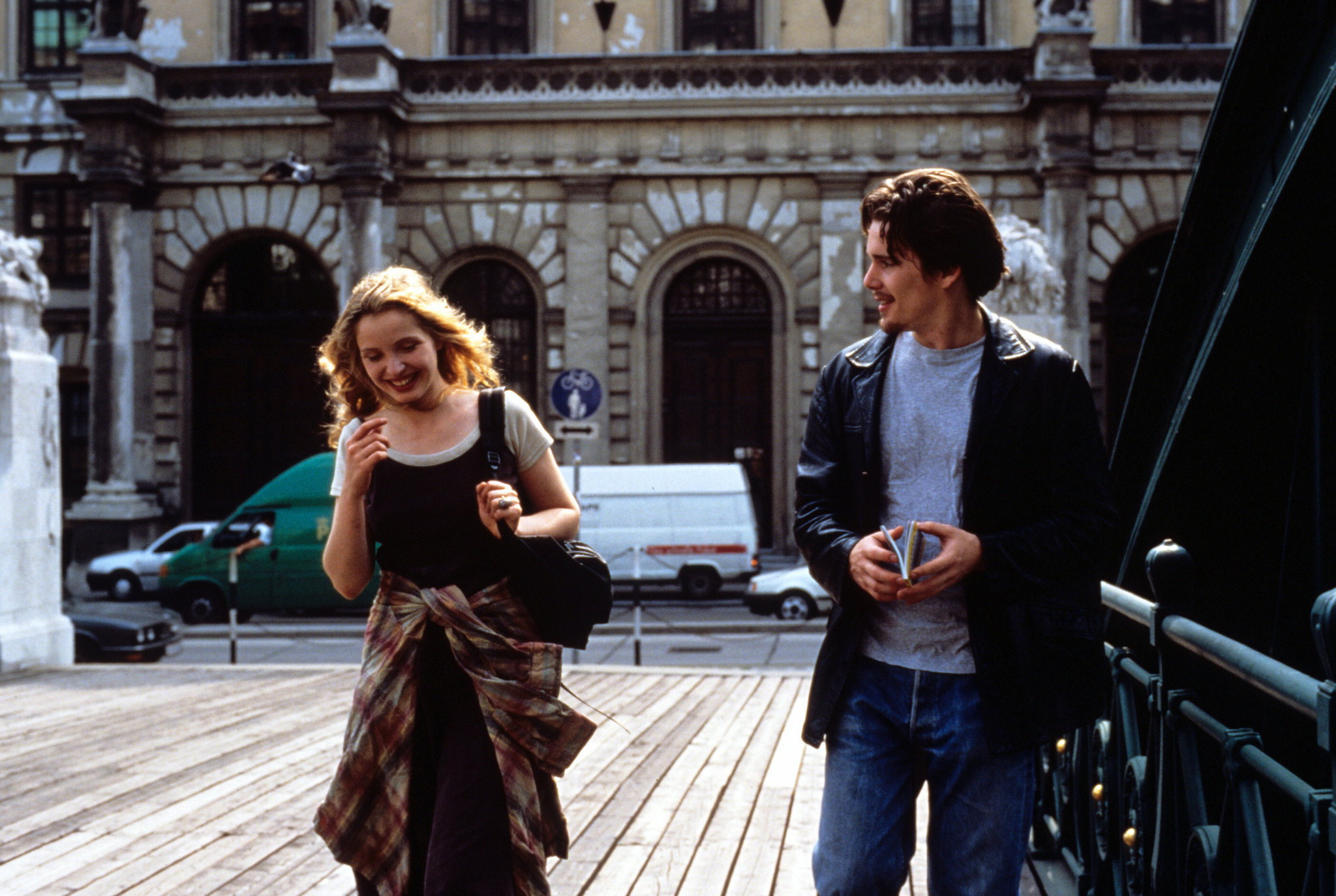
Before Sunrise: Screenwriter Kim Krizan on what led up to the classic 1995 travel-romance movie
Six years after talking about Before Sunrise on the above-mentioned episode about “the best travel movies,” I got the pleasure of talking about this movie with its co-writer, Kim Krizan. Joining me in the discussion was my wife Kiki, who’s always been a fan of Before Sunrise (and was a natural partner with whom for me to talk about romantic fate). Where before I had speculated about the circumstances under which it was written, it was fascinating to hear about the actual circumstances of its writing — and how Kim’s own youthful travels (not in Austria, but in the UK) influenced it.
One fun part of this episode came in Kiki and me looking back at our own travel romances, and how — unlike in the Before Trilogy — sometimes it’s best to leave travel romances in one’s memory, as Kiki did in Italy when she was young, and how I probably should have done so (as I ruined the experience by trying to follow up with a road romance) during my USA van trip when I was young.