
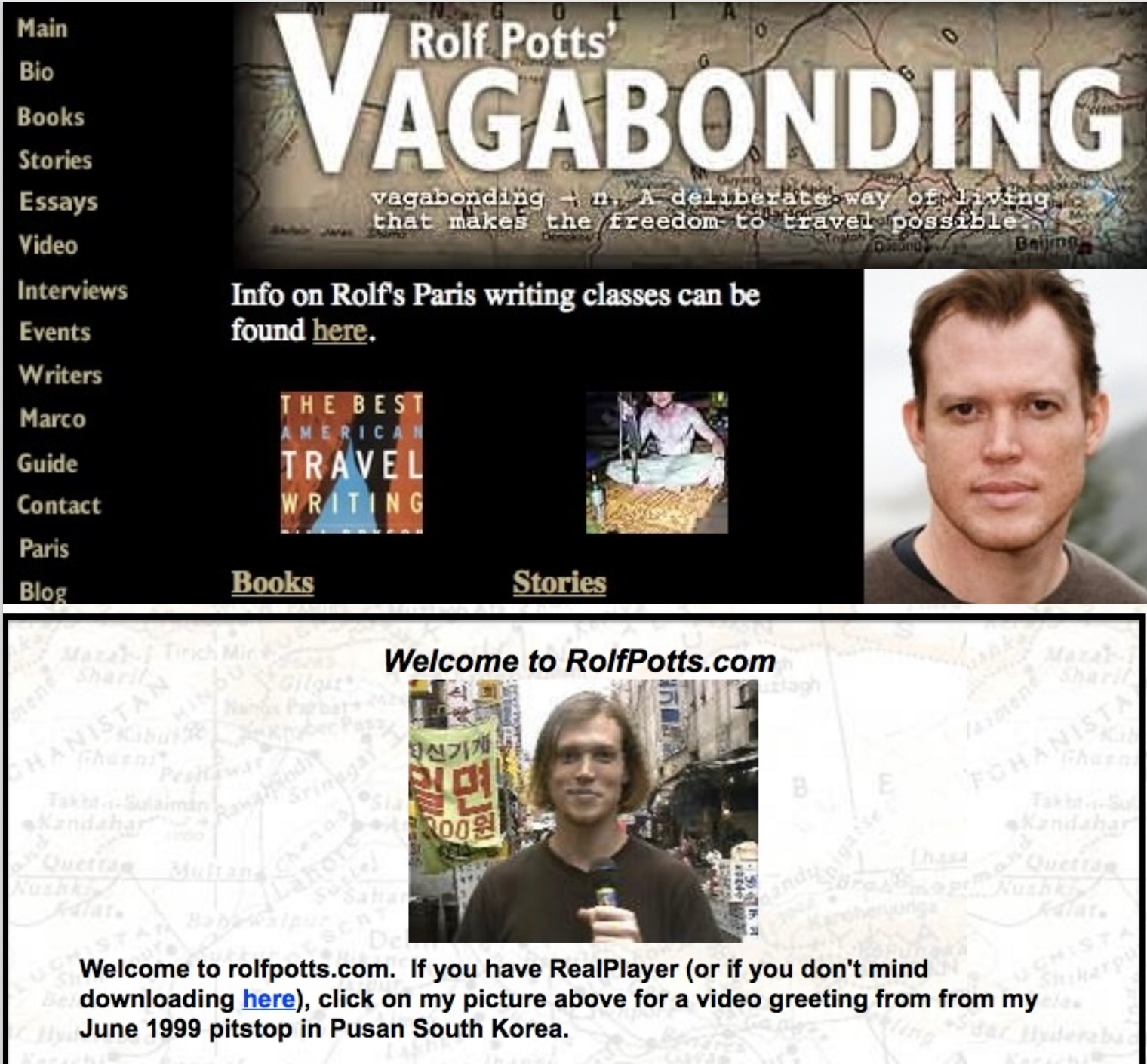
Earlier this year, around mid-October, RolfPotts.com went offline for a few days, due to a DNS glitch that happened as my webmaster was moving the site’s content to a bigger server.
It was a weirdly unsettling experience, for reasons I’ll try to explain here.
On having had a personal website for nearly three decades
RolfPotts.com has been up since 1998, which — at nearly three-decades — must make it one of the older author websites to be in continuous use since the dialup Internet era. It got a major redesign in 2000, and the seeds of my first (and bestselling) book Vagabonding took hold here shortly thereafter, as a list of philosophical travel tips.
By the time I’d redesigned RolfPotts.com again, in 2016, the world of the Internet had changed completely: Social media, which had scarcely existed in 2000, was a far more common way to get content out into the world than personal websites; blogging, which had been booming since the mid-aughts, had begun to decline in influence; in general, fewer people were getting their stories and information from places like author websites.
After the 2016 redesign, this site became a personal and professional archive as much as it did a place to post new content. Here, I aggregated interviews and travel writer profiles going back to the late 1990s; I posted YouTube videos of my own lectures and TV appearances and field dispatches; I archived discontinued or completed projects like Vagablogging and the No Baggage Challenge; and I showcased my various books and creative writing classes.
I also began, around this time, to post esoteric essays covering topics like music, movies, and sports — but I soon found that my podcast (which debuted one year later, in 2017) was a better outlet for that kind of content.
Going offline as a kind of digital memento mori
Hence, when RolfPotts.com went offline for a couple of days in the fall of 2025, it didn’t really compromise how people related to me online. A few people reached out to say they couldn’t access the site, and email queries about my Paris classes began to bounce. But, for the most part, nothing really happened, and about one week later my website was back to normal.
Hence, losing my website for a few days was less a practical problem than an existential source of disquiet — something of a memento mori acknowledgement of the limits of one’s ability curate the contents of one’s own life.
A couple of months earlier, my mother, Alice Potts, had passed away after a long struggle with dementia. I’d commemorated her memory here, first as a eulogy, and later as an oral history and video retrospective — but my sudden inability to access those tributes made me feel like I’d lost whatever part of her I was trying to hang onto by memorializing her with digital tools.
This incident also made me realize the fragility of archiving my own life here. Someday I will be gone, and whatever digital traces I leave online will surely disappear not long after.
Utility and futility: On the merits of keeping a website going
It just now occurs to me that I’m a little more than twice as old now as I was when I started RolfPotts.com in 1998 — which means that I’ve officially lived more years of my life with a personal website than I have without one.
The common argument for keeping a personal website going these days, even as website content garners less visibility than it used to, is that it doesn’t leave you beholden to algorithms — that aggregating your own content gives you a measure of independence from the whims of platforms (like social media) that you ultimately have no control over.
This is fair, but, for me, maintaining a website maintains a ritual purpose as well as a practical one. It enables me to pay closer attention to what interests me, to track how my vocational life continues to take form, and to archive different ways of my having given attention to life, and to the world.
Posting and curating content here is, in other words, its own reward, regardless of audience metrics and digital legacies.
Hope to see you here in another 28 years!