
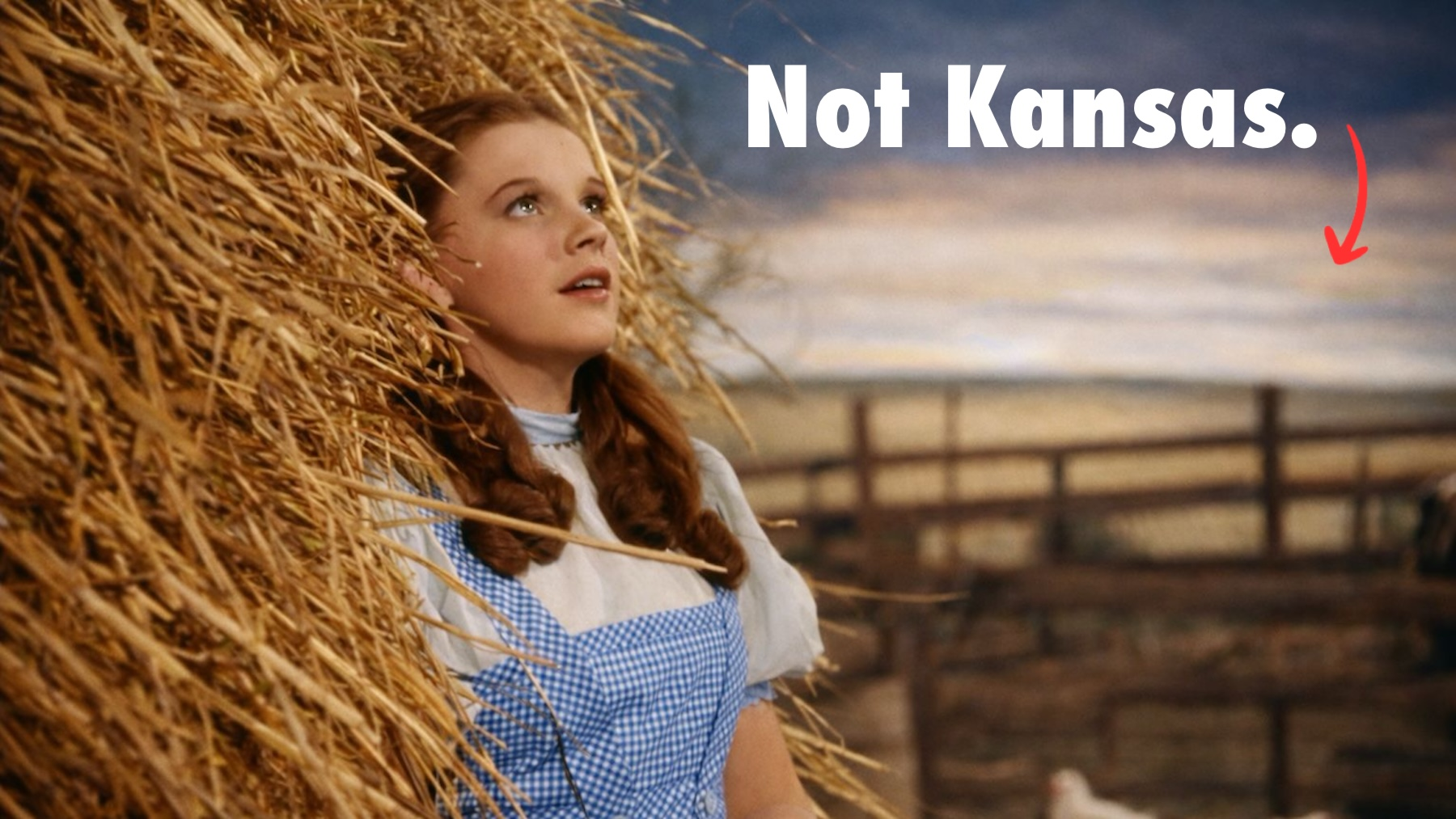
DOROTHY AND TOTO ARRIVE IN THE LAND OF OZ from The Wizard of Oz (1939)
Rolf Potts (narration): The most iconic moment in the Wizard of Oz is tied up in one of the biggest lies that movies tell us.
Judy Garland: “Toto, I’ve a feeling we’re not in Kansas anymore.”
Rolf Potts (narration): I come from Kansas and while it’s nice to know that Dorothy loves her home as much as I do…
—
DOROTHY IN BED IN “KANSAS” from The Wizard of Oz (1939)
Judy Garland: “There’s no place like home. There’s no place like home…”
Rolf Potts narration: …It’s no particular secret that Judy Garland was never really in Kansas to begin with. Kansas is a place that doesn’t appear much in the movies to begin with and when it is depicted some other place usually stands in for it.
—
MONTAGE OF SCENES FROM Showdown at Abilene (1956) | set in Abilene, Kansas | filmed in Agoura Hills, California; Gunsmoke (1955-1975) | set in Dodge City, Kansas | filmed in Thousand Oaks, California; Dances with Wolves (1990)| set in Fort Hays, Kansas | filmed in Rapid City, South Dakota.
Rolf Potts narration: How loyal should we be to a place when we dramatize it on screen? What is lost when one place stands in for another? It has now become unacceptable to say dress up white people in feathers and war paint and pass them off as Native Americans. So what does it mean when a place gets passed off as another place that may well exist on the other side of the world?
—
MONTAGE OF SCENES FROM Kansas (1995) | set in “Burt County,” Kansas | filmed in Australia; Capote (2005) | set in Finney County, Kansas | filmed in Manitoba, Canada; The English (2022) | set in the Kansas High Plains | filmed in Ávila Province, Spain.
Rolf Potts narration: It’s been said that in storytelling setting begets character and character begets plot. So what goes missing from the stories we tell about the world when one place stands in for another? My home state makes a good pretext to explore this question since, while there are occasional exceptions, Kansas rarely if ever plays itself.
—
MAIN TITLE: Kansas Never Plays Itself
SUBTITLE: Part One: “No Place Like Home”
—
KRISTEN BUSH TESTIFIES IN THE KANSAS STATEHOUSE, 2023
Rolf Potts narration: Our journey begins here in a Kansas State House of Representatives sub-committee considering tax incentives for filmmakers shooting in the state.
Kristen Bush: “Thank you Mr. Chairman, members of committee. My name is Kristen Bush.”
—
MONTAGE OF KRISTEN BUSH TV AND MOVIE ROLES in Law & Order: SVU (2006); Suits (2011): The Affair (2014); Slumber (2017); Elementary (2019)
Rolf Potts narration: Kristen Bush, who is testifying here, isn’t famous, but you may have seen her before. On shows like Law and Order SVU or The Good Wife or Suits or NCIS. These shows are set in places like New York and Chicago and D.C. Urban places that frequently figure in the stories America tells about itself. In 2023, Kristen Bush resolved to shoot her own film in Kansas, in part because she rarely saw her home state depicted on screen.
—
KRISTEN BUSH TESTIFIES IN THE KANSAS STATEHOUSE, 2023
Kristen Bush: “When I’m asked where I’m from, people invariably make a Dorothy joke — that happened just last week — and while I wholeheartedly agree that ‘there’s no place like home,’ I’m frustrated that the only cinematic reference that people have for our state is an 84-year-old movie that was shot on a soundstage in Southern California.”
—
MONTAGE OF MOVIES SHOT IN VANCOUVER from Vancouver Never Plays Itself (2015)
Rolf Potts narration: Of course, filmmakers who are given tax incentives to shoot in a given place don’t necessarily deepen the way that place is depicted on screen. As Canadian editor Tony Zhou pointed out in this video essay about his own hometown.
Tony Zhou narration (from Vancouver Never Plays Itself): “This is Vancouver, where I grew up. If you watch enough TV shows or blockbusters, then chances are you’ve seen my city. Disguised as Barbara, or Seattle, and even one time as the Bronx. …To Hollywood, Vancouver is a location, but not a setting. It’s a place with talent and scenery and tax incentives, but almost no film identity of its own. Just other identities it can borrow.”
Rolf Potts narration: Zhou makes a good point here about the way places end up being depicted or not depicted in movies. And it could be said that I’m stealing the format for my video essay from him, but I’m not.
—
MONTAGE OF MOVIES SHOT IN LOS ANGELES from Los Angeles Plays Itself (2003)
Rolf Potts narration: We’re actually both stealing the format from a film that appeared 12 years before Zhou’s.
Thom Anderson narration (from Los Angeles Plays Itself): “This is the city. Los Angeles, California. They make movies here. I live here. Sometimes I think that gives me the right to criticize the way movies depict my city. I know it’s not easy. The city’s big. The image is small.”
Rolf Potts narration: This now iconic video essay was written and produced by a film critic named Thom Anderson, who grew up in Los Angeles and bristles at the way that Hollywood movies have saddled his city with certain cinematic clichés.
Thom Anderson narration (from Los Angeles Plays Itself): “One of the glories of Los Angeles is its modernist residential architecture. But Hollywood movies have almost systematically denigrated this heritage by casting many of these houses as the residences of movie villains.”
Rolf Potts narration: Los Angeles Plays Itself as a three-hour masterclass in the nuances of architecture and urban design. These are clearly the fixations of the man who created it, but at no point do we learn much about who Thom Anderson is. This feels like a weakness in what is otherwise a brilliant video essay. Even his essay’s narration was voiced by another man.
—
VHS FOOTAGE OF ROLF POTTS IN VARIOUS KANSAS LOCATIONS IN 1996
Rolf Potts narration: I tend to be suspicious of any essay that obscures the person who’s writing it, especially an essay that uses a personal connection to geography to argue for the importance of place and storytelling. So let me tell you a little bit about myself. This is me, or at least it was me, in 1996, just before I moved from Kansas to South Korea to teach English.
—
VHS FOOTAGE OF ROLF POTTS WITH HIS FARMER GRANDFATHER IN COFFEY COUNTY KANSAS, IN 1996
Rolf Potts narration: Since it felt like movies hadn’t properly shown the state where I grew up, I decided to make my own video to show my students what it looked like.
Rolf Potts in 1996 home video: “This is my grandfather, he’s going to be 79, probably by the time you say this, but he’s still running all over the place and getting into all kinds of trouble.”
Rolf’s grandfather in 1996 home video: “Yeah, you ain’t a kidding. Oh, he’s taking pictures right now?”
Rolf Potts in 1996 home video: “Oh yeah, he’s videotaping it.”
Rolf’s grandfather in 1996 home video: “Oh, shit. He’s crazier than I thought he was.”
Rolf Potts in 1996 home video: “So the grandfather here was born in Mexico and he’s been living in Kansas ever since he was 11 years old. He’s a farmer and he’s grown just a little bit of everything. Why don’t you say something to the kids in Korea?”
Rolf’s grandfather in 1996 home video: “I wouldn’t know what to say. I can’t talk Korean.”
Rolf Potts narration: I guess we all do this now. We make videos to show other people what it’s like in the place where we live. But this is a very recent thing.
—
VHS FOOTAGE OF ROLF POTTS GESTURING AT THE DOWNTOWN WICHITA SKYLINE IN 1996
Rolf Potts narration: At the time I made this VHS tape for my Korean students I lived in Wichita, a mid-sized industrial city of about 300,000 people. I shot this video because so far as I knew at the time my hometown had never been
certified” by a movie.
Rolf Potts in 1996 home video: “This is a good typical Midwestern American industrial town.”
—
NIGHTTIME STREET SCENE from Panic in the Streets (1950)
Rolf Potts narration: To clarify what I mean when I say certify, in Walker Percy’s 1961 novel The Moviegoer there’s a scene where the main character watches a movie called Panic in the Streets, which was set in New Orleans where he lives. Seeing his own city on the big screen fills him with a strange sense of excitement. As he quote certifies that he lives in a place that is somewhere, as opposed to anywhere, or even worse, nowhere.
—
MONTAGE OF COWBOY SCENES from Wichita (1955) | filmed in Santa Clarita, California
Rolf Potts narration: I’ve since come to learn that by 1996 Wichita had been certified by a handful of cowboy movies, none of which I’d seen, and none of which were filmed in Wichita.
—
MONTAGE OF TV AND MOVIE CLIPS from Stark: Mirror Image (1986); Seinfeld (1992); Planes, Trains and Automobiles (1987)
Rolf Potts narration: Which meant that for the most part my childhood hometown existed in movies not as a setting, but as a passing reference evoking an obscure and distant place.
–
Nicolas Surovy: Here you go.
Kirstie Alley: Wichita, Kansas? You’re a little out of your jurisdiction, don’t you think, Toto?
–
Jerry Seinfeld: Hey, do you ever pretend there’s like murderers chasing you and you try and see how fast you can get your keys out and get in your apartment?
Nina Tremblay: I’m from Wichita, so…
–
Dylan Baker: I’m to drive you to Wichita to catch a train?
John Candy: Yeah, we’d appreciate it.
Dylan Baker: Train don’t run out of Wichita. Unless’n you’re a hog or a cattle.
–
Rolf Potts narration: Even when these movies do make it to Wichita, my hometown is depicted as a place that exists in contrast to some more important waypoint.
Steve Martin: I’m in Wichita.
Susan Page: Wichita, Kansas? Are you all right? What happened?
Steve Martin: We couldn’t land in Chicago.
—
MONTAGE OF “WICHITA” SCENES from The Ice Harvest (2005)
Rolf Potts narration: And when Wichita is the main setting for a movie, it can be astonishing how little interest the filmmakers have for the actual city.
Connie Nielsen: Does this mean you’re rich, Charlie? Because if you are, we could run away together.
John Cusack: It is a thought.
Connie Nielsen: Leaving Wichita? Damn right, it’s a thought.
—
DIRECTOR HAROLD RAMIS COMMENTARY from The Ice Harvest DVD (2006)
Harold Ramis: Most people don’t know Wichita and Wichita Falls are two different places. Wichita is in Kansas and Wichita Falls is in Texas. I realized, no one knows what Wichita looks like. I couldn’t even find any pictures of Wichita, you know? And I realized, I think Wichita looks like the Chicago suburbs.
—
VIDEO DISPATCH OF VARIOUS OUTTAKES FROM THE WORLD TRAVELS AND KANSAS LIFE OF ROLF POTTS from the No Baggage Challenge web series (2010)
Rolf Potts narration: The way places are depicted in the media doesn’t just concern me in relation to the place where I grew up. Depicting places has, in a way, become my career.
Rolf Potts to camera in 2010: Over the past decade, I’ve been fortunate enough to have some pretty amazing adventures in different parts of the world, including seven years of living and traveling in Asia. I drove a Land Rover across the Americas for three months. I’ve been to Africa for the New York Times Magazine. I’ve been to Australia for Slate. I’ve been to the Falkland Islands for National Geographic Traveler. I’ve appeared as an expert on the Travel Channel and talked about independent travel in places like the Do Lectures in Wales and Authors@Google in New York. But all of those far-flung travels had one thing in common. I brought luggage. And the more I traveled, the more I thought —
ON VIDEO, ROLF’S DOG JUMPS OUT THE WINDOW OF THE PICKUP TRUCK
Rolf Potts to camera in 2010: Dumbass! What kind of dog jumps out the window?
Rolf Potts narration: By the time I made this video, I’d recently moved back to Kansas. Not to my childhood hometown, but to a rural area, 90 miles north of Wichita, where I still base myself when I’m not traveling.
—
FOOTAGE OF ROLF POTTS ON A HORSE NEAR THE GIZA PYRAMIDS IN EGYPT from the No Baggage Challenge web series (2010)
Rolf Potts narration: Travel writing is a complicated and, at times, ethically dubious profession for a number of reasons, including the fact that travel media exists in a weird relationship with the travel industry and the travel industry markets places based on expectations that have, as we noted earlier, been created by popular depictions of those places in other mediums, most notably the movies.
—
MOVIE-TRAILER TAHITI FOOTAGE FROM from Mutiny on the Bounty (1962)
Mutiny on the Bounty trailer voiceover: “Tahiti, for generations the dream island of the western world. A land of easygoing, fun-loving people. A land that has always represented escape from civilization. A land where there is no time. No tomorrow. Only today.”
—
MOVIE SCENE SHOT IN MAYA BAY, THAILAND from The Beach (2000)
Rolf Potts narration: Just as a Marlon Brando movie created a thriving tourist market for Matavai Bay, Tahiti, a Leonardo DiCaprio movie attracted so many visitors to Maya Bay, Thailand. Its beaches had to be closed to outsiders for four years so that its ecosystem could recover from over tourism. An irony here is that in 1999, the producers of The Beach imported 100 coconut palms from the Thai mainland to plant in the sands of Maya Bay in the hopes of creating a more cinematic vision of what a beach in Thailand should look like.
—
MOVIE SCENE SHOT IN MATAVAI BAY, TAHITI from Mutiny on the Bounty (1962)
Rolf Potts narration: Just as in 1961, Mutiny on the Bounty producers imported tons of white sand from New Jersey to make Tahiti live up to certain fantasies of what a South Pacific beach was supposed to look like.
—
SOUNDSTAGE-FILMED “SCOTLAND” SCENES from Brigadoon (1954)
Rolf Potts narration: This was nothing new. After scouting movie locations in Scotland, producer Arthur Freed quipped, quote, I went to Scotland but I could find nothing that looked like Scotland, end quote. So it was that Brigadoon was shot on an MGM sound stage in Culver City, California.
—
YOUTUBE TOURIST FOOTAGE FROM PETRA IN JORDAN, ALONG WITH MOVIE SCENES from Indiana Jones and the Last Crusade (1989)
Rolf Potts narration: But the way movies project fantasies under real places can go far beyond cosmetic alterations to real world locations. When tourists these days travel to the magnificent rock city of Petra in Jordan, they are less likely to imagine the ancient Nabataeans who built it. And they are to imagine Indiana Jones and his father on a quest to find the Holy Grail.
—
YOUTUBE TOURIST FOOTAGE FROM TATAOUINE, TUNISIA, ALONG WITH MOVIE SCENES from Star Wars: A New Hope (1977)
Rolf Potts narration: To visit the North African town of Tataouine is in one sense to experience a part of Tunisia. But it also evokes a more famous Tatooine, this one a desert planet that existed a long time ago when a galaxy far far away.
—
YOUTUBE TOURIST FOOTAGE FROM DUBROVNIK, CROATIA, ALONG WITH TV SCENES from Game of Thrones (2012)
YouTuber David Cao: “So for a Game of Thrones fan this place is actually super iconic and crazy. “
Rolf Potts narration: In truth, movies are never fully loyal to places. As is the case with Dubrovnik finding renown as the shooting location of the fictional city of King’s Landing, entire wings of the global tourist trade hinge on exploring landscapes that belong more to the cinematic imaginary than they do to the real world.
—
YOUTUBE TOURIST FOOTAGE FROM “DOROTHY’S HOUSE” IN LIBERAL, KANSAS, AND THE “OZ MUSEUM” IN WAMEGO, KANSAS
Rolf Potts narration: Even Kansas, my humble home state, has not one but two places where tourists can celebrate The Wizard of Oz. One of them, Dorothy’s House in the town of Liberal, offers daily tours by local teenagers dressed as the film’s protagonist. While on the opposite side of the state, five hours away by car, the Oz Museum in Wamego displays memorabilia commemorating the movie. Both Wizard of Oz sites are among the most popular tourist attractions in Kansas, which creates a kind of circular causality, where in the movie creates a fantasy that the place itself winds up replicating so it can attract tourists. In this way, many landscapes in the world exist as backdrops that certify our fantasies, rather than places where people’s real lives play out.
—
KRISTEN BUSH TESTIFIES IN THE KANSAS STATEHOUSE, 2023
Rolf Potts narration: And that brings us back to Kristen Bush’s testimony in front of the Kansas state legislature in 2023.
Kristen Bush: Instead of hoping productions will come to Kansas, I’ve decided to create my own. So this June, I will self-fund, executive produce and star in The Game Camera, a short film set in Kansas. Were we to shoot this in Oklahoma we could save an estimated 12 grand against our $60,000 budget thanks to that state’s film incentives. The thing is, I don’t want to shoot in Oklahoma and pretend it’s Kansas. I want to shoot in my home state, so I will.
—
MONTAGE OF ROLF POTTS / KIKI BUSH WEDDING PHOTOS, AND TRAILER from The Game Camera (2025)
Kristen Bush: I had that dream again. The one where he’s alive.
Rolf Potts narration: Now since I previously asserted that no essay should obscure the person who’s writing it, I have one more personal detail to share. Kristen Bush, the actress? She’s my wife. I call her by her nickname, “Kiki.” I met her in Kansas where we both grew up. We got married in Kansas, and we livd together in Kansas. I helped her write the script for The Game Camera. Most of the exteriors were shot on our land in north-central Kansas, and while the word “Kansas” has never mentioned in our short film about a woman dealing with the death of her husband, the Kansas landscape can’t be separated from the story we were trying to tell. This is because, when it comes to storytelling, the places where we choose to set our story should play a dynamic role in what those stories say.
—
TITLE: Part Two: “Why Place Matters”
—
MONTAGE OF NEW YORK SCENES from the Wiz (1978)
Theresa Merritt: “Do you know you’re 24 years old and you’ve never been south of 125th Street?”
Rolf Potts narration: In The Wiz, Motown’s 1978 re-imagining of The Wizard of Oz, Judy Garland’s Kansas farm girl has been replaced by Diana Ross’s Harlem schoolteacher, its rural tornado replaced by an urban snowstorm.
Michael Jackson: Come on, Dorothy! Come on! Woo! Woo!
Rolf Potts narration: The Yellow Brick Road leads to a landscape that looks a lot like downtown Manhattan, and The Scarecrow is played by Michael Jackson. In her book, Imagining the Heartland, anthropologist Britt Halvorson pauses that this change of setting certified that Motown’s rendering of the Oz story was quote, “geographically part of black culture and experience” in contrast to quote, “a white Midwest meant to stand in as a generic backdrop of American existence.” The implication here is that by 1978, the Black American experience was inseparable from the urban experience, and setting The Wiz in a place like Kansas might have made African-American audiences feel like it wasn’t really about them. But if the Kansas in The Wizard of Oz has come to represent a generic and saccharine narrative Whiteness, then I’d reckon it has a pretty thin relationship to the Kansas that exists in real life.
—
DOROTHY SINGS ON THE FARM IN “KANSAS” from The Wizard of Oz (1939)
Judy Garland: “It’s not a place you can get to by a boat or a train. It’s far, far away. Behind the moon, beyond the rain. Somewhere over the way more, way up far.”
Rolf Potts narration: The 1939 MGM movie that most people associate with The Wizard of Oz was based on a children’s novel written by Frank Baum in the year 1900. Baum, who was born in New York and died in California, wrote The Wizard of Oz in Chicago and based its Kansas scenes on his experience of South Dakota a few years earlier. So far as I can tell, Baum had no direct experience of Kansas, nor did anyone involved in the MGM movie that made his story world famous. The Kansas of The Wizard of Oz doesn’t really correspond to a geographical or cultural place. Kansas is as fanciful and fantastical is the Land of Oz itself. Not a setting, so much as a backdrop for the opening act of a story that takes place elsewhere.
—
DOROTHY BEGINS HER JOURNEY ON THE YELLOW-BRICK ROAD from The Wizard of Oz (1939)
Rolf Potts narration: Dorothy’s story may have originated in a children’s book published at the turn of the 20th century, but it mirrors a much more ancient narrative template, one that comparative mythologist Joseph Campbell dubbed the Hero’s Journey: A tale which follows its protagonist from a familiar world to an unfamiliar one, where the Hero confronts challenges, finds helpers, overcomes tribulations, and returns home transformed. This mythic resonance could well be why the movie has been so beloved for so long. Regardless of where you’re from, there’s something resonant in the idea of making peace with the world you were born into by escaping that world in all of its limitations and frustrations, pushing your boundaries in a scary and spectacular new place, and getting a new appreciation for what home is in the process.
—
YOUTUBE FOOTAGE OF DOROTHY IN “KANSAS” from the Dark Side of the Rainbow mashup (c. 1995)
Rolf Potts narration: The Wizard of Oz has in fact resonated so deeply for so long that it’s woven itself into the very texture of American culture. When the internet was brand new in the 1990s, one of the earliest obsessions of online pop culture message boards was the eerie synchronicity that resulted when you paired The Wizard of Oz with Pink Floyd’s Dark Side of the Moon album.
—
MONTAGE OF OLD-SCHOOL VIDEO GAME AND VINTAGE COLOR CARTOON FOOTAGE from The Wizard of Oz (1933)
Rolf Potts narration: The Wizard of Oz has been part of video game culture ever since video games look like this. A technological moment that echoed the kinds of children’s stories being told during the advent of full-color animated films half a century earlier.
—
MONTAGE OF THE WIZARD OF OZ PERFORMED AS A MUSICAL IN 1902 AND 2011
Rolf Potts narration: Frank Baum wrote thirteen sequels to The Wizard of Oz, and its first adaptation wasn’t a movie, but a musical that toured the country in the nineteen aughts and has been reimagined many times in the ensuing century, including, most recently, a West End stage adaptation co-written by Andrew Lloyd Webber.
—
OUTTAKES OF “KANSAS” SCENES from The Wizard of Oz (1925) and The Wonderful Wizard of Oz (1910)
Rolf Potts narration: The 1939 Judy Garland movie that everyone associates with The Wizard of Oz wasn’t the first time Baum’s book was adapted for the silver screen. And in fact the first movie adaptation of The Wizard of Oz came out a good twelve years before Judy Garland was born.
—
MONTAGE OF SCENES from Oz the Great and Powerful (2013) and Wicked (2024)
Rolf Potts narration: So iconic is its narrative that entire movies have been made about the origin stories of its characters from the Wizard of Oz himself, to a kind and brave young person who went by the name Elphaba Thropp before she became known as The Wicked Witch of the West.
—
VISUAL GRID SHOWING DOROTHY AS AN “ARCHETYPE”
Rolf Potts narration: But I’m not exploring The Wizard of Oz here, I’m exploring the way places are depicted onscreen through the lens of my own home state. In a sense the Kansas we see in The Wizard of Oz isn’t a place so much as an archetype. It’s a symbolic stand-in for home: A stable but confining rural place, where an orphan living with an adoptive family dreams of broader horizons, which are eventually found in a distant and dangerous and dazzling antipode to home — a fantastical metropolis which is where the real story takes place.
—
VISUAL GRID SHOWING SUPERMAN AS AN “ARCHETYPE”
Rolf Potts narration: This Kansas trope belongs to The Wizard of Oz but it eventually came to be part of another fantasy franchise that took hold in the American imagination in the late 1930s. A universe where a different orphan lived in Kansas with a different adoptive family before leaving for a different metropolis where the main action of the story takes place.
—
“KANSAS” OUTTAKES FROM SUPERMAN SCENES in Smallville (2001), Superman IV: The Quest For Peace (1987), and Man of Steel (2013)
Rolf Potts narration: As with Dorothy in The Wizard of Oz, Superman lives in parallel worlds. And, just as Dorothy’s Kansas exists in contrast to the land of Oz, Superman’s Kansas is as apocryphal as Krypton and Metropolis. The motifs of both franchises have an uncanny similarity in depicting Kansas less as a place than a symbol of generic American virtue.
Harry Lennix: “What do we know you won’t one day act against America’s interests?”
Henry Cavill: “I grew up in Kansas, General. I’m about as American as it gets. Look, I’m here to help.”
Rolf Potts narration: This takes us back to an important question about the role places play in movies, which is whether or not being quote “as American as it gets” corresponds to an unrealistically wholesome vision of rural Midwestern Whiteness.
—
MONTAGE OF “MIDWEST” SCENES from The Music Man (1962) and Meet Me in St. Louis (1944)
Rolf Potts narration: It’s worth noting here that a saccharine White vision of the American Heartland wasn’t restricted to Kansas when it came to 20th century cinema. Even when you narrow this era of American cinema down to the movies that Judy Garland herself made in the wake of The Wizard of Oz.
—
FOOTAGE OF HATTIE MCDANIEL ACCEPTING HER OSCAR AWARD IN 1940
Rolf Potts narration: Yet the same year that The Wizard of Oz was nominated for an Academy Award as Best Picture of 1939, that same ceremony saw Hattie McDaniel of South Los Angeles take the best supporting actress Oscar for a role in Gone with the Wind, a first for African-American actors, who were rarely given substantial roles in mainstream cinema.
—
MONTAGE OF 1930s MOVIE OUTTAKES from Gone With the Wind (1939), Swing (1938), Birthright (1939), and Lying Lips (1939)
Rolf Potts narration: And while the America of Gone with the Wind could be as blindingly White as Hollywood’s other fare at the time, a vibrant counter-narrative was being curated by independent black filmmakers, most notably Oscar Micheaux, whose characters live vibrant and prosperous and sometimes troubled lives in cities like New York and Chicago.
Charles La Torre: “If Miss Bellwood didn’t want to go on these private parties, you know what that means. I wouldn’t make her go.”
Robert Earl Jones: “Say, if I had my way, I’d clean up every cabaret in this town. I stay so annoyed when I have to look up on other girls forced to put up with all they have to that it just makes my blood boil.”
—
RICHARD ROUNDTREE WALKS THE STREETS OF NYC in Shaft (1971)
Rolf Potts narration: One generation after Oscar Micheaux pioneered black films for black audiences, MGM, the company that had produced The Wizard of Oz, distributed a movie made by a black director and starring a black protagonist that harnessed the Black Power movement to create a new kind of action narrative. One that solidified the notion that cities like New York were, to return to a phrase we alluded to earlier, quote, “geographically part of black experience.” To this day, the word urban is used as a synonym for African American culture.
—
RURAL KANSAS SCENE from The Learning Tree (1969)
Rolf Potts narration: But Shaft wasn’t director Gordon Parks’ first movie. Two years earlier, he had made The Learning Tree, a coming-of-age film based on a semi-autobiographical novel of the same name, about growing up in rural Kansas. The Learning Tree is about a lot of things, including the fact that, in America, the rule of law doesn’t always apply equally to everyone.
Kyle Johnson: “What if Papa mean by there would be “trouble” if a Negro had killed Mr. Kiner?”
Felix Nelson: “It meant just what he said. It could be real trouble like they had a wind box full of cuffs of years back. Pretty see a shot of white man who did his sister.”
Kyle Johnson: “What happened?”
Felix Nelson: “Well, white’s lynched pretty and burned down half the Negro homes.”
—
“CHEROKEE FLATS” KANSAS SCENE from The Learning Tree (1969)
Rolf Potts narration: But The Learning Tree also put its black characters at the center of the story, portraying them with a middle American “normalcy” that Hollywood had previously only afforded its white characters.
Arcella’s mother: “Coming to the picnic, I hope?”
Estelle Evans: “Hope so.”
Arcella’s mother: “Arcella is starting piano lessons today. We’re going for sheet music”
Estelle Evans: “How nice.”
—
MONTAGE OF KANSAS SCENES from The Learning Tree (1969)
Rolf Potts narration: In The Learning Tree, the notion of what an American community looks like revealed itself to be an ongoing conversation, when that sometimes blurred lines of race and class. And its Kansas landscape appears not as a generic backdrop for saccharine Whiteness, but as a dynamic place, where Black lives can play out in rich and complicated ways.
—
GREAT BEND, KANSAS CEMETERY SCENE from the Oscar Micheaux documentary (2021)
Rolf Potts narration: As it happened, Gordon Parks wasn’t the only urban filmmaker whose sensibility had been formed in Kansas. Oscar Micheaux, the great independent black director of the early 20th century, spent part of his youth in Great Bend, Kansas, which is where he was laid to rest when he died in 1951.
—
NEWS FOOTAGE FROM HATTIE MCDANIEL’S CHILDHOOD HOME IN WICHITA
Rolf Potts narration: Hattiei McDaniel lived in South Los Angeles when she won her Oscar, but she’d spent her childhood in Wichita, where her memorial to her career now sits across the street from her birthplace.
—
RURAL KANSAS SCENE from The Learning Tree (1969)
Rolf Potts narration: In making The Learning Tree, Gordon Parks sought to evoke a specific moment, when Black Migration to big cities was transforming what life in America looked like. In a very literal way, The Learning Tree was about how we perceive the places where we live, and how we stay in conversation with those places for the rest of our lives, wherever we end up.
Estelle Evans: “Don’t you like it here, son?”
Kyle Johnson: “I don’t know. I ain’t been to a place else.”
Estelle Evans: “Well, I hope you won’t have to live here all your life. It’s not all good place, not all bad place either. Sort of like fruit on a tree, some good, some bad. You understand? No matter if you go or stay, think of Cherokee flats like that till the day you die. Let it be a learning tree.”
Rolf Potts narration: Indeed, if a setting is going to be more than a trope or an archetype, it needs to flow from a nuanced sense for what that place is like at a certain moment in time.
—
MONTAGE OF RURAL KANSAS SCENES from The Game Camera (2025)
Rolf Potts narration: When Kiki set out to make her own film on our land in Kansas, it was at a very practical level, a way to create work for herself at a point in her career when the entertainment industry, in its own time-honored way, begins to ignore actresses who’ve reached a certain age. For Kiki, creating an authentic protagonist meant using setting not as a generic backdrop, but as a nuanced landscape where that character can confront the complexities of what it’s like to be alive at a certain moment in time. A time when new surveillance technologies have come to alter how he perceived the world around us.
Kristen Bush: “And he will command his angels to guard you.”
Bree Elrod: “Angels are a metaphor for something intangible, Ann. Even in the Bible. They aren’t something that triggers a motion-detector.”
Kristen Bush: “So it’s not an angel, it’s Justin in the flesh: Look at him.”
—
STILL PHOTOS OF INTRUDER FROM THE GAME CAMERA, AND THE REAL-LIFE PHOTO THAT INSPIRED IT
Rolf Potts narration: For us, where The Game Camera was set was inseparable from where it was shot, not just because we had access to the location, but because the location itself had provided us with the first kernel of real life inspiration that eventually led to our story. All of which raises an important question: What if anything is lost when movies are set in one place but filmed in another?
—
SOUTH DAKOTA LANDSCAPE MONTAGE from the Oscar Micheaux documentary (2021)
Rolf Potts narration: Wait, one more thing before we go on to the next part. Oscar Micheaux may have spent part of his youth in Kansas, but two other places figure prominently in his early life. One was South Dakota, where, beginning at age 20, he homesteaded a plot of land for the better part of the next decade. This experience led to his first novel, The Homesteader, which in 1919 he made into his first film, shot on location in South Dakota, where he approached filmmaking with the same fortitude and persistence he’d practiced there as a homesteader.
Kevin Willmott: “I think all of that comes from that experience in South Dakota. You’ve got to go out in the middle of nowhere, you’ve got to plant your seed, you’ve got to grow the crop, and then you’ve got to harvest it, and then you’ve got to take it to market. I mean, he does all of that with film.”
—
METROPOLIS, ILLINOIS MONTAGE from the Oscar Micheaux documentary (2021)
Rolf Potts narration: The other essential place in Micheaux’s early life was the town of Metropolis, Illinois, where he was born. So it was that in 1972, the Illinois State Legislature passed a resolution honoring Metropolis as the childhood home of…Superman. That’s right, Metropolis, Illinois touts itself as the childhood home of a fictional character, who, in the first several decades of his existence, was mainly known as a superhero who came from outer space.
—
OPENING-CREDIT SEQUENCE AND COMICS MONTAGE from Adventures of Superman TV series (1952–1958)
Superman TV man-on-the-street character: “Look, up in the sky, it’s a bird. It’s a tree! It’s Superman!”
Superman TV title voiceover: “Yes, it’s Superman! Strange visitor from another planet who came to earth with powers and abilities far beyond those of mortal men.”
Rolf Potts narration: In comic books, pegged Superman’s childhood home to an unspecified town called Smallville as early as the 1940s.
—
JONATHAN AND MARTHA KENT DISCOVER YOUNG SUPERMAN IN A KANSAS FIELD, from Superman (1978)
Rolf Potts narration: But it wasn’t until 1978, six years after Metropolis, Illinois lay claim to Superman, that a movie depicted Jonathan and Martha Kent discovering a young incarnation of Superman on the Kansas prairie. The original draft of the screenplay, written by Mario Puzo of Godfather fame, was vague about where the Kent family lived. But director Richard Donner, wanting Superman’s backstory to be specific yet timeless, placed the Kent family in rural Kansas. Donner’s choice wasn’t based on a first-hand familiarity with Kansas, so much as a desire to evoke a, quote, “Norman Rockwell-style aura” to Superman’s upbringing.
—
CLARK KENT SAVES LOIS LAND FROM DANGER IN METROPOLIS, from Superman (1978)
Rolf Potts narration: This gentle vision of a mythic Kansas hometown counterbalance the hard-edged New York City feel of Metropolis, where a grown-up Clark Kent worked for the Daily Planet newspaper, when he wasn’t off-saving people from deadly peril. Of course, the Kansas we see in the Superman movie isn’t actually Kansas. Those scenes were shot on location in Alberta, Canada…which takes us back to the question: What, if anything, gets lost when movies are set in one place but filmed in another?
—
TITLE: Part Three: “Why Location Matters”
—
“NOT IN KANSAS ANY MORE” MONTAGE from Office Space (1999), Swingers (1996), Little Shop of Horrors (1986), Avatar (2009), and The Matrix (1999)
Rolf Potts narration: To understand why this matters, let’s consider this phrase.
–
Ron Livingston: “We’re not in Kansas anymore.”
Jennifer Aniston: “Heh, yeah. Really.”
–
Deena Martin: “Lisa works at the MGM Grand.”
Katherine Kendall: “I’m a Dorothy.”
Jon Favreau: “Well, we’re not in Kansas anymore.”
–
Ellen Greene: “Am I dreaming this?”
Audray II: “No, and you ain’t in Kansas, neither.”
–
Stephen Lang: “You are not in Kansas anymore. You are on Pandora.”
–
Keanu Reeves: “What does that mean?”
Joe Pantoliano: “It means buckle your seatbelt, Dorothy, because Kansas is going bye-bye.”
—
DOROTHY IN “KANSAS” IN BLACK-AND-WHITE from The Wizard of Oz (1939)
Rolf Potts narration: Of course, The Wizard of Oz was never really in Kansas to begin with. Which hints at how Hollywood has always treated Kansas as an abstraction. And unpack why it is that movies keep doing this…
—
DIRECTOR HAROLD RAMIS COMMENTARY from The Ice Harvest DVD (2006)
Rolf Potts narration: …let’s go back to what the late director Harold Ramis said about filming The Ice Harvest.
Harold Ramis: “I realized, no one knows what Wichita looks like. I couldn’t even find any pictures of Wichita, you know? And I realized, I think Wichita looks like the Chicago suburbs.”
—
LIBRARY CONFESSIONAL SCENE from The Breakfast Club (1985)
Rolf Potts narration: When I was a teenager in Wichita, the movies I loved about teenagers were John Hughes movies, which were set in the Chicago suburbs.
Molly Ringwald: “How are you bizarre?”
Ally Sheedy: “He can’t think for himself.”
—
MONTAGE OF CHICAGO AND CHICAGO-SUBURB SCENES from Ferris Bueller’s Day Off (1986)
Rolf Potts narration: My favorite John Hughes character was Ferris Bueller, who was not a stereotypical movie rebel or jock, but a guy unique to himself: a resourceful, tech-savvy, effortlessly charismatic force of personality, who cut school one day so that he could take his friends on a fantastic adventure to downtown Chicago. When I was growing up in Wichita, suburban Chicago was an imaginative landscape for a certain kind of teenage life. Ten years after I finished high school, I wrote a screenplay based on my experiences of running on the track team at Wichita North High School. It was inspired by the teen movies of John Hughes, but it didn’t look like that world…
—
STILL PHOTOS OF WICHITA NORTH HIGH TRACK TEAM IN 1989 AND SCREEN-CAPS OF LAST NINE SCREENPLAY
Rolf Potts narration: …because my teenage world looked like this. Indeed, to assume that Wichita is like the Chicago suburbs is to completely misunderstand what Wichita is like. At least in the city’s industrial North End, where I attended high school. The script I wrote reflected the social texture of a place where one might travel from a mostly white neighborhood, to a mostly Latino and Asian immigrant neighborhood, to a mostly Black neighborhood, all in the course of one four-mile run down north 21st street. The place that informed my coming of age screenplay didn’t look much like a John Hughes movie, but the teenagers I knew had dreams and anxieties that rivaled the teenagers I saw in his movies.
—
FAMILY DINNER SCENE from Splendor in the Grass (1961)
Rolf Potts narration: Kansas never had a John Hughes, but back around the time my father was a teenager, it did have William Inge, whose plays and screenplays drew on what he saw and experienced while growing up in small town Kansas in the 1920s and 30s.
Barbara Loden: “I’m going to California and live with Aunt Blossom and study art.”
Pat Hingle: “Art who?”
Rolf Potts narration: Inge later said quote, I’m one of those people who grew up in Kansas feeling very superior to it. He was boring as hell and I wanted out.
Barbara Loden: “I hate it here. I’m a freak in this town. Everybody stares at me on the street like I was something out of a carnival.”
Pat Hingle: “That’s because you proxied your hair and banged your face up like an Indian.”
—
TEEN PARTY SEQUENCE from Splendor in the Grass (1961)
Rolf Potts narration: Part of what made Inge a good storyteller is that his young characters were invariably struggling with the desire to be someplace else — a universal coming-of-age yearning that isn’t limited to Kansas, even as those of us who grew up there could relate. Yet while the young characters and Splendor in the Grass longed to be anywhere but Kansas, it never quite feels like they’re in Kansas to begin with, since Director Elia Kazan chose to shoot the movie near New York City. A decision that makes the story at times feel less like William Inge’s world from the 1920s in an extension of The Great Gatsby’s Long Island.
—
MONTAGE OF SMALL-TOWN KANSAS SCENES from Picnic (1955)
Rolf Potts narration: By contrast, Picnic, based on Inge’s Pulitzer-winning play of the same name, was shot entirely in Kansas. The opening shot of the movie was filmed about 20 minutes away from where I’m recording this. And its swimming scene was shot about a mile from the house where my wife, Kiki, grew up.
Young woman watching William Holden’s character dive: “Absolutely and positively the cutest thing I ever saw.”
Rolf Potts narration: I’ve been talking about how Kansas is represented in cinema for about 40 minutes now. And I’ve shared more than 70 clips from scripted movies and TV shows. Yet so far only two of them, The Learning Tree and now Picnic were shot on location in Kansas.
William Holden: “I never been to Kansas before. Maybe you can tell me where Benson lives.”
Rolf Potts narration: Picnic was nominated for a Best Picture Oscar, even as many critics complained that William Holden, who was pushing 40 at the time, was too old to play the romantic interest of Kim Novak, whose character was supposed to be 19 years old. And while shooting a movie about a place and the actual place where the story is set certainly brings a sense of authenticity to a movie, it doesn’t solve the problem of verisimilitude when it comes to evoking the real story of a place on screen. As with so many other movies of that era, the Kansas we see in Picnic doesn’t appear to be hummed to any non-white people. And at times, the sequence depicted in the Neewollah Festival, which was based on an actual event in William Inge’s hometown, belong more to a generic and faintly sentimental Norman Rockwell vision of 1950s Americana than they do to a specific place.
Man speaking into microphone: “Attention everybody. Attention. The child has been found. Says he has no name. Anyone missing a child with no name can claim him here at the pavilion.”
Rolf Potts narration: I did find something oddly familiar about the movie’s pie-eating contest. Not because I had seen one growing up in Kansas…
—
OUTTAKE OF PIE-EATING CONTEST SCENE from Stand By Me (1986)
Rolf Potts narration: …but because it was a dead ringer for a pie-eating contest from one of my favorite coming of age movies, one that came out when I myself was coming of age in the 1980s. Indeed, Stand By Me might have set out to evoke life in 1950s Oregon, but director Rob Reiner appears to have faithfully stolen all of its pie-eating-contest details from a movie that had been made in Kansas three decades earlier. Watching this is a useful reminder of the fact that movies draw from other movies to create a sense of time and place, as much as they draw from the actual texture of the place where they’re set.
—
MONTAGE OF KANSAS SCENES from Kansas (1988)
Rolf Potts narration: Few movies illustrate this quite so completely as the 1988 Andrew McCarthy Matt Dillon movie Kansas, which — while it was actually filmed on location in the place it’s named for — was directed by an Australian, and credited to a Connecticut-born screenwriter who’d never set foot in Kansas when he wrote the script. The resulting movie feels like it was assembled by a computer algorithm that drew on half a century of time-worn Americana tropes. When the movie production arrived in Valley Falls, Kansas, its designers built vintage flourishes — things like gazebos and parade stands — in an effort to make small-town Kansas look more like what the producers thought small town Kansas should look like. The actual bank in Valley Falls had modern features like ATMs and drive through tellers, so producers built an old-timey Wild West-looking bank set with teller cages and a walk-in vault, so that its bank robbery scene felt truer to how bank robberies were supposed to play out on screen. Though set in the 1980s, the movie begins and ends with its protagonist jumping freight trains as if it were still the Great Depression, a detail that owed less to its actual Kansas setting than to generations of movies about drifters passing through small Midwestern towns, most notably Picnic, which clearly had a huge influence on the creative team that made Kansas three decades later. Yet for all of its shortcomings, this 1980s Kansas movie evokes something true about the place, even truer than The Wizard of Oz, I’d wager, for the simple fact that the producers made the effort to actually shoot on location in the actual state of Kansas.
—
CASTLE ROCK, OREGON TOWN SCENE from Stand By Me (1986)
Rolf Potts narration: The power that a filming location has over a story is borne out by a film we touched on earlier. Indeed, while its pie-eating fantasy sequence was clearly stolen from a movie shot in Kansas three decades before, Stand By Me is a quintessential Oregon movie, in spite of the fact that it was based on a Stephen King novella that was set in the fictional town of Castle Rock, Maine.
Richard Dreyfus: “I was living in a small town in Oregon called Castle Rock. There were only 1281 people, but to me, it was the whole world.”
Rolf Potts narration: Transforming the movie from a Maine story into an Oregon story was as simple as shooting the film on location in Oregon and respecting that landscape as its true cinematic setting.
—
WESTERN KANSAS ROAD TRIP SCENE from Paper Moon (1973)
Rolf Potts narration: It is for this reason that Peter Bogdanovich’s Paper Moon is remembered as a quintessential Kansas movie, even though it’s based on Joe David Brown’s novel Addie Pray, which is set in the Deep South.
Ryan O’Neal: “Nothing but trouble anyway. First you charge too much, then you want to give it away.”
Tatum O’Neal: “Where are we now?”
Ryan O’Neal: “We just left Plainville. Twelve dollars for a Bible. Then it’s up to 24. If I start with you I’ll spend the rest of my life in jail.”
Tatum O’Neal: “There’s a depot in Lincoln, you can take me to Lincoln.”
Ryan O’Neal: “You bet I will!”
Rolf Potts narration: As Tatum O’Neal’s Addie Pray falls into a contentious relationship amid a Depression-era road trip with Ryan O’Neal’s con man, Moze, the starkness of the movie’s Western Kansas filming location — and its far-flung index of real-life Great Plains places — provides a tableau against which the two characters develop a growing connection.
—
ROAD TRIP SCENE AND OFFICIAL MOVIE TRAILER from In Cold Blood (1967)
Scott Wilson: “Welcome back to Kansas, buddy. The heart of America. The land of wheat, corn, bibles, and natural gas.”
Rolf Potts narration: In Cold Blood is another quintessential Kansas movie. Because this adaptation of Truman Capote’s non-fiction novel pioneered what would become known as the “true crime” genre, shooting it in Kansas was inseparable from the fact that it was telling a story about actual murders that had happened there. The movie’s original trailer made a point of touting its connection to real-life events.
In Cold Blood 1967 movie trailer voiceover: “The crime depicted in In Cold Blood took place inside this house. It is reenacted inside this house, so that the motion picture itself becomes a terrifyingly true story of our generation, a generation both repelled and attracted by violence.”
—
MONTAGE OF IN COLD BLOOD OUTTAKES from In Cold Blood TV miniseries (1996), Capote (2005), and Infamous (2006)
Rolf Potts narration: Yet while the movie touted itself as having been filmed on location in Kansas, In Cold Blood has, two generations later, become something of its own cultural brand, one that regards its Kansas setting as a symbolic backdrop, a wholesome waypoint on the axis of good and evil.
Margot Finley: “I’ll bring you some apple juice from the orchard after church tomorrow. Daddy just made some.”
Rolf Potts narration: The people that live in this true crime Kansas have come to symbolize a kind of shattered innocence, and have less it staked dramatically than the men who passed through this place and murdered four people. At times, the films in this franchise have less interest in the place where the murders happened than the man who traveled there to write about them.
Toby Jones: “It’s illogical to suppose there’s only one killer. The clutters were tied up to tie them up. He’d have to put his gun down. Once he put the gun down, the clutters would run for the hills.”
Jeff Daniels: “I don’t believe I know who you are.”
Rolf Potts narration: The Kansas of In Cold Blood has thus become as archetypal as the Kansas of Superman or The Wizard of Oz — less a place than a solid and virtuous counterpoint to the complexity and flamboyance of urban America.
—
MONTAGE OF RURAL KANSAS SCENES from The Game Camera (2025)
Rolf Potts narration: A few other movies have been shot in Kansas over the years, but not that many. In choosing to shoot her own film in Kansas, Kiki and her collaborators joined a curiously small cohort of filmmakers who’ve endeavored to let Kansas play itself. Granted, her movie was a short film and short films tend to exist as a testing ground for narrative ideas or to showcase an actor’s dramatic range. Or, given a larger budget, to illustrate what might be expanded into a feature length film. But in Kiki’s case, the film also illuminates what happens when you shoot a specific story in a specific landscape and why making that effort matters.
—
FOOTAGE OF SACHEEN LITTLEFEATHER FROM THE 1973 OSCARS CEREMONY
Rolf Potts narration: Okay. While we’re on the topic of how places affect the stories we tell, here’s one more thing to consider.
Sacheen Littlefeather: Hello, my name is Sacheen Littlefeather. I’m representing Marlon Brando this evening. He very regretfully cannot accept this very generous award. And the reasons for this being by the treatment of American Indians today, by the film industry…excuse me…
Rolf Potts narration: One of the most memorable moments in the history of the Oscars came in 1973, when actor Marlon Brando asked a Native American activist to speak on his behalf after he won best actor for his role in The Godfather. The protest took issue with Hollywood’s simplistic and sensationalized portrayal of indigenous Americans over the years. Yet it would be another quarter century before a feature film written and produced by Native Americans found mainstream distribution.
—
MONTAGE OF COUR D’ALENE RESERVATION SCENES from Smoke Signals (1998)
Rolf Potts narration: Part of the charm of the Native American indie film Smoke Signals was the way its indigenous characters were well aware of how cinematically shades had come to influence the way outsiders perceived them.
Adam Beach: “White people will run all over you if you don’t look mean. You’ve got to look like a warrior. You’ve go to look like you just came back and killing a buffalo.”
Evan Adams: “But our tribe never hunted buffalo. We were fishermen.”
Adam Beach: “What? You want to look like you just came back from catching a fish? This ain’t Dances With Salmon, you know?”
Rolf Potts narration: The story of Smoke Signals was inseparable from where it was shot on the Coeur d’Alene Indian reservation in the Pacific Northwest. The screenplay was written by novelist Sherman Alexie, who has asserted that Native American literature is defined by its relationship to place.
Randy Peone: “Time for the weather report.”
Chief Leonard George: “Lester here. One of the clouds up there looks like a horse. And the other one looks like, uh, you know that tavern we use to go to, the log one, and the waitress there? Ho, lah! Looks like her.”
Rolf Potts narration: In a 2011 interview, Alexie said, quote, “you could say that every Indian’s literary vision extends only as far as they can see.” To presume to speak for broader geographies and what you know, he added, is to” tell stories like a white person.”
—
MONTAGE OF “NATIVE AMERICAN” SCENES from Geronimo (1962), Navajo Joe (1966), and Masterson of Kansas (1954)
Rolf Potts narration: Understandably much has been said over the years about the absurd and authenticity of white actors playing Indigenous Americans in Hollywood movies, of Chuck Connors playing an Apache medicine man, or of Burt Reynolds playing a Navajo.
Burt Reynolds: “My father was born here in America, his father before him and his father before him and his father before him. Now, which of us is American?”
Rolf Potts narration: Less has been said about the inauthenticity of Western movie geography. Of the nearly three dozen mid-20th century cowboy movies with scenes set in Kansas, most of them were filmed in and around Southern California. This landscape was recycled again and again as the standard filming location for Westerns of that era, wherever in America the story was set.
—
MONTAGE OF NATIVE AMERICAN SCENES from Buffalo Dance (1894), Buffalo Bill’s Wild West Show (documentary footage), and Last of the Renegades (1964)
Rolf Potts narration: Hollywood also had a way of recycling a standard indigenous costume, which typically involved some combination of buckskins, beads, and feathers. This visual stereotype actually goes back to some of the earliest movie reels produced by Thomas Edison’s studio in the late 19th century. These early moving pictures employed performers from Buffalo Bill Cody’s Wild West Show, a vaudeville era undertaking that toured the world and sold millions of tickets in the US and Europe. Those old 19th century vaudeville tropes didn’t just influence scores of 20th century Hollywood Westerns. They also branded a generic vision of the American West that showed up in well-known European movies as well, including this one, which was shot in Croatia by a German Italian production team with a French actor playing its Apache protagonist.
—
FOOTAGE OF SACHEEN LITTLEFEATHER FROM THE 1973 OSCARS CEREMONY
Rolf Potts narration: This beads-and-buckskins shorthand for what American Indians look like very much applied to Sacheen Littlefeather., who must have looked certifiably Apache to Marlon Brando and the rest of Hollywood, even though her real name was Maria Cruz, and she’d been born in Monterey County, California, to a white mother and a Mexican American father, neither of whom had ties to any North American indigenous communities.
—
FOOTAGE OF “IRON EYES CODY” from a “Keep America Beautiful” PSA (1971)
Rolf Potts narration: The idea that indigeneity is a portable identity that you perform rather than a culture that draws its character from a specific landscape hinges on the fact that, in modern societies, non-native people don’t really know what they’re looking at when they look at an indigenous person…or if that person is even indigenous at all.
—
MONTAGE OF DOCUMENTARY OUTTAKES from In the Land of the Headhunters (1914) and Among the Cannibal Isles of the South Pacific (1918)
Rolf Potts narration: This isn’t just a product of Hollywood, it’s also tied up in the earliest documentary films, which tended to reduce North American indigenous cultures to their most flamboyant cultural stereotypes. Part of the problem here is that portraying indigenous rituals for mass media audiences is at odds with the way those rituals serve the community in the context of a very specific landscape. To not have a personal relationship to that place is to miss apprehend the ritual. When Kansas-born filmmakers Martin and Osa Johnson traveled to the Melanesian South Pacific in the early part of the 20th century, their mission was to get footage of cannibals and headhunters. They claimed to have found cannibals on the island of Malekula in what is now the nation of Vanuatu, but in truth neither they nor their audiences were in a position to understand what they had captured on film.
—
VIDEO FOOTAGE FROM ROLF POTTS AND KIKI BUSH’S JOURNEY TO VANUATU IN 2024
Rolf Potts narration: In 2024, Kiki and I traveled to Malekula by cargo ship and four-wheel-drive to do reporting for a book I’ve been researching about the legacy of the travel tales the Johnsons took home from places like the South Pacific. The goal of travel writing, at least the kind of travel writing I aspire to, is not to speak on behalf of a place, so much as to acknowledge the liminal space you occupy as an outsider, describe what it feels like to be there, and on behalf of your home audience, illuminate the stories that local people tell about themselves. For us, this meant seeking out stories that Johnsons might have missed in their quest for titillating tales about cannibals. The problem with this, as we discovered, was that most Malekula and indigenous stories are reserved for people who’ve been initiated in local ceremonies. Even the male performers you see here weren’t privy to many of the songs and ceremonies Malekula and women shared with each other. So, as is the case in indigenous societies worldwide, what we witnessed was a watered-down ceremonial performance created for tourists. By local men and boys who, in day-to-day life, wear t-shirts, use mobile phones, and, as was the case in this particular village, attend Catholic Church services each Sunday. It’s easy to look at scans at the tourist demand for what anthropologists have deemed, quote, staged authenticity.
—
HORSE RIDING MONTAGE SCENE from The Rider (2017)
Rolf Potts narration: But generations of moviegoers have also been drawn to an essentialist, pre-modern vision of how indigenous people are supposed to live. Some of the best movies about indigenous North Americans in recent years have blurred the old cinematic dichotomy of cowboys and Indians, since, at places like the Pine Ridge Reservation in the Badlands of South Dakota, many of the young Lakota Sioux who live there are quite literally cowboys.
—
MONTAGE OF OKLAHOMA SCENES from Reservation Dogs (2021-2023)
Rolf Potts narration: Cinema is an expression of the industrialized world, which tends to see places as interchangeable backdrops for human enterprise, whereas indigenous understandings of the world tie specific meanings to specific places, whichever costume you happen to be wearing.
Jon Proudstar: “How is California better than here?”
Paulina Alexis: “Because Snoop Dogg’s from there, Dr. Dre.”
Jon Proudstar: “But it’s fun here. There’s things to do here. I don’t know, eat catfish and walk around and, you know, just walk around and look at things.”
Paulina Alexis: “Why didn’t you ever leave?”
Jon Proudstar: “Nothing out there for me. And everything I want is here. My family, my friends. I just always believed, tend to my own garden. Let everyone else tend to theirs.”
Rolf Potts narration: The clear affection that reservation dogs has for Okmulgee, Oklahoma, the capital of the Muskogee Nation, where much of the show was filmed, brings us back to where I left off…
—
TITLE: Part Four: “Why Kansas Matters”
—
MONTAGE OF CONEY ISLAND SCENES from He Got Game (1998)
Rolf Potts narration: And to understand why shooting a specific story in a specific landscape matters, it helps to listen to director Spike Lee’s 2024 NPR interview with radio host Terry Gross.
Terry Gross: “I grew up in Brooklyn and it was so…”
Spike Lee: “Where?”
Terry Gross: “Sheep’s Head Bay.”
Spike Lee: “Did you go to high school in Brooklyn?”
Terry Gross: “Yes.”
Spike Lee: “Where?”
Terry Gross: “Sheep’s Head Bay.”
Spike Lee: “I went to John Dewey.”
Terry Gross: “Where was John Dewey?”
Spike Lee: “Coney Island.”
Terry Gross: “Oh, I used to go to Coney Island a lot.”
—
MONTAGE OF BROOKLYN SCENES from Crooklyn (1994) and Do the Right Thing (1989)
Rolf Potts narration: Spike’s avid curiosity about where in Brooklyn, Terry Gross went to high school reminded me of what I do when I meet someone who’s from my childhood hometown. To know whether they went to Wichita North or Wichita East, to Bishop Carol or Collegiate prep, immediately gives me a sense for what their world was like and how it might have connected with my own. Indeed, developing an imaginative relationship to places that have informed your life and, in particular, your youth, is inseparable from the way you come to tell stories about the world.
Spike Lee: “I had a great, wonderful childhood. I mean, we forget these video games. We played street games. We weren’t doing just sitting in front of television. We made up games. We played on the streets. We were running around and the summertime was the best because it wasn’t… It went to get dark to like 9.30. So you leave the morning. You leave the house in the morning. And you have to show up till it got dark. Oh, it was joy.”
Rolf Potts narration: Like all great storytellers, Spike Lee knows that places aren’t interchangeable. Brooklyn isn’t Manhattan. Bed-Stuy isn’t Harlem. And intuitively knowing the difference amplifies your authority as a filmmaker.
—
SACRAMENTO MOVIE MONTAGE from Lady Bird (2017)
Rolf Potts narration: As the novelist Eudora Welty wrote, quote, “Place absorbs our earliest notice and attention. It bestows on us our original awareness. One place comprehended can make us understand other places better. Sense of place gives equilibrium. Extended, it is sense of direction too.”
Saoirse Ronan: Did you feel emotional the first time that you drove in Sacramento? I did. And I wanted to tell you, but we weren’t really talking when it happened. All those bends I’ve known my whole life. Stores and the whole thing.
Rolf Potts narration: In her book The White Album, the great Sacramento-born essayist Joan Didion wrote, quote, “A place belongs forever to whoever claims it the hardest. Remembers it the most obsessively, wrenches it from itself, shapes it, renders it, loves it so radically that he remakes it in his image.” In this way, Sacramento now belongs to Lady Bird filmmaker Greta Gerwig as much as it does to Didion.
—
RESEDA NIGHTCLUB STREET SCENE from Boogie Nights (1997)
Rolf Potts narration: Southern California’s San Fernando Valley, on the other hand, belongs to Paul Thomas Anderson, who imbues the place with its own suburban glamour. Which distinguishes it from the standard issue glamour tourists look for 20 miles away just over the Santa Monica Mountains, in Beverly Hills are on the Sunset Strip. By evoking Reseda with a familiarity and fondness usually reserved for a Hollywood or Venice Beach, Anderson rescues Southern California from cinematic abstraction.
—
“EMPORIUM” POOL-HALL SCENE from Dazed and Confused (1993)
Rolf Potts narration: By California standards, Greta Gerwig’s Sacramento and Paul Thomas Anderson San Fernando Valley are backwaters. But places perceived as backwaters have their own energy, which is why Richard Linklater’s love of Central Texas is so engaging to see onscreen. As the philosopher Edward S. Casey asserted in his phenomenological history of place, the experience of life can’t be teased apart from where it happens. “To live is to live locally,” he wrote. “There is no knowing a place except by being in that place”. A sentiment embodied by where Linklater chooses to shoot his films.
—
MONTAGE OF BALTIMORE SCENES from The Wire (2002-2008)
Rolf Potts narration: Casey also noted that the word culture goes back to the Latin colere, which means to cultivate or inhabit or care for a place. “To be cultural is to inhabit a place intensely enough to cultivate it,” he wrote. “To respond to it, to attend to it, to be true to what it offers you.” In this way, Baltimore most certainly belongs to David Simon’s The Wire, which, over the course of five TV seasons, investigates the life of a city through the lens of institutions like industry and law enforcement and education in city government. David Simon was an outspoken critic of the notion that American stories need to be filtered through places like New York or Hollywood, declaring, quote, “…my impulses are the reaction of any writer who lives in close proximity to a specific American experience, and who are trying to capture that experience for his audience. I don’t mean this to come off as some snotty declaration of pseudo-proletarian pretension,” he added. “But it is what it is. I live in Baltimore.”
—
MONTAGE OF OMAHA SCENES from Citizen Ruth (1996), Election (1999), and About Schmidt (2002)
Rolf Potts narration: Nebraska native Alexander Payne has expressed a similar attitude towards Omaha, where he said and filmed his first three movies. “If you’re trying to recreate life, the life you best knows the one you grew up with,” he told The New York Times in 2002. “I hadn’t seen The Midwestern movie. I wanted to see it. It was as simple as that.” For Election, this meant moving Tom Perrotta’s novel from New Jersey to Omaha. For About Schmidt, it meant moving Louis Begley’s novel to Nebraska from the Hamptons. “Schmidt is the most Omaha of my films,” Payne told The Times. “Have I gotten it right? I’m not sure. Did Fellini get Rome right?”
—
MONTAGE OF KANSAS MOVIE SCENES from Ninth Street (1999), Jayhawkers (2014), and Destination Planet Negro (2013)
Rolf Potts narration: Oftentimes, places belonged to the filmmakers who sharpened their craft in New York or Los Angeles. Not to tell stories about those cities, but to put those places into conversation with the landscapes that formed their earlier lives and imaginations. The most ardent cinematic champion of Kansas in recent years has been Kevin Willmott, who studied dramatic writing at New York University, but grew up in Junction City, a hard-scrabble town near the army base that houses the US First Infantry Division. Ninth Street, his first movie, evoked that part of Kansas at a time when black market commerce and the presence of Vietnam-bound soldiers made it notorious for advice.
Martin Sheen: Sometimes I wonder if I ever should have come down here on Ninth Street. But I love the life here. Powerful nourishment had gave me, and I wanted to take that nourishment to my parishioners.
Rolf Potts narration: Willmott’s screenwriting collaboration with Spike Lee on BlacKKKlansman eventually won him a Best Adapted Screenplay Oscar in 2019. But his own directorial efforts have kept him based in Kansas. In 2020, he told an interviewer, quote, “the big thing I learned from Spike Lee was that I had to go back home to make my films. Spike worked with people in New York, but I didn’t know anybody in New York and the people in New York didn’t really want to tell my stories. So I went back to Kansas, where people knew the stories I was trying to tell.”
—
MONTAGE OF KANSAS MOVIE SCENES from The Incredible Brown NDN 2 (2020), Dancing on the Moon (2003), The Dead Can’t Dance (2010), Unsurety (2022), and Fear Not (2020)
Rolf Potts narration: The thing is, for every Oscar nominated filmmaker like Kevin Willmott or Greta Gerwig or Richard Linklater, local filmmaking scenes everywhere have people who make movies in their spare time out of simple obsession. Filmmakers with no connections to Hollywood, who tell stories set and shot in certain places because they live in those places. For more than two decades now, I’ve been watching the Wichita movies of Roderick Pocowatchit, who puts his own spin on what Native American movies look like, including a satirical horror movie that has fun with the conceit that Indigenous Americans are the only people who happen to have genetic resistance to a certain zombie virus.
Guy Pocowatchit: “Take your paws off on your damn dirty zombie.”
Rolf Potts narration: Wichita is also home to filmmakers like Devon Bray, whose movies put a human face to the joys and idiosyncrasies of African American life in a Midwestern city that doesn’t often figure in the movies that coastal filmmakers tell about the Black American experience. Emily Railsback, who worked with Kiki on The Game Camera, has directed other films on location in Kansas, including a story where Kiki plays a Mennonite schoolteacher struggling with a law requiring that she keep a gun in her classroom.
—
KANSAS CAR DRIVING SCENE from Somebody Somewhere (2022-2024)
Rolf Potts narration: Ultimately, being cinematically true to a place isn’t about the place alone. It’s about the passion and sincerity a given creator brings to that place. One of the best depictions of Kansas in recent memory is Kansas-born Bridget Everett’s HBO dramedy Somebody Somewhere, which, for a combination of budget and logistical reasons, was shot in exurban Chicago, but imbues its vision of Kansas with a narrative nuance rarely seen on screen.
—
BRIDGET EVERETT “GROWN KANSAS FILM” VIDEO TESTIMONY, 2023
Rolf Potts narration: Bridget actually sent video testimony for state-level film subsidies around the same time Kiki gave her speech before the legislature in Topeka.
Bridget Everett: “I am so happy to hear that Kansas is considering a film incentives bill. This is critical to bring productions into Kansas. It will create jobs and opportunity, and most importantly, let the world see how beautiful Kansas is.”
—
KEVIN WILMOTT TESTIFIES IN THE KANSAS STATEHOUSE, 2023
Rolf Potts narration: Kevin Willmott spoke before the legislature in Topeka the same week Kiki did. His testimony touched on the dynamics of where he wrote his Oscar-winning screenplay, and he hinted at what could be the solution for filmmakers who want real-life places to play a more dynamic role in the stories cinema tells about life in America.
Kevin Willmott: “I wrote that screenplay in Lawrence, Kansas, not in Hollywood, California. Every day from my home in Lawrence, I Zoom with production companies and major studios about projects they want me to write. In years past when I traveled to Los Angeles for a meeting with a studio, they’d always start with, ‘so where do you live New York, L.A.?’ When I said ‘Kansas’, there were always jokes and explanations. I no longer must do that, because on Zoom, many of them are no longer in Los Angeles.”
—
MONTAGE OF SCENES SET AND/OR FILMED IN NEW YORK CITY, including 42nd Street (1933), King Kong (1933), Citizen Kane (1941), Guys and Dolls (1955), Sweet Smell of Success (1957), The French Connection (1971), Dog Day Afternoon (1975), and Annie Hall (1977)
Rolf Potts narration: It’s worth pointing out here that technology, coupled with the local availability of trained film technicians, has always had a huge influence over where movies are filmed and who is able to work on them. Though New York City is considered an iconic cinematic landscape, few movies set there were actually shot there in the early to middle part of the 20th century. For decades between the mid-1910s and late 1950s, the New York you saw on screen wasn’t New York at all. It was, apart from the occasional establishing shot, a simulation of New York, built on a sound stage in Southern California. It wasn’t until the latter part of the 1950s that high-speed film stock, coupled with lightweight cameras and synchronous sound audio recording, allowed directors to shoot fast and dirty out on the actual streets of the city, rather than on the backlot. The boom of classic independent film set in New York in the 1970s was in part an artistic achievement on the part of visionary storytellers. But it was just as much a technical achievement, the groundwork for which had been laid over the course of the previous two decades, as new advancements in filmmaking technology expanded the notion of how and where one could shoot a movie.
—
VIDEO FOOTAGE KRISTEN BUSH DOING A SELF-TAPE AUDITION IN A VANUATU CHURCH IN 2024
Rolf Potts narration: Now, more than ever, where we make movies need not be confined to a handful of locations in major American cities. This doesn’t just apply to where a movie can be filmed. Most aspects of production can now be uncoupled from Hollywood centralization, including Kiki’s audition process, whereas auditions were once confined to production offices in Los Angeles or New York. Kiki now does self-tape auditions from wherever she happens to be, whether that means our home in rural Kansas, or, as was the case when I was researching my book in the South Pacific last year, taping an audition from a village church on the island of Uripiv in Vanuatu, a place with no grid electricity or indoor plumbing — but, thanks to smartphone technology and a passively neutral background wall, was a place where she could try out for a guest role on NBC’s Law & Order from 8,500 miles away.
—
MONTAGE OF NEWS FOOTAGE ABOUT THE 2023 SAG ACTOR’S STRIKE, AS WELL AS A.I. ACTORS AND LANDSCAPES
Rolf Potts narration: Among the many issues raised in the Screen Actors Guild Strike of 2023, one was pushed back against quote “geographic discrimination,” whereby actors who reside outside of New York and Los Angeles are offered lesser terms for the same role. The Alliance of Motion Picture and Television Producers ultimately rejected this proposal, but the fact that it even made the list of demands means that the entertainment industry is beginning to broaden its sense for which places do and don’t matter. But even as new technologies allow us to portray our humanity on location almost anywhere, another innovation threatens to dehumanize our stories in a literal way. A key concern in the 2023 Actors Strike was quote “replacement of human performances by AI technology.”
Bryan Cranston: “We will not be having our jobs taken away and giving to robots.”
Rolf Potts narration: At this moment in history, it feels like whatever I say about artificial intelligence is going to sound outdated almost immediately. But as unsettling as new developments in AI simulation might feel, storytellers will use them whenever these tools prove cheaper and easier than organic reality. This is, after all, why sound stages stood in for real life places in the past, and why AI-generated landscapes will do so in the future. My final point, both as an artist and a person who loves Kansas, is this. However, movies wind up depicting places, all places contain multitudes, which is why no place should be perceived through a single story, especially a story that has no connection to the place in question.
—
“NO PLACE LIKE” HOME SCENE FROM THE WIZARD OF OZ AND END-CREDIT DANCE SCENE FROM THE GAME CAMERA
Rolf Potts narration: Dorothy’s Kansas wasn’t really Kansas, it was a California soundstage. But her ultimate realization remains true: There’s no place like home. As artists, it’s our duty to honor our homes as authentically as possible, so the world might understand those places in new and nuanced ways.
—
TITLE CARD:
The 2023 effort to secure state-level tax credits for filmmakers shooting on location in Kansas was vetoed in 2024.
TITLE CARD:
As of this writing, the future of film incentives in Kansas remains uncertain.
TITLE CARD:
As of this writing, The Game Camera is being screened on the film festival circuit.
—
TITLE CARD:
Kansas Never Plays Itself
TITLE CARD:
Written, directed, and narrated by ROLF POTTS
TITLE CARD:
Produced by ROLF POTTS and KRISTEN “KIKI” BUSH | Editor and story producer FORREST MALLARD | Additional editing by JUSTIN GLOW
—
ROLL END CREDITS
Film and TV Clips (in order of appearance)
The Wizard of Oz (1939)
Showdown at Abilene (1956)
Gunsmoke (1955-1975)
Dances with Wolves (1990)
Kansas (1995)
Capote (2005)
The English (2022)
Suits (2011)
Law & Order: SVU (2006)
Elementary (2019)
The Affair (2014)
Slumber (2017)
Vancouver Never Plays Itself (2015)
Los Angeles Plays Itself (2003)
Panic in the Streets (1950)
Wichita (1955)
Stark: Mirror Image (1986)
Seinfeld (1992)
Planes, Trains and Automobiles (1987)
The Ice Harvest (2005)
The Beach (2000)
Mutiny on the Bounty (1962)
Brigadoon (1954);
ndiana Jones and the Last Crusade (1989)
Star Wars: A New Hope (1977)
Game of Thrones (2012)
The Game Camera (2025)
The Wiz (1978)
The Wizard of Oz (1933);
he Wizard of Oz (1925)
The Wonderful Wizard of Oz (1910)
Oz the Great and Powerful (2013)
Wicked (2024)
Smallville (2001)
Superman IV: The Quest For Peace (1987)
Man of Steel (2013)
The Music Man (1962)
Meet Me in St. Louis (1944)
Gone with the Wind (1939)
Swing (1938)
Birthright (1939)
Lying Lips (1939)
Shaft (1971)
The Learning Tree (1969)
Oscar Micheaux documentary (2021)
Adventures of Superman (1952–1958)
Superman (1978)
Office Space (1999)
Swingers (1996)
Little Shop of Horrors (1986)
Avatar (2009)
The Matrix (1999);
The Breakfast Club (1985)
Ferris Bueller’s Day Off (1986)
Splendor in the Grass (1961)
Picnic (1955)
Stand by Me (1986)
Kansas (1988)
Paper Moon (1973)
In Cold Blood (1967)
In Cold Blood TV miniseries (1996)
Capote (2005)
Infamous (2006)
Smoke Signals (1998)
Geronimo (1962)
Navajo Joe (1966)
Masterson of Kansas (1954)
Buffalo Dance (1894)
Last of the Renegades (1964)
Keep America Beautiful” PSA (1971)
In the Land of the Headhunters (1914)
Among the Cannibal Isles of the South Pacific (1918)
The Rider (2017)
Reservation Dogs (2021-2023)
He Got Game (1998)
Crooklyn (1994)
Do the Right Thing (1989)
Lady Bird (2017)
Boogie Nights (1997)
Citizen Ruth (1996)
Election (1999)
About Schmidt (2002)
Jayhawkers (2014)
Ninth Street (1999)
Destination Planet Negro (2013)
The Incredible Brown NDN 2 (2020)
Dancing on the Moon (2003)
The Dead Can’t Dance (2010)
Unsurety (2022)
Fear Not (2020)
Somebody Somewhere (2022-2024)
42nd Street (1933)
King Kong (1933)
Citizen Kane (1941)
Guys and Dolls (1955)
Sweet Smell of Success (1957)
The French Connection (1971)
Dog Day Afternoon (1975)
Annie Hall (1977).