
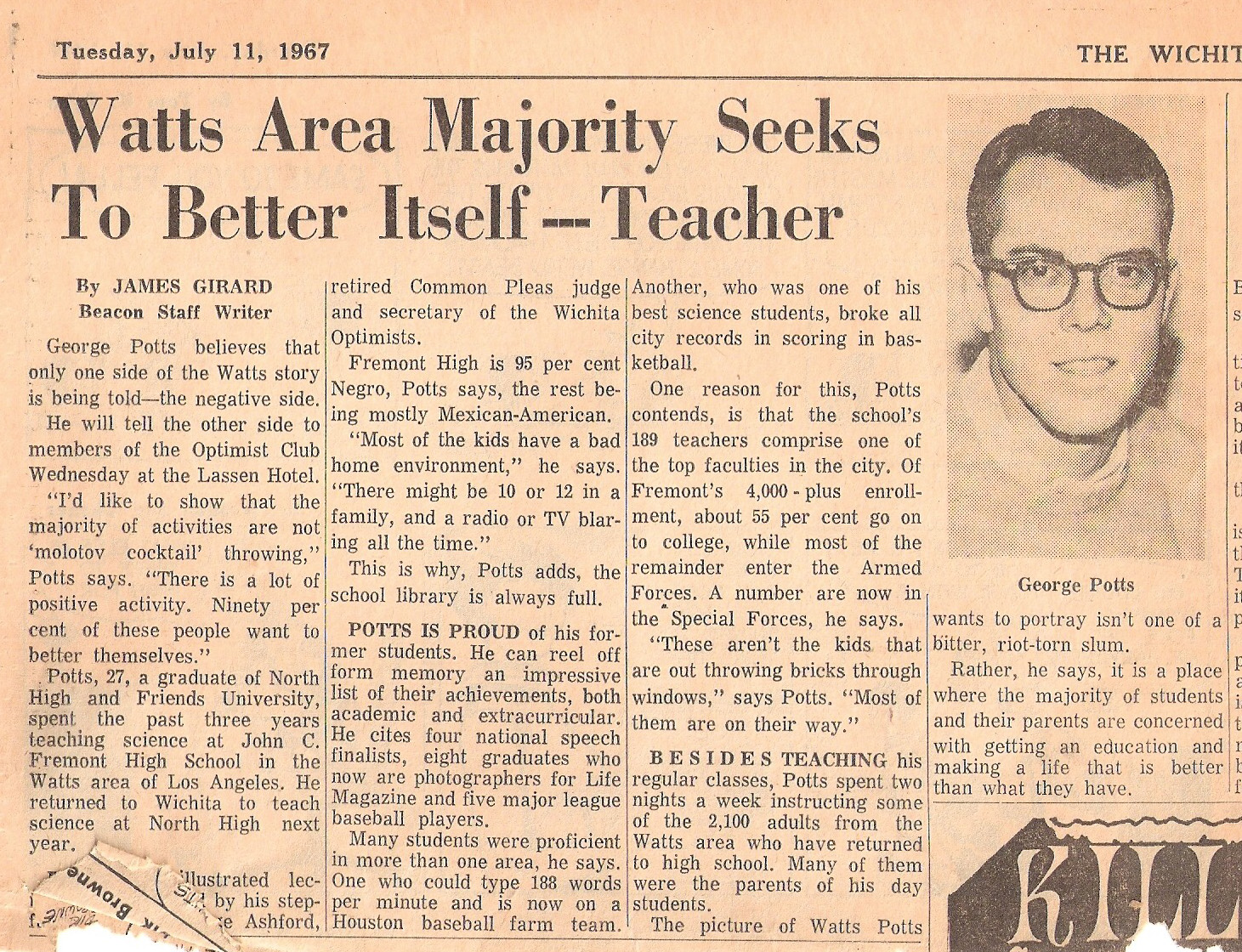
My father, George Potts, taught science at Fremont High in south-central Los Angeles from 1964-1967. In the popular imagination this corner of urban America is associated with the 1965 Watts Riots, but I grew up knowing, despite media/historical stereotypes, that the young people of this community helped my father (who at the time wasn’t sure what he wanted to do with his life) find his calling as a teacher.
It has become common for people to take a dim view of public institutions, but Fremont High was, in its day, an institution that, for the most part, worked. Not just in its mission to equip young students with life-skills, but also in inspiring young teachers like my dad to make engaged connections with (and instill high expectations in) those students.
Like the kids he was teaching, my dad spent a lot of his time at Fremont learning — and his truest mentor in the art of teaching was Orlando Powers, the science department chair. Mr. Powers had grown up in Alabama and attended Tuskegee in the same era as Ralph Ellison and Albert Murray. But while Ellison and Murray took on a very public role in 20th-century African-American intellectual life, Orlando Powers’ genius shone in the less glamorous realm of the urban public-school classroom.
Most movies about teachers (especially white teachers who go to work in the inner city) imply that the purest expression of the vocation somehow involves maverick individuals making dramatic breakthroughs with classrooms full of underserved students. In practice, however, I’d reckon the best teaching happens in humbler circumstances, over the course of many years, as skilled, experienced teachers like Orlando Powers quietly pass their vision, skills, and standards along to the likes of George Potts.
The kids who graduated from Fremont in 1967 grew up at the bottom of the socioeconomic ladder, but — 50 years on (now largely retired from their careers) — the folks I met in Los Angeles when I traveled on my dad’s behalf to 2017 class reunion represented a rich mix of American life: musicians and lawyers; business owners and medical professionals; office managers and career soldiers; coaches and (inevitably) teachers. When they shared their stories of Mr. Potts (or Mr. Powers, or Mr. Wasmuth, or any number other engaged teachers from that era), they tended to focus on the small moments of connection, consistency, and good-faith that had helped them identify and explore their own strengths.
Not the stuff of cinema, perhaps, but it made me happy witness this aspect of America (and proud to be the son of Mr. Potts).


