
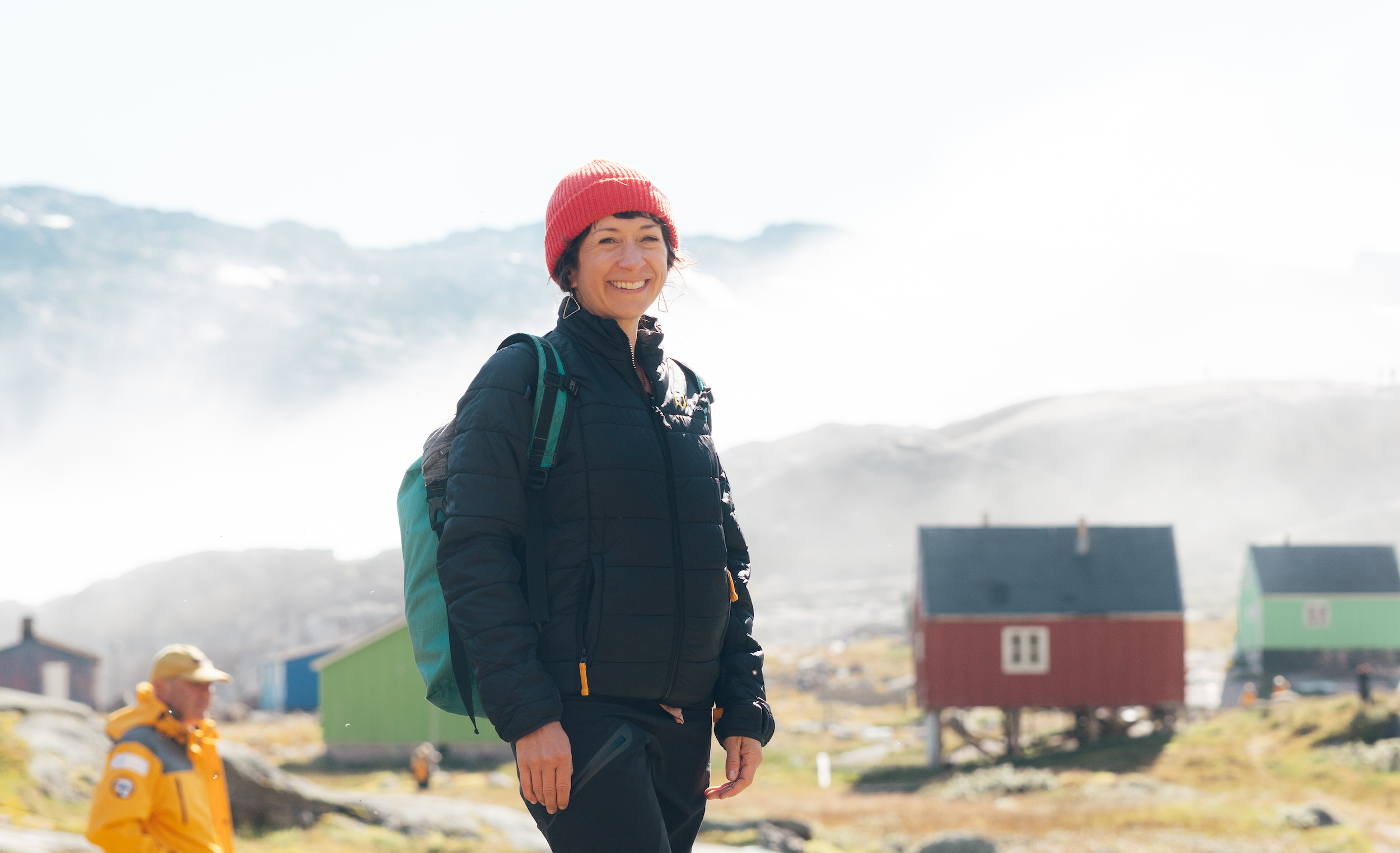
Jen Rose Smith is an award-winning writer and editor living in Vermont’s Green Mountains, where she writes deeply reported features on travel, culture, sustainability, adventure, and place. Her work has been featured by the Wall Street Journal, the Washington Post, National Geographic, BBC Travel, and many other outlets. Recent stories include a feature for the BBC about bikepacking across Morocco, one for the Wall Street Journal about partying in Vermont country stores, and a print feature for Virtuoso about Tanzanian safaris.
How did you get started traveling?
It’s what I’ve most wanted for as long as I can remember.
At 17, I signed up for an intense Forest Service job — seasonal trail work and firefighting — primarily to pay for all the travel I was yearning to do. I spent the first six-month off-season on an extended trip from New Zealand to Europe and North Africa, crewing on a tall ship, hitchhiking, trekking, absolutely loving it. The next year was a seven-month overland trip from Panama back to the US.
I was entranced. That rhythm, of alternating intense work and travel, has defined much of my life since then.
How did you get started writing?
Before this, I was a pastry chef with a small “travel-inspired” seasonal bakery in Vermont — RIP The Nomadic Oven. I spent each winter traveling in search of new-to-me recipes, interviewing producers, and blogging about it. Over time, I realized that my favorite part of the year wasn’t baking at all: it was turning my burning questions about food, culture, and people into writing. I started pitching stories to local magazines, then sold the bakery and made the jump to full-time writing in 2015.
What do you consider your first “break” as a writer?
Getting hired to write my first guidebook, in 2015. It was a confidence boost, and pushed me to become a better, faster writer, as well as a more exacting researcher.
As a traveler and fact/story gatherer, what is your biggest challenge on the road?
It’s always time. The most interesting stories to tell are usually ones I had no clue about before leaving home — the things that emerge from hanging around, chatting with locals. I spent quite a bit of time traveling, but often have the sense that I’m heading home just as the good stuff emerges. That’s a major factor behind my decision, in recent years, to focus on making repeated trips to places that interest me, so I can follow up on the most intriguing threads from the previous visit.
What is your biggest challenge in the research and writing process?
I sometimes go deep into the weeds — I tend to drastically over-report feature stories. That’s fine, because nerding out energizes me. But I often end up with a pile of books and a million notes, needing to simplify an overstuffed narrative for an audience that’s not in the grips of my personal obsession. Outlining with index cards pulls me back to reality.
What is your biggest challenge from a business standpoint?
It’s sometimes tough to achieve a balance between work that pays well, and work that’s creatively, intellectually, and personally rewarding. I strive for an end-of-year equilibrium: I do some very underpaid work I love, and some well-compensated writing jobs that don’t exactly fire me up.
At the moment, I’m trying to carve out time to work on a book proposal. That means weeks of unpaid work, which is fine, but it’s something I need to account for in the overall profit-to-passion mix. It helps that I live in a Vermont village, not a big city — all the best things to do here are free.
Have you ever done other work to make ends meet?
I do some copywriting and editing. When I got news of my first guidebook contract, I was standing behind the bar at a small-town VFW. The regulars — older guys who wake up early to work on power lines and garbage trucks — insisted on a round of Fireball (!) shots to celebrate. I haven’t tended bar since then, but sometimes when I get a particularly thorny round of edits, I think: I wonder if the VFW needs an extra pair of hands?
What travel authors or books might you recommend and/or have influenced you?
There are so many! Some of my favorite travel books are by Jan Morris (I love Venice and Among the Cities), Freya Stark (start with The Valleys of the Assassins), Bruce Chatwin (Songlines), Martha Gellhorn (Travels with Myself and Another), and Wilfred Thesiger (every time I overdose on dates, which is surprisingly often, I think of Arabian Sands).
On travel and food, it’s always M.F.K. Fischer. I also love reading books that, while not explicitly about travel, powerfully evoke place through first-person writing, like Cal Flyn’s Islands of Abandonment or Underland, by Robert Macfarlane.
In recent decades — and partly for entirely sympathetic reasons — the travel writing genre has become very, very “nice,” particularly the stuff appearing in newspapers and magazines. Sometimes I yearn for the saltier days of yore, and when that happens, I like to revisit Paul Theroux, America’s grumpy travel-writing uncle.
I’m always keen to read great new feature writing on travel, so I keep an eye out for anything by Katherine LaGrave, Henry Wismeyer, and J.R. Patterson.
What advice and/or warnings would you give to someone who is considering going into travel writing?
First: Go for it, but consider a backup. Having a second income source — as I did in my early days as baker-slash-writer — gives you creative freedom and flexibility that can be hard to achieve if you’re fully dependent on placing stories to stay afloat.
Second: Keep in mind that the best stories are often those that no one’s trying to sell.
There’s a massive PR machine promoting the travel industry. That’s one reason that lots of travel writing — especially on the digital side — looks like repurposed marketing content. (I see lots of pitches along these lines in my capacity as a travel editor for a Vermont newspaper.)
Some of my closest friends work in PR, and many stories I write would be impossible to pull off without help — financial, logistical, or otherwise — from the marketing department. It’s worth keeping some daylight there, though, because independent reporting and research shows in the quality of the resulting work.
What is the biggest reward of life as a travel writer?
It’s a standing excuse to open doors and ask questions. I’d be a traveler no matter what I did for work — and you don’t need to be a travel writer to be nosy — but writing offers me a framework for connecting with fascinating people wherever I go. It’s an enormous joy and privilege.